Showing posts with label Books. Show all posts

Saturday, March 19, 2011

Guy Kawasaki’s Enchantment: A Book Review in Verse

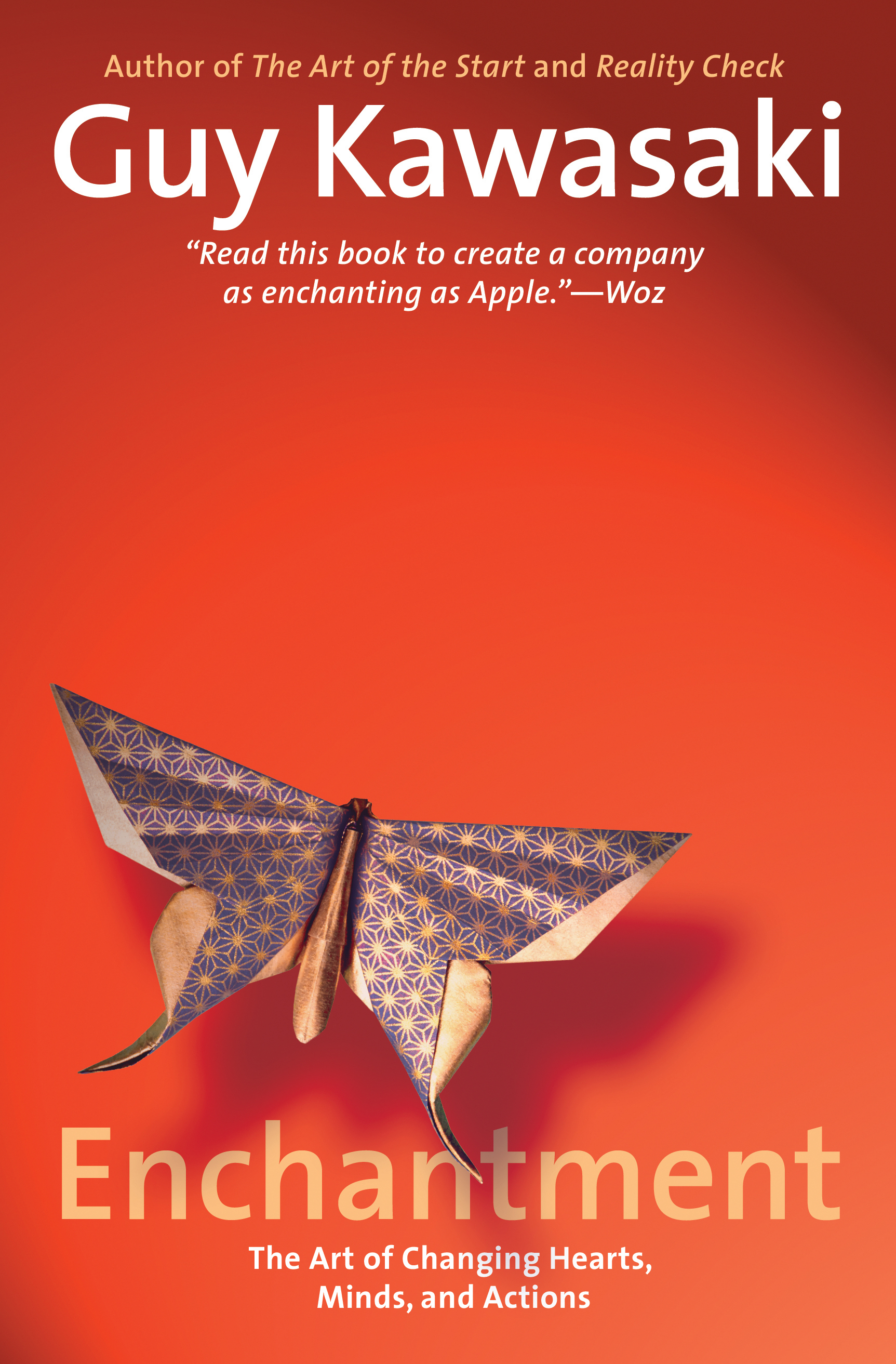
Enchantment: The Art of Changing Hearts, Minds, and Actions is Guy Kawasaki’s tenth book. In it, he explains how to influence what people will do while maintaining the highest standards of ethics.

This is my book review post written as a poem.
------------------------------------------------------------------
Have you ever wondered
Why others get all the attention;
From business, loyalty, and customers
To posts, Likes and mentions.

What are the things that go beyond
Just merely a pull and a shove?
What persuades and makes the difference
Between being in like and being in love?

Enchantment gives that difference
From basic Likability, Trustworthiness, and Preparation
Along with cues for employers and employees
To help customer relationships across organizations.

Guy's book is chock-full
Of simple, savvy, and smart information.
Most of which would seem common knowledge
But often gets ignored or lost in translation.

Each chapter ends with short personal stories
From real people and their impressions.
These vignettes are wonderful writing tools
To help crystallize the book's concepts and lessons.

Take some time to read this book.
(Pay close attention to the section on Reciprocity.)
Fine-tune the things you can do today
And become an Enchanting virtuosity.
------------------------------------------------------------------
Yep, there's a reason why I don't make my living as a poet. If you need more convincing, here are some other (non-poetic) reviews, but they're still pretty good. Happy reading:
Enhanced by Zemanta

Monday, September 13, 2010

Book Review: Putting the Public Back in Public Relations

Photo: Frank Gruber via Flickr Creative Commons
I've been devouring a professional book for a while. I just finished reading Putting the Public Back in Public Relations: How Social Media is Reinventing the Aging Business of PR by Brian Solis and Deirdre Breakenridge.

This book should be required reading for PR students as well as for those PR professionals willing to pursue and learn what's now and what's next in our profession.

After laying the foundation what New PR is, it's value, and what it looks like through relationships, the authors guide readers through some tactical ways to facilitate an organizations' conversations.

Breakenridge and Solis guide the reader beyond the surface-level of social media tools into deeper waters of conversation curation techniques.

Here are some of the more intriguing ideas and passages the struck me to share:
In a section called Don't Fear Change, the authors write
"Social Media is forcing changes that should have happened a long time ago in everything related to business...Whether or not you jump on board, these changes will continue to occur. And, to be honest, not every current PR professional will survive the transition: The fittest and those most willing and able to adapt will be the survivors...The PR professionals of tomorrow should all be engaged in meaningful conversations using the Social and New Media applications that enable forward-moving dialogue. In fact, every department of every business will soon find itself embracing social strategies."
I believe this sums up quite well the current trend in PR. What will be telling is whether or not communication professionals will embrace the conversations with, for, and by people as opposed to focusing just on the tools themselves. To ignore the people making the rants and raves is to ignore some of the very voices that make up a community. As Breakenridge and Solis point out [in a section on Micromedia], "When enough individual voices pool together, the whisper becomes a roar -- transforming micromedia into macro influence."

Later in the book, the authors move into PR 2.0: A Promising Future explaining new roles for professional communicators, the socialization of communication, customer service and breaking news in online communities.
"...[Y]ou must humanize your intent and story, and learn how, where, and why to participate. By doing so, you reset the dynamic for engagement from top-down to one-on-one interaction...it's critical that you understand that PR is no longer rooted in broadcast methodologies and the single-focused, general messages that drive them. PR needs to follow the authoritative dialogue, where it takes place. Without you, who will answer questions, clarify confusion, defend the brand, or develop relationships for the long term?"
The authors weave theoretical with the tactical in such a way that the reader cannot help but learn of useful tools along the way. The section called A New Guide to Metrics alone is almost worth the price of the book itself.

The final section of Convergence puts it all together in a PR 2.0 + PR 1.0 formula with defining new public relations roles, the future of PR, and the conversation prism. I am very hopeful in their vision for the future of the PR profession.
"Next-generation PR professionals will exemplify a hybrid of several critical roles...PR will relearn the art of communications, listening, and interchange, and, in the process, become well versed in not only the new rules of PR, but also the following:
  • Web marketing and analytics
  • Viral marketing
  • Customer service and relationship management
  • Social tools
  • Focus groups and market audits
  • Market analysts"
Deirdre Breakenridge and Brian Solis paint an amazing picture of what could be for the PR profession while providing a roadmap and instructions on how to get there.

Don't ignore this book.

[Note: You can check out a preview of this book on Google books and see for yourself, but I still highly recommend getting your own copy if you get an opportunity.]

Friday, July 17, 2009

Lady Justice is blind, thankfully jurors are not

Nonverbal communication cues and jury duty

I recently had the distinctly new opportunity for me to sit on a jury for a driving while intoxicated (DWI) case. Prior to this week, my only justice system participation included a few speeding tickets in my youth and jury duty that mainly consisted of sitting in the over-crowded room for potential jurors waiting to be set free released back to normal life.

All of that changed for me as I sat with 15 other citizens on a jury panel being questioned during voir dire and ultimately selected among the six jurors for the case.

How exactly does this fit into a communications / public relations-focused blog? The Answer: Nonverbal communication played a factor in various stages of the case.

I want to focus on the face-to-face interaction from a juror's perspective that can be classified into three principal areas: environmental conditions where communication takes place, the physical characteristics of the communicators, and behaviors of communicators during interaction.
[Knapp & Hall (2007) Nonverbal Communication in Human Interaction.]
 
Environmental conditions
  • Not in Kansas anymore - A courtroom is a very intimidating setting. If you have never participated in the space it can be difficult to understand the culture and norms (especially if your only perspective on a jury has been on television or in the movies.)
  • While being questioned inside the courtroom by both the prosecuting and defense teams, it was hard to make value judgments about about answers being given and whether or not the "right" or "wrong" answer would get you excluded from (or included on) the final jury roster. 
Physical characteristics
  • A book and its cover - I observed two very different sets of legal teams. One included a very polished, professional front. The other seemed to have a more difficult time exuding the confidence and character the one would expect (or hope) from a lawyer. 
  • Once picked to be on the jury, I was interested (and pleased) in the fact that it did seem that the final six was a cross-section of the citizens from the panel in age, sex, race, and personal experience.
Behaviors of communicators
  • Do you cross your arms? During voir dire, we were told at one point that, "it concerns us when we see jurors cross their arms," by one of the lawyers. This struck me as odd that arms crossed as a nonverbal communication cue is still being taught to have a stigma attached when crossing one's arms sometimes is a comfortable way to sit or is a sign of being cold.
  • After being told about crossing arms, I noticed no less than four potential jurors switch, either to or from an arms crossed position.
  • During the trial other behaviors came into play such as the those of the defendant, witnesses, legal teams, and even the judge. We watched how the lawyers conducted themselves in front of each other, the judge, and the jury. We noted things about the witnesses that played into their credibility.
We, the jury, find the defendant...
To be clear, I did in fact pay attention to the actual case, facts, witnesses, and evidence. These thoughts on nonverbal communication is a reflection on the experience. However, it is worth telling you that during deliberations, the conversation hinted at relevant nonverbal communication that took place: juror comfort, lawyer attire, witness speech patterns, and even the judge who read from a newspaper.

Ultimately the case was decided based on the facts and evidence of the case within the framework of the legal charge we were given, but I am convinced nonverbal communication played an important role in the process.

We've come a long way
Being on a jury was actually pretty interesting. It helps that I was able to turn the experience into a blog post, but I am thankful to have had the opportunity. Typically, society pokes fun at jury duty and we joke about different ways to get out of serving. But, when it comes down to it, our system of a jury of one's peers is actually a very empowering and enlighted system of jurisprudence.

Don't believe me? Tell it to the witch.


Reblog this post [with Zemanta]

Wednesday, October 15, 2008

The Purpose of Influence

Blog Action Day 2008: Poverty

I have been thinking about what it was I could contribute to the international Blog Action Day conversation for a few weeks:
All of these things, while worthy of reminding, reading, and researching, led me to take a look at a question: What is the purpose of influence? 

I've read Rick Warren's The Purpose Driven Life and have also gone through a church-wide 40 Days of Purpose plan. It is a wonderful teaching tool and it helped me start doing some things I should and stop doing some things I shouldn't be doing. But, it really hasn't clicked for me until now.

What does this have to do with Blog Action Day 2008?
It all comes down to stewardship of influence. I found a 2006 TED talk by Pastor Warren entitled Living a Life of Purpose. In it Warren describes what he refers to as the purpose of influence:
The purpose of influence is to speak-up for those who have no influence.
I think we can all agree that people living in poverty fall within the category of having little to no influence on society. This should be the reason so many influential bloggers choose to participate in a Blog Action Day, to reach millions in order to shed light on this global problem. It's not about ego, driving traffic, or SEO; it's about using the gifts we are given in order to do something good.

Think about your stewardship of influence and stewardship affluence:


Monday, July 14, 2008

People first, technology last

I am reading Groundswell by Forrester Research's Charlene Li and Josh Bernoff. This book is easily one of the most intriguing professional books I've read in a while. According to Li and Bernoff the groundswell is:
A social trend in which people use technologies to get the things they need from each other, rather than from traditional institutions like corporations.

While I don't particularly care for the name they chose to describe the social media phenomenon, I do appreciate the terrific insight and research they've provided.

One graphical representation from the book helps explain the Social Technographics® Profile in the form of a Ladder to represent consumers' social computing behavior categorized by participation.

Social Technographics Ladder

The social participation rungs in the ladder are (from bottom to top): Inactives, Spectators, Joiners, Collectors, Critics, and Creators with explanations of each. The authors provide various samples of profiles to help drive home the point that different people come to you and your company or organization at very different levels of social media participation.

The POST Method


There are implications for business in assessing participation, especially when one applies the POST method for a social media strategy:
  1. Assess the social activities of your People;
  2. Decide what Objectives you want to accomplish;
  3. Plan your Strategy for changes in customer relations; then
  4. Decide on the suitable Technology or technologies to meet your goals.

I was struck by something so simple, but could have serious implications for those interested in social media if forgotten: The POST method starts with "P" for People.

People Matter


If you don't have your people, (audience, stakeholders, customers, community, or any other term you use) your social media strategy will be much harder to effectively implement and accurately assess.

To often Communication/PR practitioners are presented with the challenge of adding a social media to their communication efforts and they jump straight to the latest and greatest social media technology with buzz.

I am all for jumping in and experimenting with social media mainly because you are more credible if you've experienced the various forms of social media. This holds true even if you outsource.

However, I caution (from experience) that your community participation assessment should come first.

If the biggest sin in social media is inaction, then I think the biggest mistake is not knowing your people.