Our PRSA chapter recently held a joint program with our friends at AAF Fort Worth and Social Media Club Fort Worth to host author/speaker Jackie Huba for a fun evening at Four Day Weekend Theater. This night on the town took well over four months to coordinate, as the organizations' presidents met and e-mailed each other to work out details.
The groups share a few members, and we all recognized an opportunity to join forces on the March 27 event to meet our common desire to provide quality programming. We had a great time, too, as you can see by the photos on our Facebook page.
One day before, March 26, the Ft. Worth Star-Telegram and WFAA-TV announced their own partnership. A content sharing partnership.
"The news executives said their companies will share a wide range of content, including breaking news, sports, business, traffic, weather, dining and entertainment from all over North Texas. They also expect their staffs to work together occasionally on joint projects."
Both of these partnerships, our three organizations and the two local news outlets, caught some people by surprise. They took planning. They took not being afraid to fail. Hopefully when we look back, they will have provided positive outcomes. But if it was a fail, let us fail forward with intelligence gained.
My point is, I believe we are stronger together than we are separate. Unlikely mass communication compatriots can (should?) occasionally work together for the greater good. It might be one of the things that keeps us all afloat.
I frequently read the editorials and columns in the opinion section of my hometown newspaper. I like their digital subscription option these days since the print version mostly ended up in the recycling bin unless I needed to wrap something breakable. But that's a different story. I like catching up on what those veteran newspaper journalists have to say in and about this city.
Recently, Jim Witt, executive editor, included an intriguing bit of insight into working in the media in a piece about a former colleague who left the newspaper business.
“When you work at a newspaper, you get to be around a lot of smart people every day. You get to be “in the know” about almost everything going on, and — until Facebook and Twitter — you decide what the public knows. You can do things that help the community by pointing out problems and offering solutions.”
Did you catch it? He's alluding to a disruption to agenda-setting theory by a couple of social media tools. Agenda-setting theory describes the "ability [of the news media] to influence the salience of topics on the public agenda."1
“In other words, the media shape top-of-mind presence regarding issues. The typical news consumer focuses on a handful of topics daily, and these topics are presented to him or her, in one form or another, by the media. With the next news cycle, a topic from the day before may disappear, and so does its importance among news consumers.” 2
Now, PR pros understand that we play an important function in this multi-directional process since journalists cannot possibly cover all of the possible angles, stories, or topics. It's our role to augment and advance the issues through media relations that impact the communities and organizations we represent.
But what about Facebook and Twitter? The behemoths of the social web. As the editor mentions, journalists used to have the market cornered on what the public knows. As masters of mass communication, media outlets laid out the news of the day. And then new media tools changed things. Over time, the eyeball economy has shifted to what some might describe as a democratized system of attention.
A local reporter told me recently their assignment editor had been coming down on all of the reporters about being more entrepreneurial with the development of stories. Translation: dig deeper into those Facebook messages and Twitter leads. Sources are just waiting to help tell a story. (This reporter was not thrilled at this concept but understood the expectation.)
I believe it's important for PR people to understand that this shift has taken place. We need to use this to frame our thinking for issues management since their are tools to help monitor some of these very same sources. We still need to follow the conversation, streamline access to the facts, truth and subject-matter experts as needed, so we ultimately position our organizations for success.
The agenda-setting theory is still spinning today, it just has a few (million) more spokes in the wheel.
1 McCombs, M; Reynolds, A (2002). "News influence on our pictures of the world". Media effects: Advances in theory and research.
2 Study Guide for the Examination for Accreditation in Public Relations (Communication Models and Theories)
In a move that I hope will send some of those online trolls to cower under their bridges away from the light, the Ft. Worth Star-Telegram announced this week that they will now require users to log in to Facebook to use their commenting system.
In his announcement, S-T executive editor, Jim Witt explained that the reason was pretty simple: "Facebook requires account holders to use their names, and we believe that anyone who wants to contribute to our public forums should put their name on it."
He then went on to bolster the argument for signed (in) online comments because of the difference in discourse between those that were anonymous vs those that come in with real names attached.
"In signed letters for our print editions, writers make their points using reasoned and usually reasonable arguments. But online, comment threads too often devolve into a cesspool of name-calling. On some stories, we are forced to turn off the commenting feature because the language becomes too offensive.
"In talking to readers, I’ve found that many have been discouraged from commenting because they are turned off by the nastiness."
I believe this is a smart move for my local paper and one that hopefully will raise the intelligence quotient a bit on stories that matter to communities across DFW covered in the paper. It seems to me the S-T recognizes that for at least the near future, Facebook doesn't appear to be going anywhere. And other media outlets use it as their commenting system of choice for some of the very same reasons as outlined in the S_t announcement.
Why is this important for PR? Since a function of PR includes media relations, it's part of our job to know how the stories are getting developed, sourced and told. We should also know to whom we connect a journalist in order to provide the trusted source they need. (Hint: it's often not the PR person.) We've seen that a growing number of journalists are finding and using sources from social channels.
"...51 per cent of journalists worldwide say they use microblogs (e.g. Twitter, Facebook and Weibo) to gather new stories – provided the source behind those accounts is known and trusted by them (2012 figure, 54 per cent). As was the case in 2012, reliance on these sources falls dramatically when the sources are not known to the journalist: 25 per cent say they source stories in this way." [Oriella PR Network Global Digital Journalism Study 2013]
The study also indicates that in certain respects, a journalist's success on stories now tends to be measured in the number of unique visits, number of views, increase in social followers, likes/tweets on articles, and number of online comments along with advertising revenue and exclusive features.
I hope our journalist friends over at the Star-Telegram will take this shift to Facebook commenting as an opportunity to engage in what could be ongoing dialogue on the important issues in the community. It is not out of the realm of possibility to have a trusted source from within the organization chime in through article comments (if it's in the best interest of the organization s/he is representing) to provide clarifications, corrections, or contextual additions. This might give pause to some especially for those who don't like to mix work life with home/community life. I believe we've reached the point that our online professional and personal selves are blends now and we should treat online communication as such.
TL;DR
The Ft. Worth Star-Telegram now requires Facebook for article comments. It's a good thing and online trolls beware.
Photo credit: Doug Wildman via Flickr Creative Commons
Last week, Simon Salt (@incslinger) spoke at the Greater Ft. Worth Chapter of PRSA April luncheon with his presentation, "Conversing with Consumers." He covered the types of conversations that consumers are already having about your brand, plus how you can join in and more importantly, when it's appropriate. These are the highlights:
The social consumer has a much larger network from which to gather advice/guidance for purchases. The old sales paradigm was relatively simple: your brand has product(s)/service(s) and you exchange those for money. The new sales paradigm includes social capital. Simon explained that the social consumer expects more from the exchange. They want a way to accrue goodwill from a brand and be rewarded for leveraging their network.
You need to know where they are sharing
Salt reaffirmed the reality that social media is not the silver bullet or the center of the universe. Social consumers share IRL (in real life); face-to-face, over the phone, etc. Are they using social media tools? Yes, of course. But bear in mind the influence is still very much a relational activity. Using a grid of opportunity and engagement, Salt touched on mobile and brand property compared to face-to-face and social media for relevant reach.
He gave the stat that 70% of brands fail to respond to negative tweets and that if you'd do that small thing, you'd be outpacing much of the competition. He also is a proponent of leveraging Yelp with the caveat that customers don't know how to rate you. Rating are not the end of the conversation, just the beginning. (I think this could be an area for deep-dive for retailers, restaurants, and other service-industry types.)
You need to know why they share
"There are no wallflowers in social media," stated Salt on using social media to share all of the details of your day. "Your life isn't really that interesting." I think he's right since being an Internet celebrity often seems to be the name of the game for some especially those that go way overboard on the 'personal branding' kick. It goes back to having a motivation to improve social capital. He also said do not dismiss the fact that some people may be paid to bash your brand by other brands. (This concept seemed to shock some attendees.) Look for the sharer's deeper motivation.
At this point, Simon Salt shared a breakdown of the Conversation Triage likening it to emergency response color-coded tape for dealing with injuries:
RED - Critical; YELLOW - Urgent; GREEN - Non-Urgent; and BLACK - Non-responsive
I was particularly intrigued by this concept and asked him to explain it again after the meeting. Here's his response:
He gave some quick advice on what to do with typical interactions in social media. If you/your brand gets:
Praise - Say 'thank you'
Question - Route it to the appropriate person and respond as necessary
Complaint - Apologize
Simon gave a funny tongue-in-check response to the concept of viral: "The secret to getting something to go viral, piss people off."
--> Content strategy must be a part of the planning. <--
He shared some thoughts on working with influences and fans plus the idea of having brand advocates as defenders. They will defend your brand if you empower them.
Simon Salt closed with the three keys to giving your content greatest opportunity to spread:
Make it Fun - Humor works. (Self-deprecating humor is best. Don't make fun of your customers.)
In honor of the start of the 2012 MLB season and excitement I have for my favorite team, Texas Rangers, I thought it was time to repost something from a few years back: a list of the roles and functions for public relations pros explained using baseball positions.
Pitcher (P) - In baseball, the pitcher is the player who throws the baseball from the pitcher's mound toward the catcher to begin each play, with the goal of retiring a batter who attempts to either make contact with it or draw a walk. In PR, the pitching role is one where the professional attempts to garner publicity or attention through effective media relations.
Catcher (C) - Positioned behind home plate, the catcher can see the whole field; therefore, he is in the best position to direct and lead the other players in a defensive play. In PR, this is the role of strategy. Like a catcher, the PR professional sees the big picture where they understand that actions will lead to specific reactions.
First baseman (1B) - A first baseman is the player on the team playing defense who fields the area nearest first base. In PR, this is the role of first response. The initial response to problems and/or crisiswill make or break the situation.
Second baseman (2B) - The second baseman often possesses quick hands and feet, the ability to get rid of the ball quickly, and must be able to make the pivot on a double play. In PR, this role is of measured quickness. A public relations professional helps to protect reputation and vital relationships when an organization is under attack.
Third baseman (3B) - Third base is known as the "hot corner", because the third baseman is relatively close to the batter and most right-handed hitters tend to hit the ball hard in this direction. In PR, this is the role of coordination and quick reactions that comes with experience from having to catch hard line drives or difficult internal communication challenges.
Shortstop (SS) - Shortstop is often regarded as the most dynamic defensive position in baseball so naturally the PR role is one of adaptability. The one constant is that things change, it is up to the public relations professional to be aware and keep up with the broad and shifting landscape of the PR profession, media, and organizational industry.
Left fielder (LF) - Outfielders must cover large distances, so speed, instincts, and quickness in reacting to the ball are key. They must be able to learn to judge whether to attempt a difficult catch and risk letting the ball get past them, or to instead allow the ball to fall in order to guarantee a swift play and prevent the advance of runners. In PR, this role can be equated to good judgment. Professionals need to understand when not doing or saying something will provide the best benefit to the organization.
Center fielder (CF) - The center fielder has the greatest responsibility among the three outfielders for coordinating their play to prevent collisions when converging on a fly ball, and on plays where he does not make the catch, he must position himself behind the corner outfielder in case the ball gets past him. In PR, this role is made up of the credibility a professional must possess in order to be an effective communicator to both internal and external audiences. Just like a center fielder, the PR professional needs excellent situational awareness, vision and depth perception.
Right fielder (RF) - Of all outfield positions, the right fielder often has the strongest arm, because they are the farthest from third base. However, oftentimes, as in lower-levels of baseball, right field is the least likely to see much action because most hitters are right-handed and tend to pull the ball to the left field and center. In PR, this is the role of monitoring and measurement. Unfortunately, many professionals are not as up to speed in this area (me included) as we should do whatever it takes to learn how to measure. Thankfully, there is a greater push in PRmeasurement these days, so I consider this is a bright spot for the future of our profession. It requires additional work and research, but it is one of reward, sales, leads and maybe even justification for jobs well done.
Additional Positions
Designated Hitter (DH)- The designated hitter is the official position in the American League to bat in place of the pitcher. In PR, this is the role that the professional understands the usefulness of social media for listening and engaging an organization's community. We are well past the time of whether or not a PR pro needs to know how to use social media tools. They are indispensable tools in the toolbelt. The PR professional needs to fully grasp various aspects and nuances of the social web to reach audiences including, at times, as a way to by-pass the mainstream media.
Manager - A manager controls matters of team strategy on the field and team leadership. In PR, it's the same thing; strategic coordination of play and tactical movements are integral for successful public relations.
It's been a week since news broke on the drug arrests of 17 TCU students shocking the university and local Ft. Worth community on Wednesday, February 15. Much has already been written in the wake of the arrests involving the Ft. Worth Police Department and TCU Campus Police and their six-month investigation that included some students.
I think TCU navigated this challenging situation quite well. I was particularly impressed with the openness and use of their digital communication channels very early before the story developed. There are some great tactical lessons here for PR pros who are paying attention. (Disclosure: I am familiar and acquainted with staff members of the communication and media relations team at TCU.)
At 9:25 AM, they also posted to their Facebook page:
Both links went to the university's online statement and were shared right before the Chancellor's 9:30 AM press conference. TCU then tweeted a few updates during his statement.
And that pretty much covered things for them since the Ft. Worth Police took things over and explained the investigation and arrests in addition to releasing documentation. By that point, TCU had sustained some bruises, particularly the football team because of some misinformation and corrections. The arrests, while an unfortunate and sad reality for those individuals involved, gave TCU something to point the attention toward to help deflect the media spotlight a bit.
A quick check on Google News search for stories shows the typical spike in news articles and posts immediately following any major issue and then it tapered off as the recovery phase sets in and the news moved on to other things.
PR Gold
TCU must have learned some valuable transparency lessons and damage control from other high-profile crisis communication issues at other higher ed institutions. Fortunately for them they came forward very early with their information. They shared what I consider a quality statement and response to the investigation and arrests along with details about the process.
Through the university's communication, expectations for students were reinforced along with encouragement for the university community.
Others in public relations have approved of the way TCU initially navigated this issue including Helen Vollmer, president of Edelman Southwest. Vollmer wrote via email on TCU's response:
"...TCU has done a GREAT job in the last couple of days with the drug busts happening. We do a lot of work in education (not for TCU)—Notre Dame, Ohio State, U of H, Princeton, etc. and I laud them highly for their handling of this issue and their great use of social media to convey their 'no nonsense' approach."
Once things calm down a bit at the Ft. Worth campus, I hope to talk with the TCU communication team about their response. I just want to say to them, publicly, well done.
This is my presentation for last week's Texas School Public Relations Association 2012 Conference. I told attendees I'd have the deck available on the blog. Thank you to all who came to the afternoon presentation and for the great questions. I hope you took away something(s) useful.
Special thanks to Craig Verley (Mission CISD) and Scott JuVette (Ft. Worth ISD) for letting me use you and your districts as good examples for the group.
On Halloween Monday the University of North Texas launched an awareness campaign for some official communication channels and procedures in a fun and creative package. The campaign had a simple premise: UNT had been invaded by pterodactyls.
Alyssa Yancey, a university News Promotion Specialist, pointed out that the project was "designed to show a lighter side of UNT" and encourage students to engage with the university’s Facebook page and Twitter profile.
(Full Disclosure: I am a proud alumnus of UNT and thought this was pretty cool.)
Why did you choose pterodactyls?
The University of North Texas wanted to choose a topic that would be recognized as a joke and not a serious threat immediately. UNT also wanted something that would resonate with students and alumni. An extinct dinosaur, with a striking resemblance to UNT’s mascot Scrappy the eagle seemed to fit the bill.
What did you hope to achieve through this initiative?
This initiative was designed to increase UNT’s engagement with our Facebook fans and our Twitter followers. We haven’t ever really done anything like this, so we wanted to show our students that we have a personality and a sense of humor.
Was it considered a success?
The invasion was definitely a success. Throughout the day, we engaged with students and others in the Denton community, and had a great time. We encouraged students to submit photos, and they did. Some went on to add to the pterodactyl storyline by submitting historic photos of pterodactyls on campus, and suggesting they know other dinosaurs are plotting a Thanksgiving invasion. Students also joined in on the fun by retweeting the safety tips, release and PSA, sharing information to their Facebook pages and blogging about the invasion.
On Twitter, our retweets, direct mentions and follower counts all showed a strong increase from regular news days. UNT Facebook posts about the invasion, as well as student-contributed content, received numerous likes and positive comments, and the Scrappy YouTube video shot to more than 500 views quickly.
In addition to Alyssa, I reached out to Samra Bufkins, MJ, APR, Strategic Communications Lecturer at UNT's Mayborn School of Journalism for some additional thoughts on the invasion"
"They were hoping for a little more student interaction, but we're finding many students still aren't on twitter or following UNT official accounts. However, I think it's the kind of thing they should try again, maybe at another holiday time. You expect stuff like this at Halloween and April Fool's Day—maybe have some fun around a holiday that's not one for pranks. It was a good, fun, creative outlet and allowed everyone to poke fun at the construction and some other things around here. And at mid-semester, everyone needs a laugh!"
---
I really loved this fun and creative attempt to increase awareness and usage of the university's Facebook and Twitter presences along with some basic campus resource information. This is a great example of an organization demonstrating that they have a personality. Well done.
[Top photo credit: UNT Facebook page submitted photo]
Small non-profits, operating on limited budgets, need information,
assistance and training to use media relations, social media and other
public relations tools to help raise awareness of their important
missions. The free workshop was our chapter's way of providing some
insight in these areas for local non-profit organizations.
I was fortunate enough to be one of the panelists along with (L-R) Sandra Brodniki, APR, Gigi Westerman APR, and Nancy Farrar, our moderator.
Special thanks to PRSA members Kendal Lake and Dustin Van Orne from the Modern Art Museum of Fort Worth for organizing the community service event.
I enjoy participating in these types of panels because I usually end up coming away with some great insights from the others. This one was no different.
The solid reminders in the areas of media relations and storytelling from Sandra and Gigi, plus the guiding discussion from Nancy made this a wonderful professional development opportunity.
Image via WikipediaCole County (Mo.) Circuit Judge Jon Beetem issued a preliminary injunction on Friday against a law designed to prohibit teachers from having private online conversations with students declaring that it “would have a chilling
effect” on free speech.
The law reads in pertinent part, "No teacher shall establish, maintain, or use non-work-related internet site which allows exclusive access with a current or former student."
Judge Beetem writes in the preliminary injunction, "Even if a complete ban on certain forms of communication between certain individuals could be construed as content neutral and only a reasonable restriction on 'time, place, and manner,' the breadth of the prohibition is staggering...The Court finds that the statute would have a chilling effect on speech."
This clumsy state-wide provision was sitting there waiting to be challenged and (hopefully) overturned. I have no issue with the intent of wanting to curtail inappropriate contact between students and teachers using social media. It just seems these provisions were doomed from the beginning from a free speech perspective and from an enforcement standpoint. It will be interesting to see what comes next or if other states watch the Missouri outcome and tailor similar bans.
"Mansfield ISD will no longer host district or campus-level Facebook pages. The open nature of the Facebook commenting feature continues to cause regular disruption and place the district as a liable participant in issues related to sharing of private student information, defamation of employees and other abusive online behavior. In addition, MISD is not able to commit the administrative or campus staff time necessary to adequately moderate user content posted to these pages."
Those of you that know me know that I am huge advocate for integrating social media tools into communication and public relations work flow. Facebook page management was/is among those tools I recommend.
Be careful what you wish for...
With the District page open for community commenting, of course we created and posted the rules of engagement to back up our removal of inappropriate material. We wanted feedback. We got feedback. Not all of it positive. Which was, and is fine. Getting useful feedback from the community on news and information was an objective since it helped us determine if messages were being received. The human element of the social web will always bring out critics and critiques. The problems came when those were aimed at students, parents, community and individual staff members.
So what changed?
In essence the liabilities were outweighing the benefits of the district's Facebook page. We became keenly aware of just how much time it was taking to adequately monitor the page in order to remove postings that were abusive and/or offensive.The page audience grew to a respectable 6,900 fans ('Likes') connected to it. Unfortunately, somewhere along the way it reached a point where detractors (passionate and occasional) decided to use the commenting features to share negative information and feedback about individual students and staff members. There were also instances of bickering and arguing with each other including back and forth between kids and adults that sometimes left the realm of civil and intelligent discourse. I know that is shocking to anyone who has a personal Facebook profile. (sarcasm)
Perhaps there was a magic number of fans or tipping point for the community that marked this shift. It's hard to tell.
Why not just turn off the comments for the page?
In the current Facebook Page editing capabilities, Admins can toggle on/off the Posting Ability to adjust the setting "Users can write or post content on the wall." But, that only stopped new comments going to the wall, not on previous or new posts shared by the Page. That setting simply doesn't seem to exist right now. Admins still have to watch and delete inappropriate replies and ban users if necessary. So it's still a moderation/time issue.
Does this mean we are backing away from social media? Hardly. Consider this: Facebook ≠ Social Strategy
I do not consider adopting any one single social media tool, even the current front-runner, Facebook, as being equal to having a social strategy. The underlying reasons or objectives behind why you use these communication tools and how you evaluate and measure their effectiveness are what ultimately propel an organization's success.
What do you think? Have you run across these commenting management issue on pages you run for your school district or clients? I'm curious to know what others think. As always, the comments are yours.
At the grocery store, a bar code scanner reads the bar code on your product and tells the register what it is and how much it costs. QR Codes use the same concept.
People can now use their cell phone cameras (bar code scanner) to read QR Codes (bar codes), which instantly directs their phone to a designated website, PDF, contact information, video, etc.
Sufficiently confused? Let’s use it in an example scenario. Pretend I’m a PIO at Mainstreet ISD–my district is holding a TRE (tax rate or tax ratification election) and we’re holding a community meeting next week. We’ve built this awesome webpage with all kinds of information and graphs and videos explaining how school finance works and why we need to pass this TRE. But if we just tell them about the website, we risk them forgetting to go there after the meeting, or forgetting the URL altogether.
From the creator’s end So I take my webpage URL, let’s say it’s www.mainstreetisd.org/news/finance/tre, and go to one of many QR Code generating websites, plug in my URL and it will automatically create a unique QR Code (just like a bar code). That QR Code has my link embedded in it so that anyone who scans it will be automatically directed to our TRE website. I can then print this QR Code on any posters or handouts we distribute at the meeting, I can make a giant display version so that anyone in the audience can scan it from their seats, I can even print it on t-shirts or stickers if I wanted to.
You can create a personal account on many of these QR Code generator websites that will allow you to see how many people are scanning your code, change the link (without changing the bar code) that your users are directed to, password protect your code or set it to expire at a certain date.
From the user’s end While there are tools that make this technology available on any phone with a camera, it’s really most usefully for smart phone users. All I need to do is go to the app store on my phone and download a QR Scanner app–there are a bunch out there, not all of which work as well as the next, particularly for BlackBerry which seem to have a difficult time. Then, whenever I see a QR Code I want to scan, I open the QR Scanner app, which will typically activate my phone’s camera, then point the camera at the QR Code until your camera can scan the code–just like you’d do at the grocery store. Depending on the app, it’ll typically identify the file, URL, video, etc. that the QR Code is linked to and will ask you if you want to open it.
Because there’s linking involved, this does require a wireless connection on your phone, which involves data usage and the fees associated with it. If the code links to a PDF, Word doc, Google map, calendar event, etc., these will likely be saved onto my phone; websites, however, will not be saved unless through the phone’s browser history.
So what are some other ways school districts can use QR Codes?
Using codes on back to school materials to link to school calendars (some tools will allow users to integrate your calendar into their phone’s calendar) or school supply lists
Displaying codes at the front of schools that will link to school contact information, TEA ratings, etc.
Displaying codes at graduation that link to do’s and don’ts, a PDF of the program or information on school-sponsored graduation night activities
Posting codes in teachers lounges and workrooms with links to internal communication materials
Collateral materials with codes to your district’s fundraising initiatives–information on branded licenses plates, website that allows them to purchase tickets for your event, online store for school/district merchandise, etc.
Considerations before diving in or writing them off
Consider your audience–how many of your parents or community members are using smart phones? What about students?
While this technology has caught fire in Asia, and is growing in popularity among the techie Westerners, many people may still be unaware of QR Codes and how they work (even if they already have the technology to use them). Before rolling out any coded materials, take the time to educate your constituency.
The mystery of these codes can, however, create more interest in using them and finding out what they do.
This technology is free for you to produce and free (besides data usage) for them to scan and use.
Because your codes will generally redirect users to existing content, this doesn’t require a third-party developer, or drafting usage policies, or monitoring for misuse, or purchasing expensive/complicated hardware or software. This is just a more direct way to get them from point A to point B.
I like to keep track of interesting questions in the hopes that someday I might have an answer or would ask others in the hopes of furthering the dialogue on social media and school public relations.
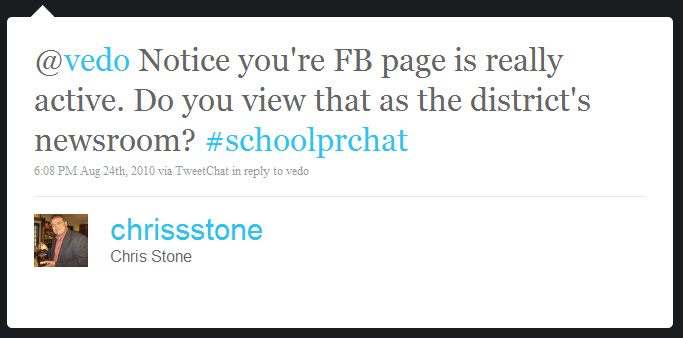
This is a great question because it forced me to pause and take a critical look about how I was using my school district's Facebook page.
A school district's Facebook page is a prime location for sharing timely, relevant, and interesting content with the community of parents, students, staff and even some random people that have decided to 'Like' the page along the way.
The strategy behind the school district using Facebook could be summed up as fish where the fish are. With so many people on the social utility, it just makes sense for school districts engage their community there.
But Facebook as a school district's newsroom? I think in the traditional sense of the term 'newsroom' perhaps not since it doesn't really provide enough to meet journalists' expectations. From distribution and content expectations of journalists, Facebook doesn't really work.
Ah, but journalists aren't the only people school PR folks are trying to reach. Certainly traditional media should (and will continue to) be a fundamental component for school district communication pros. And we should do everything we can to sharpen our media relations skills and approach.
But don't let that be the only focus.
School districts should already be leveraging Facebook for communication and community outreach.Set your district's Facebook rules of engagement, prepare and gather content from all over the district to share. Post, listen, engage and promote...and repeat.
I know some school districts don't allow you to comment on their Facebook page wall. I don't agree with this broadcast-only practice. The magic is in the feedback. When we post items to Facebook like updates, questions, links, photos, videos, student/staff recognitions, explanations, news, events, etc. it's done with the audience in mind. I use Facebook in my school district to share and engage with the community.
Oh and for the record, I recently tried to pitch a story to a local newspaper reporter only to be told, "yeah, I saw that on Facebook earlier."
Come to think of it, maybe it isthe district's newsroom.
The following is a guest post from Brazilian public relations professional Rodrigo Capella.* Rodrigo is a lecturer and writer, he edits the blog PR Interview and has more than 20 books published.
------------------------------------------------
For a long time, the traditional press release has been used in Brazil. With basic information (title, lead, quotes, boilerplate and contacts of the PR agency), this tool of communication led several news (mergers, product launches, new strategies, etc.) to the journalists.
In the first years of existence, the traditional press release was very well evaluated by professionals working in publications. It happened because the Brazilian PR Agencies always adapted the institutional information according to the journalists’ needs.
Nowadays, the contact of the journalists with this tool is wearing out quickly (most of the media professionals prefer to receive all the information together - image, video, quotes, etc). Even so, for many years, Brazil has insisted - contrary to many countries - to use the traditional press release as a primary tool of communication.
To get an idea, for more than five years, many in the United States adopted alternative tools, such as the Social Media Press Release (SMPR). Made in various formats, this platform can unite, in a single space, podcast, video-release, relevant links, tags, and RSS. There is also, of course, the elements of the traditional press release, like boilerplate and quotes, among others.
Now, after overseeing the successful of the SMPR around the world (here's another example), Brazil has surrendered to this agile tool and already collected some interesting cases. To announce the launch of the new 3DS, the portable console that lets you play in 3D without special glasses, the PR agency S2 Publicom sent to the Brazilian press a SMPR (there’s a password and login to access this platform) with files in English and Portuguese. In this SMPR, it was possible to have access to video-releases, pictures and a variety of information about the launch.
Another interesting example was conducted by CDN in partnership with Cinnamon Communication. The PR Agencies did a SMPR to launch the new VAIO notebook Y. With video release, links, images and testimonials, the platform has brought all the necessary information for journalists reporting the product.
These two examples of SMPR (3DS and VAIO Y) confirm a trend: there is no communication without innovation. Brazil learned this lesson. Now, it needs to be aware of upcoming changes for not getting used to be outdated.
[The reference to the Social Media Press Release (SMPR) should be understood to flow interchangeably with social media news release (SMNR) or just Social Media Release. I found Rodrigo's post particularly interesting and relevant since it points out some of the basic ways to help PR pros get a better grasp on how one can use social elements and digital assets with releases.]
This is my presentation given at the 2011 Texas School Public Relations Association Annual Conference in Arlington, TX.
Thank you to the attendees who came out in the afternoon for this social media 201 session. I wanted to provide some thoughts on how to put social media to work for school PR people and share some tips and tactics that could be taken back to their home districts.
This is the presentation I gave at the Fifth Annual Faith Community Leadership Summit provided to the community by Texas Health Resources. I was thrilled to be included as a speaker at this educational outreach event.
The following is a guest post by Colleen Fischer, who agreed to share her thoughts, experiences and tactics on the PR job hunt scene:
------------------------------------------------------------
As a PR professional job searching in a new city, I am faced with one of the greatest challenges of my life, yet I treasure the unique opportunity I have been given to truly start fresh. My husband’s career has taken us away from a large professional and social network, an everyday routine, and a calendar full of commitments. I suddenly have found myself with an abundance of time, motivation, and excitement about the unknown. While I deeply miss past colleagues, long-standing media relationships, and the central Ohio community, I see more potential for my career in Fort Worth every single day. This potential is not only found through job listings and interviews, but more importantly, through the relationships I am constantly building. I have a new appreciation for the human component in job searching and the importance of connecting with people in my everyday life.
Communication is the foundation to public relations, which is fortunate for PR job seekers such as myself. HAPPO (Help a PR Pro Out) chats on twitter, linkedin groups, and networking events are a few resources that are not as easily accessible in other industries. The nature of people in the PR field is typically warm, helpful, inviting and social. This is something I constantly have to remind myself, as I ask others for their time and recommendations.
Having spent my high school, college and eight years of my career in one city, the concept of asking favors of strangers is foreign to me. In addition to a welcoming industry, the community of Fort Worth has been overwhelmingly hospitable. The mix of friendly Fort Worth life-ers and fellow transplants is a recipe for a great city to be new in.
In addition to the daily grind of googling and job board searching, below are some of my job hunt tactics:
Blogging-My blog depicts me personally. It definitely has a professional edge, but the purpose it serves is to display my creativity and sense of humor. I want to be hired for these qualities in addition to my professional expertise.
Social Media -Twitter, LinkedIn, and Facebook are my daily necessities for continuously learning, conversing, and building my community. I am my authentic, witty self on these platforms, with the intention of standing out among the rest.
DFWcommunicators.com - I was blown away by the amount of PR opportunity in the DFW area when I first discovered this job bank. I have continued to check the listings every day, applying for positions, learning from duties, requirements, and job descriptions, and gaining a deeper grasp of the local PR industry.
Fort Worth PRSA - They key to capitalizing on this group is active involvement. In my new role of Hospitality Chair, I have already connected with chapter leaders and expect to build many more relationships throughout 2011.
Toastmasters - Valuable public speaking and leadership development through practice, this group simply gets me out of the house as well as out of my comfort zone.
Social Media Club - I have found this to be the most laid back, easygoing networking group. The tweet-ups are truly fun and there is a real sense of community as relationships are easily maintained on twitter.
These elements, combined with a great deal of patience, are the keys to my job hunt strategy. I have promised myself not to settle for A job, as I want THE long-term position that is right for me. Putting myself out there as me is the best way to make that match. In addition to working toward my career goals, these everyday efforts are simultaneously helping me to make friends and stay sane.
------ Updated 1/23/11 - I'm happy to report that Colleen's efforts have paid off as she's recently accepted a position as PR Manager with M/C/C Ad Agency & PR Firm in Dallas.
------
Check out other musings over on Colleen's blog as she continues her search.
Also, look for more information in the coming weeks from HAPPO (Help a PR Pro Out) as we celebrate the anniversary of this growing network.
What hasn't been obvious for school districts is how they should develop guidelines and policies. The new Code of Ethics provisions don't provide specifics, those are left for districts to decide.
School districts have had to operate in a system with minimal guidance for social media. More and more districts are waking up and recognizing that social media tools are tremendous assets in education. But it's still a situation where the technologies have continued to outpace the laws and districts are still trying to get caught up. Anything school districts can do to help teachers recognize the potential pitfalls will help us all.
I applaud the state for giving some initial guidance, but without proper application by districts, we're left to fend for ourselves in a lot of ways.
A higher standard
Educators are held to a higher standard. News reports of inappropriate contact or relationships between teachers and students are jarring and alarming. School districts must provide guidelines to help their professional educators while protecting students and maintaining parent confidence and trust.
Just when you thought it was safe to have your school board members on Twitter...
Ok maybe it was never really "safe" to have elected officials on Twitter, but then again as citizens, it's really up to them to decide. That being said, officials need to be reminded that once they decide to share content via Twittter or other public site, social network, etc. they open themselves up to additional scrutiny and potential for pitfalls.
The tweet above was from a Houston Chronicle education reporter who covers the Houston ISD. She was apparently live-tweeting at least some of the meeting and became suspicious that the board started the meeting in closed session which seemed out of character. So she apparently knows that an undetermined number of HISD board members are on Twitter and was hoping to get a scoop.
I'm not picking on the reporter here, she's just doing her job framed by a J-school taught suspicious mentality on behalf of the fourth estate. What I am concerned about are school board members who might use Twitter as a way to inappropriately share information that could put themselves and/or their school district in a compromising situation.
(Please note: A board only needs to have the agenda posted publicly 72 hours prior to a public meeting. Specific items on the agenda, such as Closed Session, can be moved around as needed during the meeting.)
PR people
School district public relations and communications professionals need to have a handle on these types of chatter for potential issues. This could serve as an early-warning device for impending problems or revelations. I'm pretty sure you don't want this kind of surprise.
Elected officials
I'd also encourage current or future school board members to be very careful with their online communication. Much is yet to be decided upon (and written about) concerning open government and transparency. The media will (and should) look into inconsistencies and problems plus give context through news items. You need to be vigilant to stay on the viewing side of the gallows. I'm pretty sure you don't need to give them the rope.