Have I mentioned how much I dig Storify? In addition to being super-easy to use (drag-n-drop), it's a great tool for capturing tweets, pics, posts, slide decks, videos, links and more on a topic, event, news item or anything really if you are creative. I recommend PR pros experimenting with Storify.
Enough with the unpaid praise for Storify. Here's my latest from the June 2012 Ft. Worth PRSA lunch program with Kristie Aylett, APR.

Showing posts with label Communications Crisis. Show all posts
Showing posts with label Communications Crisis. Show all posts
Monday, June 18, 2012

Friday, June 1, 2012
Getting the best PR outcome from a student protest
Oh what a difference a year makes. One year ago my school district had a lively (and ultimately positive) PR issue at end to the school year: a high school student protest at the administration building.
From our official statement:
The important thing to note is that in this situation is we were not surprised by the demonstration. The students tipped their hand through word of mouth and social media. The rumor-mill revved up during the last week of school about the students being upset that one of the teachers was being moved/fired/replaced/sent away/etc. (You know, the way the rumor-mill works, they only had a portion of the truth.)
Thankfully, I got wind of it pretty early because we aggressively monitor traditional media and social media for mentions, problems, topics related to the District and campuses. It wasn't long before the students took to Twitter and Facebook to rally support and organize the demonstration. Using Twitter search and a Boolean search string with hastags, campus name, the teacher's name and the 'OR' operator, I had a pretty good handle (and free look) into the conversation on that channel. The students also set up a Facebook Page to save the coach and pretty much left it wide open for anyone to see. This was good because we could observe as well.
When the conversation moved to an actual organized protest for the last day of school, we were not taken by surprise and were able to anticipate their movements. Originally, they wanted to demonstrate at the high school, which was a bad idea because in addition to it being the last day of school it was also a finals day. Naturally, the concern here was a disruption in the academic process particularly for those students not involved or interested in this particular demonstration. But things changed.
What happened next? Since we were monitoring the conversation, we followed the news that the students decided against rallying at the high school and instead were going to gather and demonstrate at the District administration building. Great. Again, this was the last day of school but this was a better situation for us since we could contain things away from students taking finals.
As luck would have it, that same morning I was finishing up with an interview at another campus about a great story of teen from the district who had published her first novel when I got the first call from a local radio station about the high school student demonstration.
The radio station told me they had heard there were "300 students gathered at the stadium" to protest. Since we had anticipated the students' moves and had confirmation from District police, I was able to give her the actual numbers (approximately 50 kids at the time) and an updated location of our administrative complex. I told her to have the reporter meet me in the parking lot and we'd go from there.
And thus started the media relations side to this story.

As members of the local media began to arrive and get their b-roll of the students marching then coming over to get some interviews I took an opportunity to show a little strategic support for the students. I had our student nutrition department deliver cases of bottled water so we could distribute among the students during what was quickly becoming a hot Texas day. Ideally, I wanted the media footage to include us passing out the water. Yes, this was done on purpose from a strategic viewing benefit as well as simply being a case of us still being responsible for the students during a school day.
The media interviews went fine. Most of the articles and stories that aired were balanced and we were able to share the key messages that this was all a part of our District's job-saving measures during a time of state education budget cuts. In general, I still consider this a positive experience also because the students did a good job of staying focused and took the demonstration seriously instead of using it to act unruly, disrespectful, or cause problems for traffic or the general community. These were good kids, they didn't have a perspective beyond what they thought they knew. It was actually refreshing to observe an organized student protest for something they believe in even though we had to deal with the media fall-out from it and took a bit of a short-term bruising.
I've used this case study a few times over the past year, but figured it was time to put it down in a post so hopefully other school PR pros or administrators can benefit from some of the steps we took. Simply put, school districts must monitor the online conversations and when topics or issues arise, be ready to take action. Traditional media and social media monitoring are must-haves in a school PR pro's arsenal from an early-warning device to a part of the measurement practices.
I'll leave you with one of the local media stories on the protest:
From our official statement:
On Friday, June 3, approximately 100 students from Timberview High School held a peaceful demonstration at the Mansfield ISD administration building voicing their concerns over the decision to transfer a staff member from their campus to another school within the District.
The Timberview staff member received notice of an administrative transfer to a middle school in MISD as a teacher and coach starting in the 2011-12 school year. To date, this individual is one of 75 Mansfield ISD employees who received such administrative transfers in our continuing efforts to save jobs in the District. (While other districts were cutting staff and eliminating positions, the Mansfield ISD administration and board committed to avoid personnel and student program cuts during the state of Texas' education budget uncertainty.)
The important thing to note is that in this situation is we were not surprised by the demonstration. The students tipped their hand through word of mouth and social media. The rumor-mill revved up during the last week of school about the students being upset that one of the teachers was being moved/fired/replaced/sent away/etc. (You know, the way the rumor-mill works, they only had a portion of the truth.)
Thankfully, I got wind of it pretty early because we aggressively monitor traditional media and social media for mentions, problems, topics related to the District and campuses. It wasn't long before the students took to Twitter and Facebook to rally support and organize the demonstration. Using Twitter search and a Boolean search string with hastags, campus name, the teacher's name and the 'OR' operator, I had a pretty good handle (and free look) into the conversation on that channel. The students also set up a Facebook Page to save the coach and pretty much left it wide open for anyone to see. This was good because we could observe as well.
When the conversation moved to an actual organized protest for the last day of school, we were not taken by surprise and were able to anticipate their movements. Originally, they wanted to demonstrate at the high school, which was a bad idea because in addition to it being the last day of school it was also a finals day. Naturally, the concern here was a disruption in the academic process particularly for those students not involved or interested in this particular demonstration. But things changed.
What happened next? Since we were monitoring the conversation, we followed the news that the students decided against rallying at the high school and instead were going to gather and demonstrate at the District administration building. Great. Again, this was the last day of school but this was a better situation for us since we could contain things away from students taking finals.
As luck would have it, that same morning I was finishing up with an interview at another campus about a great story of teen from the district who had published her first novel when I got the first call from a local radio station about the high school student demonstration.
The radio station told me they had heard there were "300 students gathered at the stadium" to protest. Since we had anticipated the students' moves and had confirmation from District police, I was able to give her the actual numbers (approximately 50 kids at the time) and an updated location of our administrative complex. I told her to have the reporter meet me in the parking lot and we'd go from there.
And thus started the media relations side to this story.
As members of the local media began to arrive and get their b-roll of the students marching then coming over to get some interviews I took an opportunity to show a little strategic support for the students. I had our student nutrition department deliver cases of bottled water so we could distribute among the students during what was quickly becoming a hot Texas day. Ideally, I wanted the media footage to include us passing out the water. Yes, this was done on purpose from a strategic viewing benefit as well as simply being a case of us still being responsible for the students during a school day.
The media interviews went fine. Most of the articles and stories that aired were balanced and we were able to share the key messages that this was all a part of our District's job-saving measures during a time of state education budget cuts. In general, I still consider this a positive experience also because the students did a good job of staying focused and took the demonstration seriously instead of using it to act unruly, disrespectful, or cause problems for traffic or the general community. These were good kids, they didn't have a perspective beyond what they thought they knew. It was actually refreshing to observe an organized student protest for something they believe in even though we had to deal with the media fall-out from it and took a bit of a short-term bruising.
I've used this case study a few times over the past year, but figured it was time to put it down in a post so hopefully other school PR pros or administrators can benefit from some of the steps we took. Simply put, school districts must monitor the online conversations and when topics or issues arise, be ready to take action. Traditional media and social media monitoring are must-haves in a school PR pro's arsenal from an early-warning device to a part of the measurement practices.
I'll leave you with one of the local media stories on the protest:
Tuesday, February 21, 2012
Solid Crisis Response and Damage Control by TCU
 |
| Image via Wikipedia |
I think TCU navigated this challenging situation quite well. I was particularly impressed with the openness and use of their digital communication channels very early before the story developed. There are some great tactical lessons here for PR pros who are paying attention. (Disclosure: I am familiar and acquainted with staff members of the communication and media relations team at TCU.)
At 9:24 AM, Wednesday, February 15, the university tweeted the following:


Both links went to the university's online statement and were shared right before the Chancellor's 9:30 AM press conference. TCU then tweeted a few updates during his statement.
The communication team also provided FAQs and one additional update related to drug testing through their 'Other News' section of Recent News online.
And that pretty much covered things for them since the Ft. Worth Police took things over and explained the investigation and arrests in addition to releasing documentation. By that point, TCU had sustained some bruises, particularly the football team because of some misinformation and corrections. The arrests, while an unfortunate and sad reality for those individuals involved, gave TCU something to point the attention toward to help deflect the media spotlight a bit.
A quick check on Google News search for stories shows the typical spike in news articles and posts immediately following any major issue and then it tapered off as the recovery phase sets in and the news moved on to other things.

TCU must have learned some valuable transparency lessons and damage control from other high-profile crisis communication issues at other higher ed institutions. Fortunately for them they came forward very early with their information. They shared what I consider a quality statement and response to the investigation and arrests along with details about the process.
Through the university's communication, expectations for students were reinforced along with encouragement for the university community.
Others in public relations have approved of the way TCU initially navigated this issue including Helen Vollmer, president of Edelman Southwest. Vollmer wrote via email on TCU's response:
"...TCU has done a GREAT job in the last couple of days with the drug busts happening. We do a lot of work in education (not for TCU)—Notre Dame, Ohio State, U of H, Princeton, etc. and I laud them highly for their handling of this issue and their great use of social media to convey their 'no nonsense' approach."

Saturday, October 8, 2011
Speculating to the Media is Playing with Fire
 Image by alykat via FlickrEarlier this week, an area chemical plant was engulfed in flames as a huge fire ripped through the facility. I watched with interest not just because of the captivating videos and shocked reactions to the unfolding catastrophe, but also as the local media scrambled to get the latest information from the scene from anyone who would talk. Anyone. One television news station found a worker willing to speak as the fire raged on screen.
What caught my attention about this was the potential for trouble from a PR perspective. The worker identified himself as an employee of the company and said that he lived near the chemical plant and was sleeping when he "heard a loud explosion." The camera was fixed squarely on the fire as the worker was being interviewed by phone from his home. During the phone interview the worker was asked about the incident and he said something that should make the hair on the neck of any good PR pro stand up on end:
"...I don't know exactly, but I can safely speculate that..."Yikes.
[emphasis added]
In a crisis situation, this is one of those things that you hope never happens from one of your employees. Proper communication protocol and training should be provided. In my opinion, that worker should have never taken on the role as unofficial spokesperson for the chemical company. I don't know what, if anything, happened to the worker that was interviewed.
It's one thing to provide some decent context to a situation by sharing background information on things you know to be true. It's something completely different (not to mention, an awful idea) to provide guesses about the situation on the fly to the media before any official word has been available. As the problem unfolds on live television. After just waking up. Good grief, what a stupid move.
What do you think, am I being to harsh on this worker's decision to share? Or should his career go up in flames for this lapse in judgment? The comments are yours.
---
Thankfully, according to plant officials, employees and visitors of the chemical plant evacuated safely and two employees sustained minor injuries but were not hospitalized.
---

Thursday, August 11, 2011
How crisis communication theory meets crisis communication reality
 Image via Wikipedia
When Worlds Collide!
Image via Wikipedia
When Worlds Collide!How crisis communication theory meets crisis communication reality
Guest post by Brad Domitrovich, PR Zealot
What is a crisis? By definition, it is a crucial or decisive situation, a turning point. For those of us who happen to be in the school PR business, a crisis is better defined as any event that causes us to stop what we are doing and react. From a personal standpoint, I define a crisis as any situation that makes me reach into my medicine cabinet and grab my favorite bottle of headache relief!
Over the past year, I’ve presented crisis communication seminars at several conferences across Texas. In attendance at these workshops were School Board Trustees, Superintendents, District Level Administrators, and Campus Level Administrators. It is always such a breeze lecturing people about what to do in a crisis, especially when there isn’t one going on at that very moment. It sure is easy being “the expert” on stage answering questions about managing the media when there isn’t a line of reporters at my door. Life is so easy when you’re operating in “theory” mode rather than “reality” mode. I’m a big fan of the show Seinfeld. So what happens when, as the character George Costanza states, “worlds collide?” What happens when reality is here and theory takes a back seat?
Every school district has to deal with a crisis from time to time. The ones I have worked for are no exceptions. A couple of months ago, I had a crisis situation pop up. A big one. One of those that you know that within the next twenty-four hours, you are going to be contacted by virtually every media outlet in your market.
Instead of getting myself worked up into frenzy mode, I opted to close my office door, sit in the quiet for a few minutes, and jot down some notes as a plan of action. When I finished penning my last bullet point, I realized that what I was jotting down, was a parroting of what I have been presenting as “theory” throughout the past year.
#1: Be prepared
Although each crisis is different and should be weighed on its own merit, preparation is paramount. What does being prepared mean? Being prepared for me in this case was reviewing information with key individuals. I made sure that I had all the details I needed so I knew what to say. There is no such thing as having too much information when you are preparing for a media blitz. I reviewed timelines, activities, and actions and made sure that all of us knew what to do and what to say during and after the crisis period. Bradley D. Smith, School Board President for Georgetown ISD reiterates this thought. “My advice to administrators would be to completely understand the facts regarding the crisis and then articulate a strong strategy,” he states.
#2: Never say “no comment”
Everyone knows that you should never say no comment. I always try to view the crisis from the eye of the public. Do they want to hear you say “no comment”? Anytime you ignore a crisis situation, it only makes things worse. If we provided no comment, we would have lost our greatest opportunity to control the crisis.
#3: Have one spokesperson
Having one spokesperson who is comfortable in front of reporters is an incredible asset in a crisis situation. One individual should always be designated as the primary spokesperson to make official statements and represent the company. A back-up individual should also be identified in the event the primary person is unavailable. “Have a predetermined spokesperson to handle all the information releases and interviews,” explains Craig Verley, Public Relations Director for Mission Consolidated ISD. “One voice with correct and timely info – frees up other staff to do their jobs in dealing with the emergency situation without media distractions,” he adds.
#4: Media relations is critical
The best time to build a relationship with the media is when you don’t have a major issue in the spotlight. Stay current with reporter names, phone numbers and e-mail addresses. Be proactive. Don’t wait for bad news to begin developing relationships. Mansfield ISD’s Director of Media and Communications Richie Escovedo tells us to “establish positive relationships with the media, community, and advocates before you need them.”
#5: Bleed for a day, not a week
It is always good practice to confront the situation immediately and take charge. If you’re hoping that the radar doesn’t find you because you’re lying low, that just doesn’t work. Embracing the crisis, being prepared, and having a statement ready allows you to get on with business as usual after only one day of controlled chaos.
So those were the five bullet points I jotted down. As I look back, worlds can collide! Managing a crisis can be accomplished as long as you allow “reality” to meet with “theory.”
------
Brad Domitrovich is a “PR Zealot” with over thirty years of experience in the academic, entrepreneurial, and corporate environment. He is Past President of the Texas School Public Relations Association and served for six years on the TSPRA Executive Committee. Brad is invited frequently to speak at conferences sponsored by a number of educational organizations. He has delivered keynotes and presentations for several school districts and Educational Service Centers throughout Texas. Currently, Brad is the Director of School and Community Relations for the Georgetown Independent School District. He can be contacted at Brad@Domitrovich.com or (830) 688-9912.

Thursday, June 2, 2011
8 Takeaways from the DFW Nonprofit Communicators Conference

The sessions that interested me the most were on social media policies/guidelines and crisis communications. (I suppose being in school public relations, I'd gravitate to these two areas of concern since knowledge in these areas is often needed.)
Below are 8 key takeaways from these two sessions:
Legal Policies for Social Media Communicators
presented by Whitney Presley, Sr. Director of Digital Communications, American Heart Association
- There's a difference between social media policies and guidelines: policies protect the organization and employee while guidelines should give the rules for how to behave.
- Create commenting/posting disclaimer for networks and define difference between personal/professional use of social media and social networks for the organization's perspective.
- Check the Social Media Governance website for examples of corporate and nonprofit social media policies or the online Policy Tool for Social Media to get started.
- What makes a good social media guideline/policy for an organization? According to Presley, those that at their core tell employees to be honest, stay on message, and don't be stupid. (I'll add organizations should also look into implementing a social media gatekeeper system to keep the properties within their proper control.)
Crisis Communication:A crash course that leads to developing a crisis plan
presented by Jacqueline Lambiase, Ph.D., Texas Christian University
- In a crisis, you must determine audience awareness: media relations, community relations, employee relations among the top concerns.
- Develop realistic (and reassuring) messages based on audience concerns.
- Establish credibility with fast honesty.
- Get pre-approved for some “boilerplate” messaging, press releases, information bulletins, safety warnings, and apologies. (Example used of airlines with pre-written initial press releases for plane crashes that only require flight number and locations which is a little disturbing even if it is efficient.)
[Check out Jacqueline's presentation slides over on Slideshare for some additional tips, tactics, and thoughts on crisis communication.]
Thursday, May 12, 2011
James Lukaszewski on Negative Language and PR
The following video interview with James E. Lukaszewski, ABC, APR, Fellow PRSA was taken after a recent area Communications and Public Relations workshop. The day-long professional development opportunity was provided by the Texas School Public Relations Association.
(Note: apologies for the slight shakiness of the video. Lesson-learned: Use a tripod.)
Lukaszewski's workshop focused on three man areas:
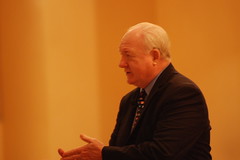 Image by hyku via FlickrThis was the second time for me to hear Lukaszewski and he didn't disappoint. Here's the PR gold that was mined from his presentations:
On Victims and Critics during a PR crisis (and other challenging times):
This is just some of the great material Lukaszewski shared along with some fantastic information on strategically advising leadership during a crisis. He gave valuable tactics on providing operational advice and how to provide the next useful thing to management.
As a communications professional, if you ever have the opportunity to hear from Lukaszewski at a conference or other speaking engagement, I would highly recommend carving out some time and sharpen your skills.

(Note: apologies for the slight shakiness of the video. Lesson-learned: Use a tripod.)
Lukaszewski's workshop focused on three man areas:
- Crisis-proofing your organization
- Building Community Relationships
- Being a Strategic Advisor
Image by hyku via FlickrThis was the second time for me to hear Lukaszewski and he didn't disappoint. Here's the PR gold that was mined from his presentations:- We need to change the language we use; Readiness vs. Crisis Management
- Readiness means being ready for adverse things.
- Old-fashioned definition of PR - Do good; take credit
- New definition of PR - Do good and let it speak for itself
- Strategic Communicators need to ask/answer, "What do we contribute to the mix?"
- Candor in a crisis - "If you want to be trusted, get the truth out there."
- Truth = Absence of fear
- In a crisis, communications becomes an operating function
- Crises happen explosively but are resolved incrementally
On Victims and Critics during a PR crisis (and other challenging times):
- Victimization is a totally irrational and voluntary state; it is self-maintaining and self-terminating
- Victims use language like betrayed, loneliness, personal/personnel failure, grief, why me/us, why now, etc.
- Victims require validation, visibility, vindication, and apology (This is part of why our media friends like to talk to the victims)
- The strategy for negotiations need to start with what is possible instead of what organization is not going to do.
- "Create as few critics everyday."
- Keep your base supporters and avoid making new angry people.
- Silence is a toxic strategy
- You must manage the victims dimension
- Don't forget the obvious - Stop the activity that is creating more victims
- The art of crisis management is to know what the mistakes are going to be
- "When there's a crisis that needs management, management is in crisis."
- Take in big picture without taking it personal; go to 50,000 feet and stay at 50,000 feet
This is just some of the great material Lukaszewski shared along with some fantastic information on strategically advising leadership during a crisis. He gave valuable tactics on providing operational advice and how to provide the next useful thing to management.
As a communications professional, if you ever have the opportunity to hear from Lukaszewski at a conference or other speaking engagement, I would highly recommend carving out some time and sharpen your skills.
Wednesday, March 9, 2011
35 hand-picked posts for fellow PR pros
 |
| Photo via timrich26 |
These are writings from those who I believe are some thought-leaders in the public relations industry or from those who continually provide rich resources for communication professionals. Many of these could just be cool and I think you should (re)read.
(Also, if you are interested, you can also check out my lists from my 34th and 33rd trip around the sun.)
Let's begin:
- Crisis Planning: Prepare Your Company For Social Media Attacks (Web Strategy)
- The Private Nature of Public Relations (Conversation Agent)
- 5 Things Depeche Mode Can Teach You About Effective Online Marketing (Copyblogger)
- Interactions, Engagement & Ecosystems (Logic + Emotion)
- Where Next for the News Release (PR Breakfast Club)
- The Digitization of Research and Measurement (Metrics Man)
- Katie Delahaye Paine's Accuracy Checklist for Public Relations and Social Media Measurement (The Measurement Standard)
- The Difference Between Making the News and Being the News (Social Butterfly)
- Posterous Grows Up as a Blogging Platform (Danny Brown)
- Planning For Disaster: Communicators And PR Must Step Up (Copywrite, Ink)
- PR pros need to write more like…gasp! Sales copywriters! (Mengel Musings)
- 4 keys to to building a social media editorial calendar (Communications Conversations)
- 57 Social Media Policy Examples and Resources (Dave Fleet)
- 11 must-read posts about blogger outreach (Communications Conversations)
- Social Media Release: Evolution (PR Squared)
- 34 Reasons to Start a Blog (Conversation Agent)
- Don’t Build Your Brand On A Third Party Platform (Social Media Optimization)
- Want to get quoted in the media? Try a video expert advisory (As Media Changes)
- Corporate Altruism: The Blurring of the Lines Between CSR and Cause Marketing (Communication Overtones)
- Is PR Ready to Adopt a Standard Set of Measurement Principles? (The Buzz Bin)
- 5 Tips on Business Blogging With Minimal Resources (TopRank)
- It's Time to Stop Collecting Facebook Fans (Ad Age)
- Content curation: A required skill for digital-era communicators (Shel Holtz)
- Newsroom Facebook Fans: Quality vs. Quantity (Journalistics)
- Klout for Business: A Useful Metric –but an Incomplete View of Your Customer (Web Strategy)
- Putting Words Into Action: PRSA’s New Social Media Policy (PRSAY)
- 96 Free Professional Blog Topics (Geoff Livingston)
- Consumer-Facing PR Means Business (Jason Kintzler)
- ‘My Tweets Are My Own’ is a Bogus Line (Lauren Fernandez)
- 10 Press Release Alternatives (Social Media Today)
- Easy Strategies to Start Measuring Your Public Relations and Social Media (The Measurement Standard)
- Q: What’s a new tool for public relations? A: Quora (PRSA Tactics)
- Building Your Own PR or Social Media Measurement Index (Chuck Hemann)
- Social Media Crisis Management: A No-Nonsense Guide (Mack Collier)
- Becoming a Conscious Written Communicator (Brass Tack Thinking)
Tuesday, October 5, 2010
Crisis communication and the saving speed of info
It has been a week since a gunman took his own life at the University of Texas and vaulted the campus community into a panic albeit relatively briefly all things considered. I watched, as did many, as an outside observer hoping this was in a fact isolated to a single random actor who for whatever reason made some tragic choices that day.
As with anything that happens in today's hyper-connected world, we watched as the events (campus evacuation, lockdown, search and press conferences) unfolded in the media as well as through individuals using social media channels.

Communicators should stop being surprised at seeing as-it-happens information or images being shared from the scene like the one shared at right from KUT Radio or the photo gallery that the Austin-American Statesman was updating as the day progressed. It wasn't even surprising to listen to live call-in interviews with students being held inside a locked-down building. These are all part of the new reality for crisis response and communication.
All of those things are secondary to a well-trained crisis response team.
What was gratifying was hearing students mention receiving text messages from UT on the situation. Also the fact that emergency e-mails and voice mails were distributed from UT made its way to the media outlets almost as fast as the news of the type of weapon being used by the shooter.
So let's give credit where it's due: through the coordinated efforts of University of Texas and the Austin Police Department. As pointed out last week in the TSPRA blog,
Being able to share information quickly is what saved the situation at UT last week. How quickly are you prepared to share? When was the last time you dusted off that crisis communication binder? What are some lessons learned? As always, the comments are yours.

As with anything that happens in today's hyper-connected world, we watched as the events (campus evacuation, lockdown, search and press conferences) unfolded in the media as well as through individuals using social media channels.
Communicators should stop being surprised at seeing as-it-happens information or images being shared from the scene like the one shared at right from KUT Radio or the photo gallery that the Austin-American Statesman was updating as the day progressed. It wasn't even surprising to listen to live call-in interviews with students being held inside a locked-down building. These are all part of the new reality for crisis response and communication.
All of those things are secondary to a well-trained crisis response team.
What was gratifying was hearing students mention receiving text messages from UT on the situation. Also the fact that emergency e-mails and voice mails were distributed from UT made its way to the media outlets almost as fast as the news of the type of weapon being used by the shooter.
So let's give credit where it's due: through the coordinated efforts of University of Texas and the Austin Police Department. As pointed out last week in the TSPRA blog,
"UT officials were able to activate warning sirens on-campus, send text messages to students and faculty and distribute emails instructing those on-campus to lock down and those off-campus to stay away, within roughly 15 minutes of the first calls to police. "During his first press conference during the active investigation for additional shooters, Austin Police Chief, Art Acevedo commended the "UT campus, UT police, and communication system to get information to students, secure the campus, and mobilize quickly. Students did their part; they cleared the streets, cleared the campus...my hats’ off to them all."
Being able to share information quickly is what saved the situation at UT last week. How quickly are you prepared to share? When was the last time you dusted off that crisis communication binder? What are some lessons learned? As always, the comments are yours.
Subscribe to:
Posts (Atom)