Showing posts with label School PR. Show all posts

Wednesday, June 4, 2014

Dig deeper when you know the story is close #schoolPR #mediarelations

Where did May go?! Another school year is coming to a close. I've been in school PR for 13 years now (lucky 13!) and as does most Mays in education, the month just goes. Quickly. We had some challenges and some great bright spots. One such bright spot came in the middle of the month and brought with it an important media relations lesson: If you know a story worth telling is buried in obscure information, dig deeper and find your pitch.

The Inquiry

The email was simple. I received a quick message from one of our American Sign Language (ASL) teachers that read as follows:
"Our ASL classes are having Deaf visitors on campus to speak with the students. I was wanting to contact the new stations and see if they would be interested in doing a story about our involvement with the Deaf community. I understand I’m to run this by you first. Is there anything specific for me to do on my end? I was planning to send out an email today."
First off, I was happy the teacher contacted me before attempting to email media outlets. That tells me the media relations procedures are being followed. That aside, this sounded like the beginning of human interest story. Maybe.

Wanted: Context and Details

There wasn't yet enough to make it newsworthy. The teacher had not shared the basics like when, where, and why to go along with a brief who and what. Without relevant details, a story stalls. The bit of info that stood out to me was the teacher's use of the phrase "speak with the students" along with sign language students. I completely admitted my ignorance to the teacher about ASL and the deaf community. So the teacher and I spent a few back-and-forth emails to get to the all important why to go along with the what. We also established the best times for photos/video as well as possible student and staff interviews. By digging deeper, our pitch was definitely starting to take shape.

The Pitch

After working with the teacher, we came up with what turned out to be a pretty solid media pitch:
Mansfield ISD American Sign Language students listen with their eyes and speak with their handsDeaf community visitors join ASL students in showcase of sign language learning and experiences Friday, May 23 
WHAT: Several members of the deaf community will visit the Ben Barber Career and Technology Academy in order to interact with American Sign Language students of various levels. This will give new and seasoned signers an opportunity to use their signing skills in a deaf-friendly environment. The students will showcase art work that contains aspects familiar to the deaf experience as well as give literary performances. 
WHY: The Mansfield ISD ASL program provides sign language learning opportunities for over 160 students. Members of the deaf community were invited to participate and share in a learning opportunity for students. 
VISUALS: All ASL teachers and students will be available for media interviews along with the visitors at any time during or between classes.
(We also included the visitors names and titles, location of the campus, and best time for interviews.)

The Coverage

Thankfully, the event took place on a Friday and thus helped since this was going to be a softer news pitch. Here's the story: Mansfield Students Learn What It's Like to be Deaf

Photo credit: holy via Flickr Creative Commons

Thursday, February 20, 2014

RPIE for the #schoolPR Pro: Communication Plan Checklist #tspra14

School public relations programs have a much greater chance of success with proactive, strategic planning that incudes measurabIe objectives set forth by research and evaluated. The following is the RPIE for the School PR Pro checklist I created to share with other school public relations pros to guide them through the 4-step process -- Research, Planning, Implementation, and Evaluation.  


This checklist was first prepared and shared at the 2014 Texas School Public Relations Association conference during the roundtables session.

Monday, September 2, 2013

Public Relations Roles of the #schoolPR Pro

I consider myself a life-long learner and as such I'm (still) in the process of studying to take the APR exam and preparing my materials for the readiness review in order to be an accredited PR professional.

This is not a post arguing for/against APR credential. Rather, it's based on reading the PR Roles and Responsibilities portion of the study materials that happened to coincide with the first week of a new school year.

I've been in school public relations since 2001 and each year look forward to new challenges and opportunities to improve or expand communication between my organization and its stakeholders (or publics). This year, I thought it would be good to share what it is we do in school PR.

The following definitions are based on a list found in the APR Study Guide which I think is a valuable tool even if you are not considering the APR.

Public Relations: A Management Function
School Public Relations is the management function that establishes and maintains mutually beneficial relationships between a school district/educational institution and the publics on which its success or failure depends. (adapted - Broom, 2009, Effective Public Relations)
Advertising: (paid content) Information placed in the media. It is a controlled method of placing messages in the media. It is useful as part of large campaigns that require detailed explanations such as bond/levies, technology, new/expanded programs, etc.

Brand/Branding: A product, service or concept that is publicly distinguished from other products, services or concepts so that it can be easily communicated and usually marketed. A school district sells trust and as such its branding must reflect ways in which it's distinguished from others.

Community relations: An area of school public relations with responsibilities for building relationships with constituent publics such as faith-based organizations, charities, clubs and activist interests of the neighborhoods or metropolitan areas(s) where a school district. Dealing and communicating with citizens and groups within district boundaries is typically the responsibility of the school PR team. 

Controlled communication channels: Self-sponsored communication channels, media and tools that are under direct control of the sender. Examples include paid advertising, newsletters, brochures, some types of e-mails, organizational websites and blogs, leaflets, organizational broadcasts and podcasts, intranets, teleconferences and videoconferences, meetings, speeches, position papers, and all other channels and communication products under organizational control. In short, be your own newsroom.

Counseling: Advising management concerning policies, relations and communications. Senior-level school PR practitioners should be among the rest of executive-level team in direct communication with the superintendent. In an advisory role, the school PR person often needs to act as organizational conscience

Crisis communication: Protects and defends a school district facing a public challenge to its reputation. These challenges can involve legal, ethical or financial standing. There are many potential issues that can flare up into full-blown crises. The school PR pro must be attuned to various facets or the organization in order to be aware of issues.  

Employee relations: Activities designed to build sound relationships between a school district and its employees, and a critical element in fostering positive attitudes and behavior of employees as ambassadors for the organization. The school PR person should be aligned with the HR team so that existing or new programs or topics are well-communicated with staff.

Financial relations: An aspect of school public relations responsible for being well-versed in the business of school districts. How education is funded from local, state, national perspectives and being able to explain it (or know who in the organization that can) in order to communicate finance topics.

Government relations: An aspect of relationship-building between a school district and other government agencies at local, state, and/or national levels, especially involving flow of information to and from legislative and regulatory bodies in an effort to influence public policy decisions compatible with the local school district's interests. Understanding legislative priorities is an important role for school PR.

Issues management: The proactive process of anticipating, identifying, evaluating and responding to public policy issues that affect school districts and their publics now and in the future. This is an important role for school PR for those that can accurate anticipate and analyze problems before they flare up.

Marketing: The management function that identifies human needs and wants, offers products and services to satisfy those demands, and causes transactions that deliver products and services in exchange for something of value to the provider. Targets customers.

Marketing communications: A combination of activities designed to sell a product, service or idea, including advertising, collateral materials, interactive communications, publicity, promotion, direct mail, trade shows and special events.

Media relations: Among strategic communication functions for the school district, the school PR pro coordinates the exchange of information with media outlets and the general public. This position maintains a dynamic newsroom and media lists as well as various information channels though which news releases and stories are posted and distributed. These enable media outlets and school district community members to keep up with what's happening in the school district.

Multicultural relations/workplace diversity: Relating with people in various cultural groups. Understanding multicultural and workplace diversity continues to increase in importance. Diversity in the workplace continues to provide challenges and opportunities to public relations practitioners and other managers impacting messaging, perceptions of ideas, and services. These considerations may include issues of household composition, ages, gender, ethnic and religious backgrounds, language, technology fluency, health status or disabilities.

Press agentry: Creating newsworthy stories and events to attract media attention and gain public notice.

Proactive public relations: Taking the initiative to develop and apply public relations plans to achieve measurable results toward set goals and objectives.

Promotion: Activities designed to win publicity or attention, especially the staging of special events to generate media coverage. Special activities designed to create and stimulate interest.

Public affairs: A specialized area of public relations that builds and maintains mutually beneficial governmental and local community relations. Also applies to the military and governmental agencies due to the 1913 Gillett Amendment.

Public information: Representation of a point of view in collected forms such as facts, news, messages, pictures or data; the process of disseminating such information to publics usually through the mass media; a designation describing persons charged with the task of such dissemination usually on behalf of government agencies, nonprofit organizations, colleges or universities. School PR pros are typically the public information officers for school districts. [Texas: Rights of Requestors and Agency Responsibilities under the Public Information Act]

Publicity: Information from an outside source that is used by the media because it has news value. It is an
uncontrolled method of placing messages because the source does not pay the media for placement.

Reactive public relations: Response to crises and putting out fires defensively rather than initiating programs. There are varying degrees of reactive public relations with some situations requiring implementation of a school district’s crisis plan.

Reputation Management: Reputation management is an important function of school public relations, which is often cited in the context of crisis management. The increased use of the web and related social media has given added urgency to the practice of monitoring, as the immediate and anonymous nature of the Internet increases the risk of communications that can damage a school or school district’s reputation. Online reputation management is a growing specialized segment of public relations.

Special events: Stimulating an interest in a person, product or organization by means of a focused “happening.” Activities designed to interact with publics and listen to them.

Uncontrolled communications channels: Uncontrolled communications channels refer to the media that are not under direct control of the company, organization or sender of messages. These include newspapers and magazines, radio and television, external websites, externally produced blogs and social media commentary, and externally produced news stories.

Related posts:
Photo credit: ashleighozment via Flickr Creative Commons

Saturday, July 20, 2013

In defense of (and clarifying) #schoolPR

Some people really don't get school public relations (or even PR in general). Repeat after me, public relations is greater than media relations. It's even worse when someone has worked in the field and still doesn't get it.
Thanks to Delaina Biernstein for sharing an article that perpetuates a silly mischaracterization and miscalculation of what is/is not school PR. In the Yahoo! Contributor Network article, "New York Taxpayers Foot the Bill for School Public Relations Services," the writer suggests:
School public relations specialists are essentially hired to spread the word about the good things being done by students, with the hope that getting the information out into the media will help districts get their budgets passed.
These specialists do photography at student recognition nights at school board meetings, write press releases on the latest district news, and assist with school publications. 
They prepare newsletters, flyers, posters, brochures, and articles for district websites. Additionally, school public relations specialists attend major district functions, such as board of education meetings, homecoming, and graduations, to compile stories and photos for dissemination to local media outlets. [emphasis added]

Tactics, tactics, tactics

That brief description above is just a bunch of boring tactics. School PR is more than what this writer purports. I believe school PR pros must approach the position from a strategic communication vision

The Texas Association of School Boards HR Services Division defines the Communications Officer [school PR] function as one that: 
“Manages and directs the dissemination of public information regarding the district. Coordinates the exchange of information with media outlets and the general public. Develops public relations programs and materials to promote a favorable image of the district and its activities.” [2012 Position Detail Report for Communication Officers]
Did you catch that? Coordinates the exchange of information with media outlets and the general public.
To be fair, I'll cut that writer some slack since he claims to have three years of experience working in school public relations. My guess is he likely served in a tactics-driven specialist job and was never given the great professional opportunity to write PR plans using the RPIE process. What he described is the implementation of some tactics that, whether he knows it or not, are from a strategic vision for a district. 

It's also worth noting that in New York, as in other states, a school district's operating budget must be approved annually by vote. This no doubt adds an interesting (challenging) dimension for school communicators, but a strategic process is still in play.

Education leaders must keep school PR in and around their vision and strategy discussions if they hope to have any success in program or campaign implementations. The media may well be a key audience, but it's certainly not the only audience to consider.

Sunday, June 2, 2013

Smart PR save from a high school yearbook mistake

High school yearbooks these days are massively creative homages to the school year. Yearbook editors are carefully selected and with the help of their staff piece together pages with the days in the lives of their peers. The vast majority of times yearbooks are published and distributed to classmates without problems.  

But sometimes there are problems, big problems, media-attention problems, problems having serious implications for teens. (Yikes.)

So naturally my heartbeat quickened when one of our high school's journalism/yearbook teachers called me last week asking if I had seen some of the negative reaction to their yearbook(Uh oh.)

Their crime: misspelling our school district's website address on one of the first few pages. (Whew!)


Yeah, that's supposed to read www.mansfieldisd.org instead of www.mansfiledisd.org. Oops. Thankfully, the typo really isn't that big of a deal. According to the teacher, the editors and staff started to see some students at their school and from the out high schools in the district making fun of the typo and posting on social media.

Instead of tucking tail and hiding their faces in shame, the yearbook editors, staff, and teacher took a more proactive and creative response and turning the joke on the detractors. They bought the misspelled domain and set up a website to poke a little fun at themselves for the mistake.

From the 'About This Site' page:
Hey Bronco Nation, we at the Arena and the Rider Online realized that very often parents, teachers and even students misspell ‘Mansfield.’ Statistically, it’s bound to happen. In typing just those two sentences we hit the backspace button twelve times. Now, normally we would just suggest simply retyping the url and continuing on your way to mansfieldisd.org, but we came to the realization that there was an entire untapped market of people who came to mansfiledisd.org and were very saddened and confused when it led them to a giant 404 error. We felt this was a grave injustice, and we dedicate this page to those poor, lost souls. Welcome, friends, to Mansfiled ISD, home of the typographically challenged.
In addition to funny bits about yearbook mistakes, Photoshop disasters, headline errors and Funny Sloth Video, they included a downloadable page to print and place in yearbooks with the corrected web address. This page printing or in some cases, printed stickers to cover up offending mistakes has become the norm since reprints can often cost in the tens of thousands of dollars for many schools.

No harm, no foul.

I think the yearbook sponsor and his students learned a good PR lesson: How you react to mistakes determines your ability to recover and move on.

Friday, March 15, 2013

We Choose Texas Public Schools


Over the last decade, it seems numerous groups have thankfully formed to advocate for public school districts across Texas. While these groups have strong commitments to public education, each has its own vision, mission, and objectives, often leaving school districts, parents, employees and public school supporters without a simple unifying message or call to action. My hope is for more people to stand up and say, "We Choose Texas Public Schools."

We Choose Texas Public Schools is a concept campaign offered freely for public school district communities, parents, students and staff. I came up with it for a public education celebration rally in February that my school district hosted with four other districts in North Texas. We had yard signs (pictured above) made to distribute to attendees. (The cost of these signs was covered by a sponsor.)

School choice continues to be a major topic of debate and conversation both in the Legislature and out in the public space. Texas public schools educates nearly 5 million students. I'm not going to delve into the arguments for/against restoring state education funding, school vouchers, high stakes testing, or other un-funded mandates in this space. Again, there are other public education advocacy groups already making positive steps for these debates. Healthy debate is good in my opinion. I offer this simple idea as a counter-message to the negative notion repeated again and again that students are “stuck” in public schools. In actuality, many families simply choose public education. I want to give a unifying message for those parents who freely choose Texas public schools.

Be proud, Texans and share that choice.
Please feel free to share, use, distribute the We Choose Texas Public Schools concept. I've shared the PDF of the yard sign art for others to use. I look forward to seeing how this concept develops.

Tuesday, October 30, 2012

'The Mom Next Door' and School PR

A recent study found that more moms make in-person recommendations (83%) than recommendations via social media (53%) which should cause school PR people to pause a moment and think about your school district's in-person contact with parents, especially moms.

The recently released study entitled The Mom Next Door: Why and How Moms Make Recommendations by 360PR and Mom It Forward provides interesting data on how moms make recommendations in-person and online. I can see it being useful for brands to dig into for thoughts on trustworthiness.

Among the Mom Next Door survey findings:
  • 71% of moms make recommendations about brands, products and services to other moms at least monthly; 
  • 50% of moms making recommendations about brands daily; 
  • 93% of moms are influenced to some extent by other moms’ recommendations.

The parts of the survey I found most relevant for school PR pros relate to trutworthiness and where moms meet-up. According to the survey, the majority of moms rate in-person recommendations as more trustworthy than recommendations via social media.
  • 59% of moms give in-person recommendations the highest possible rating for trustworthiness; and
  • only 14% of moms rated recommendations via social media as “most trustworthy.”
Moms interact with other moms most often at their child’s daycare or school (58%), at a friend’s house (54%) or another off-line get-together (48%) – meeting for coffee, shopping, working out, etc.


Why this is important for school PR
The data on in-person recommendations and locations of interactions with other moms at daycare or school should perk up the interest of school communicators. That 58% of moms interacting with other moms at their daycare or school is a useful data point because it points to an easily ignored truth when it comes to communication: moms come to the schools. 

We spend so much time thinking about how to leverage the digital communication channels through online outreach, social media tools, e-newsletters, etc. which is all well and good since we can be highly efficient with our efforts by using these channels. We should definitely keep using online tools to hopefully provide that 35% of moms meeting-up online with timely, honest, accurate, relevant information. But, we must be mindful of our in-person communication touch-points with moms (parents) so that the larger percentage get the information they need as well. Think of it this way with a few types of campus-parent interaction opportunities for communication success or failure: 
  • campus/district special events, activities, or sports; 
  • before/after school drop-off and pick-up;
  • anytime volunteers are on campus; 
  • PTA/PTO meetings;
How a campus appears, how its staff interacts with parents and the available messaging and signage locations are all three things never to be overlooked. I'd argue that many problems or misunderstandings could be mitigated with some consideration to communication. Sometimes we get caught up in the luster of the shiny objects and forget a simple explanatory handout would suffice. 

If we hope to be included among the (hopefully) positive in-person interactions and recommendations between moms, we'd better not forget when, where, and how we'll get those chances.

Wednesday, September 19, 2012

5 Reasons to Make Your In-house Editorial Calendar

How does your communication department function? Is it stuck in an old mindset of spray and pray (as in spray the press releases out to the media and then pray for coverage) or do you treat the department like your organization's own newsroom where content creation and direct communication with your community are the objectives? I'm an advocate of the latter as part of the department's function for public relations in school districts and nonprofits. An internal editorial calendar is a smart way to help in-house PR departments meet leadership goals and strategic communication objectives all year long.

Keeping an editorial calendar for your communication department allows you to:

  1. Effectively plan around the monthly and yearly occurrences in the organization
  2. Position yourself and department as the go-to source for information
  3. Drop-in plans for special events and target dates
  4. Establish timing for press releases, newsletters, blog posts, video production, etc.
  5. Allows you to get back on track with messaging when things go wrong
That's great but how do you do it? 


Here's how to get started. I'm sure there are other possibly better or more creative ways to make an editorial calendar but here's what I did. I found a simple template in Google Docs (now Google Drive) for a blog Editorial Dashboard. Then I made the appropriate adjustments for a week-by-week calendar for the department to use all year long. 

First, drop in everything for which you have set dates on the calendar. You're looking for those things that happen every year. For a school district, we have many items to quickly drop in such as holidays, board meetings, first and last days of school, high school homecoming dates, graduations, etc. 

Next, add the target or scheduled dates for any special events like any facility ground-breaking events, building dedications, board elections, bond elections (referendums), etc. (Don't forget to include important weekend event dates.)

Once these items are in, it's time to work to include your planned schedule for your recurring communication channels: electronic and/or print newsletters (external and internal if applicable), regular video updates from leadership, blog post schedule, and planned Facebook page posts. This part is an ongoing exercise and and you never really feel finished because things inevitably get shifted and you'll have to make adjustments. The calendar just gives you a guide to bring things back in order. 

We've all had those days (weeks) when things are going wrong or we're in full-blown crisis communication mode and we know in the backs of our minds some things are getting lost in the shuffle. An editorial calendar can serve as your reference tool to get back on track. I've found ours to be a solid source for making sure our timing for important announcements doesn't interfere with something already planned. We've used the calendar to remind leadership of important issues and how they play among established plans, dates, and events.

What do you think? Have you created an editorial calendar for your communication department? Are there any other benefits or tips you can add? As always, the comments are yours.

Monday, August 6, 2012

Back to #SchoolPR Tips: First Day Photos

Cute kid photos are like gold for school PR people. As a practice, we get to go around through the school year for events, programs, or any random opportunity to shoot photos in our campuses and school districts. We search for those elusive shots that capture the excitement, interest, and intrigue that can be found in education. A prime opportunity for these photos occurs during back to school.

But what happens when you can't be at all campuses at once? How can you get those first day photos with the bright smiles, carefully chosen threads, the occasional tears from the little ones and their parents, and other such images? Let the community submit these photos. Here's how:


User-Generated First Day Photos

I started our school district's first day photo concept back in 2008. The idea is simple: Put out the call for photo submissions via the communication channel(s) of  your choice website, blog, Twitter, Facebook, etc.

We do with a website posting like this 'Photo Gallery Request - Send us your first day photos' along with the criteria. We ask that users email photos taken during the first few days of school. I use Google applications for a number of other district-related items like the school district's blog, website analytics, and more so naturally I let folks email their photos to the Gmail account for quick access and labeling.  To make things even easier, we only accept .jpg format images.

We also note that by submitting photos, users are agreeing to allow the district to display the images among other submitted photos on the district's online gallery site. Users also agree to allow the district to use the images for other district-related print or electronic publications. 

These photos then get uploaded to a First Day Photos gallery for that year. (See our galleries from 2009, 2010, or 2011 for more samples.) We try not to show names or other easily identifiable images. 


Outcomes

I've been very impressed with some of the quality of images sent in by families. When I started this, I figured we get mostly younger kids. Surprisingly there are typically plenty of middle and high school students submitting photos as well. 

We get all kinds of shots like photos as kids walk out the door in their homes, standing in the driveway, climbing on the bus, walking up the school sidewalks, in the hallways and classrooms. 

In four years, we've posted over 540 photos that were sent in for the annual first day photos galleries. From these photos I've been able to pull images for use on the district's blog and website and in some cases, in print when the quality and resolution have both been high enough. Plus, there's the added bonus of being to get photos from almost every campus if we've done our job of effectively communicating the submission opportunity.

Creating a way for your users to submit photos is such an easy way to engage your families, drive traffic to various communication channels through cross-pollination of content, and mine that school PR gold. 

What do you think? What are some ways you have used back to school time for school public relations? The comments are yours.

Tuesday, July 10, 2012

Guest Work on the 'School Marketing Podcast'

I was recently asked by Randy Vaughn to join him as one his first guests on his School Marketing Podcast. His site has a primary audience of private, independent, or Christian school marketing. Prior to my current six years in a public school district, I worked five years at a private school in Ft. Worth as a communications director. There is a constant need for guidance in the areas of marketing communication and admissions for administrators of private schools. Private and public education both need capable and professional voices to help tell their stories, explain the challenges and sell their products - trust in education. 
------------


(Thanks again, Randy for the opportunity to share with your audience.)

Friday, June 8, 2012

Valuing School PR and Summer Timing

Earlier this week the Dallas ISD received some summertime media attention with their incoming superintendent setting the salaries for four chiefs in his cabinet including $185K for a Chief of communications.

I have no interest in debating whether or not this individual should or should not be paid this as a base salary for a school PR job mainly because I don't know the ins and outs of the DISD budget. Nor am I interested in the arguing the newsworthiness of the Dallas Morning News article that raised eyebrows because that education reporter was simply following the template of others: share salary of public official + compare it/share it = shock and disbelief  x  readers. Textbook.

No, I'm focused on two intriguing aspects of this situation from a school PR perspective:

(1.) An increase in the value of school communication professionals by superintendents and (2.) the timing of summer information releases.

Top-level value of school public relations
The article mentions that the new superintendent, Mike Miles, is bringing the district's communication position into the executive fold. 
DISD’s top communications position has not been a chief-level job, but Miles said the change was needed because there will be an increased focus on communication.
Honestly, I was surprised to read that communications was not previously an executive or cabinet-level position in Dallas ISD. By including his communications person among his chiefs, the new superintendent has shown how much he values strategic communications for his district administration. I sincerely hope DISD has found someone to help bring things along (or turn things around depending on where you sit) for the school communities. School PR should take note of how expectations for internal and external communication can be of value and service to a school district.
“We’re going to do communications differently,” Miles said. “Most people in the community will agree that our communications have to be better.”
I do, however, take exception to part of the Dallas Observer's post on the salary from their "Edumication News" section. (Yikes!) and his premise that anyone can do communications because it's a sales job. Joe Tone writes,
There are plenty of areas of public education that require a really specific set of skills. But communications isn't one of them. It's sales, basically, only for almost every customer you have, yours is the only product they've ever heard of.
Wrongo. What Joe Tone doesn't realize (or care to understand) is that strategic communications and school public relations does require a specific skill set just like other administrative functions. But that's ok, he's in the media. He can write what he wants. I may need to save that list for a future post.
 
Summer Timing
The other tactical aspect of this news story should be of interest to school PR pros as well. While the administration of school districts continue all year long, some of the stories for education reporters dwindles in the summer. While this salary brouhaha will cause a bit of bruising in the short-term for DISD, it won't have lasting effects since people move on to other things in their heads pretty quickly. Especially in the summer. If there was going to be a time for an OMG-look-at-what-they-are-paying article to come out, the summer is really the best time for it. Controversial news has a better chance of being managed internally and externally when released over the summer. I recommend information-gathering and using online statements as well as direct communication with the community in addition to working with the media. It's true during the school year and during the summer.

Photo credit: grbenching via Flickr Creative Commons

Friday, June 1, 2012

Getting the best PR outcome from a student protest

Oh what a difference a year makes. One year ago my school district had a lively (and ultimately positive) PR issue at end to the school year: a high school student protest at the administration building.

From our official statement:
On Friday, June 3, approximately 100 students from Timberview High School held a peaceful demonstration at the Mansfield ISD administration building voicing their concerns over the decision to transfer a staff member from their campus to another school within the District.

The Timberview staff member received notice of an administrative transfer to a middle school in MISD as a teacher and coach starting in the 2011-12 school year. To date, this individual is one of 75 Mansfield ISD employees who received such administrative transfers in our continuing efforts to save jobs in the District. (While other districts were cutting staff and eliminating positions, the Mansfield ISD administration and board committed to avoid personnel and student program cuts during the state of Texas' education budget uncertainty.)

The important thing to note is that in this situation is we were not surprised by the demonstration. The students tipped their hand through word of mouth and social media. The rumor-mill revved up during the last week of school about the students being upset that one of the teachers was being moved/fired/replaced/sent away/etc. (You know, the way the rumor-mill works, they only had a portion of the truth.)

Thankfully, I got wind of it pretty early because we aggressively monitor traditional media and social media for mentions, problems, topics related to the District and campuses. It wasn't long before the students took to Twitter and Facebook to rally support and organize the demonstration. Using Twitter search and a Boolean search string with hastags, campus name, the teacher's name and the 'OR' operator, I had a pretty good handle (and free look) into the conversation on that channel. The students also set up a Facebook Page to save the coach and pretty much left it wide open for anyone to see. This was good because we could observe as well.

When the conversation moved to an actual organized protest for the last day of school, we were not taken by surprise and were able to anticipate their movements. Originally, they wanted to demonstrate at the high school, which was a bad idea because in addition to it being the last day of school it was also a finals day. Naturally, the concern here was a disruption in the academic process particularly for those students not involved or interested in this particular demonstration. But things changed.

What happened next? Since we were monitoring the conversation, we followed the news that the students decided against rallying at the high school and instead were going to gather and demonstrate at the District administration building. Great. Again, this was the last day of school but this was a better situation for us since we could contain things away from students taking finals.

As luck would have it, that same morning I was finishing up with an interview at another campus about a great story of teen from the district who had published her first novel when I got the first call from a local radio station about the high school student demonstration.

The radio station told me they had heard there were "300 students gathered at the stadium" to protest. Since we had anticipated the students' moves and had confirmation from District police, I was able to give her the actual numbers (approximately 50 kids at the time) and an updated location of our administrative complex. I told her to have the reporter meet me in the parking lot and we'd go from there.

And thus started the media relations side to this story.

As members of the local media began to arrive and get their b-roll of the students marching then coming over to get some interviews I took an opportunity to show a little strategic support for the students. I had our student nutrition department deliver cases of bottled water so we could distribute among the students during what was quickly becoming a hot Texas day. Ideally, I wanted the media footage to include us passing out the water. Yes, this was done on purpose from a strategic viewing benefit as well as simply being a case of us still being responsible for the students during a school day.

The media interviews went fine. Most of the articles and stories that aired were balanced and we were able to share the key messages that this was all a part of our District's job-saving measures during a time of state education budget cuts. In general, I still consider this a positive experience also because the students did a good job of staying focused and took the demonstration seriously instead of using it to act unruly, disrespectful, or cause problems for traffic or the general community. These were good kids, they didn't have a perspective beyond what they thought they knew. It was actually refreshing to observe an organized student protest for something they believe in even though we had to deal with the media fall-out from it and took a bit of a short-term bruising.

I've used this case study a few times over the past year, but figured it was time to put it down in a post so hopefully other school PR pros or administrators can benefit from some of the steps we took. Simply put, school districts must monitor the online conversations and when topics or issues arise, be ready to take action. Traditional media and social media monitoring are must-haves in a school PR pro's arsenal from an early-warning device to a part of the measurement practices.

I'll leave you with one of the local media stories on the protest:

Saturday, February 18, 2012

Social Media Issues and Best Practices #tspra12

This is my presentation for last week's Texas School Public Relations Association 2012 Conference. I told attendees I'd have the deck available on the blog. Thank you to all who came to the afternoon presentation and for the great questions. I hope you took away something(s) useful. 

And remember, don't be afraid to ask for help.
Special thanks to Craig Verley (Mission CISD) and Scott JuVette (Ft. Worth ISD) for letting me use you and your districts as good examples for the group.

Saturday, August 27, 2011

Missouri judge makes good call on "Facebook bill"

Courthouse of Cole County, MissouriImage via WikipediaCole County (Mo.) Circuit Judge Jon Beetem issued a preliminary injunction on Friday against a law designed to prohibit teachers from having private online conversations with students declaring that it “would have a chilling effect” on free speech.

The law reads in pertinent part, "No teacher shall establish, maintain, or use non-work-related internet site which allows exclusive access with a current or former student."

Judge Beetem writes in the preliminary injunction, "Even if a complete ban on certain forms of communication between certain individuals could be construed as content neutral and only a reasonable restriction on 'time, place, and manner,' the breadth of the prohibition is staggering...The Court finds that the statute would have a chilling effect on speech."

Soon after the injunction, Missouri Governor Jay Nixon announced that he will ask the General Assembly to repeal the social media provisions in the controversial law.

Good call.

This clumsy state-wide provision was sitting there waiting to be challenged and (hopefully) overturned. I have no issue with the intent of wanting to curtail inappropriate contact between students and teachers using social media. It just seems these provisions were doomed from the beginning from a free speech perspective and from an enforcement standpoint. It will be interesting to see what comes next or if other states watch the Missouri outcome and tailor similar bans.
Enhanced by Zemanta

Thursday, August 11, 2011

How crisis communication theory meets crisis communication reality

Film poster for When Worlds CollideImage via Wikipedia When Worlds Collide!
How crisis communication theory meets crisis communication reality

Guest post by Brad Domitrovich, PR Zealot

What is a crisis? By definition, it is a crucial or decisive situation, a turning point. For those of us who happen to be in the school PR business, a crisis is better defined as any event that causes us to stop what we are doing and react. From a personal standpoint, I define a crisis as any situation that makes me reach into my medicine cabinet and grab my favorite bottle of headache relief!

Over the past year, I’ve presented crisis communication seminars at several conferences across Texas. In attendance at these workshops were School Board Trustees, Superintendents, District Level Administrators, and Campus Level Administrators. It is always such a breeze lecturing people about what to do in a crisis, especially  when there isn’t one going on at that very moment. It sure is easy being “the expert” on stage answering questions about managing the media when there isn’t a line of reporters at my door. Life is so easy when you’re operating in “theory” mode rather than “reality” mode. I’m a big fan of the show Seinfeld. So what happens when, as the character George Costanza states, “worlds collide?” What happens when reality is here and theory takes a back seat?

Every school district has to deal with a crisis from time to time. The ones I have worked for are no exceptions. A couple of months ago, I had a crisis situation pop up. A big one. One of those that you know that within the next twenty-four hours, you are going to be contacted by virtually every media outlet in your market.

Instead of getting myself worked up into frenzy mode, I opted to close my office door, sit in the quiet for a few minutes, and jot down some notes as a plan of action. When I finished penning my last bullet point, I realized that what I was jotting down, was a parroting of what I have been presenting as “theory” throughout the past year.

#1: Be prepared
Although each crisis is different and should be weighed on its own merit, preparation is paramount. What does being prepared mean? Being prepared for me in this case was reviewing information with key individuals. I made sure that I had all the details I needed so I knew what to say. There is no such thing as having too much information when you are preparing for a media blitz. I reviewed timelines, activities, and actions and made sure that all of us knew what to do and what to say during and after the crisis period. Bradley D. Smith, School Board President for Georgetown ISD reiterates this thought. “My advice to administrators would be to completely understand the facts regarding the crisis and then articulate a strong strategy,” he states.

#2: Never say “no comment”
Everyone knows that you should never say no comment. I always try to view the crisis from the eye of the public. Do they want to hear you say “no comment”? Anytime you ignore a crisis situation, it only makes things worse. If we provided no comment, we would have lost our greatest opportunity to control the crisis.

#3: Have one spokesperson
Having one spokesperson who is comfortable in front of reporters is an incredible asset in a crisis situation. One individual should always be designated as the primary spokesperson to make official statements and represent the company. A back-up individual should also be identified in the event the primary person is unavailable. “Have a predetermined spokesperson to handle all the information releases and interviews,” explains Craig Verley, Public Relations Director for Mission Consolidated ISD. “One voice with correct and timely info – frees up other staff  to do their jobs in dealing with the emergency situation without media distractions,” he adds.

#4: Media relations is critical
The best time to build a relationship with the media is when you don’t have a major issue in the spotlight. Stay current with reporter names, phone numbers and e-mail addresses. Be proactive. Don’t wait for bad news to begin developing relationships. Mansfield ISD’s Director of Media and Communications Richie Escovedo tells us to “establish positive relationships with the media, community, and advocates before you need them.”

#5: Bleed for a day, not a week
It is always good practice to confront the situation immediately and take charge. If you’re hoping that the radar doesn’t find you because you’re lying low, that just doesn’t work. Embracing the crisis, being prepared, and having a statement ready allows you to get on with business as usual after only one day of controlled chaos.

So those were the five bullet points I jotted down. As I look back, worlds can collide! Managing a crisis can be accomplished as long as you allow “reality” to meet with “theory.”

------
Brad Domitrovich is a “PR Zealot” with over thirty years of experience in the academic, entrepreneurial, and corporate environment. He is Past President of the Texas School Public Relations Association and served for  six years on the TSPRA Executive Committee. Brad is invited frequently to speak at conferences sponsored by a number of educational organizations. He has delivered keynotes and presentations for several school districts and Educational Service Centers throughout Texas. Currently, Brad is the Director of School and Community Relations for the Georgetown Independent School District. He can be contacted at Brad@Domitrovich.com or (830) 688-9912.
Enhanced by Zemanta

Thursday, May 5, 2011

Closing a School District's Facebook Page

Facebook logoImage via WikipediaAfter approximately 20 months of building a (mostly) positive online community, my school district has shut down its Facebook page.

In an explanatory blog post, we shared the following in part:
"Mansfield ISD will no longer host district or campus-level Facebook pages. The open nature of the Facebook commenting feature continues to cause regular disruption and place the district as a liable participant in issues related to sharing of private student information, defamation of employees and other abusive online behavior. In addition, MISD is not able to commit the administrative or campus staff time necessary to adequately moderate user content posted to these pages."
Those of you that know me know that I am huge advocate for integrating social media tools into communication and public relations work flow. Facebook page management was/is among those tools I recommend.

Be careful what you wish for...
With the District page open for community commenting, of course we created and posted the rules of engagement to back up our removal of inappropriate material. We wanted feedback. We got feedback. Not all of it positive. Which was, and is fine. Getting useful feedback from the community on news and information was an objective since it helped us determine if messages were being received. The human element of the social web will always bring out critics and critiques. The problems came when those were aimed at students, parents, community and individual staff members.

So what changed?
In essence the liabilities were outweighing the benefits of the district's Facebook page. We became keenly aware of just how much time it was taking to adequately monitor the page in order to remove postings that were abusive and/or offensive.The page audience grew to a respectable 6,900 fans ('Likes') connected to it. Unfortunately, somewhere along the way it reached a point where detractors (passionate and occasional) decided to use the commenting features to share negative information and feedback about individual students and staff members. There were also instances of bickering and arguing with each other including back and forth between kids and adults that sometimes left the realm of civil and intelligent discourse. I know that is shocking to anyone who has a personal Facebook profile. (sarcasm)

Perhaps there was a magic number of fans or tipping point for the community that marked this shift. It's hard to tell.

Why not just turn off the comments for the page?
In the current Facebook Page editing capabilities, Admins can toggle on/off the Posting Ability to adjust the setting "Users can write or post content on the wall." But, that only stopped new comments going to the wall, not on previous or new posts shared by the Page. That setting simply doesn't seem to exist right now. Admins still have to watch and delete inappropriate replies and ban users if necessary. So it's still a moderation/time issue.

Moving forward
If school PR people want to start/continue to use Facebook pages, I would recommend you make sure you (1.) have a policy that includes a response protocol for negative comments and inappropriate posts and (2.) set aside time, resources and money to listen to and moderate the conversation about your school district. This time resource is a sticky one. We could no longer sustain a level of moderation with the current Facebook Page administration capabilities to meet the growing demand for nearly constant oversight.

Does this mean we are backing away from social media? Hardly. Consider this:
Facebook ≠ Social Strategy

I do not consider adopting any one single social media tool, even the current front-runner, Facebook, as being equal to having a social strategy. The underlying reasons or objectives behind why you use these communication tools and how you evaluate and measure their effectiveness are what ultimately propel an organization's success.

What do you think? Have you run across these commenting management issue on pages you run for your school district or clients? I'm curious to know what others think. As always, the comments are yours.

Related articles
Enhanced by Zemanta

Saturday, April 9, 2011

QR Codes and School PR

The following is a guest post by Lauren Bingham from the Texas School Public Relations Association. It is cross-posted  over on the TSPRA Blog:

What in the world are QR Codes?


At the grocery store, a bar code scanner reads the bar code on your product and tells the register what it is and how much it costs. QR Codes use the same concept.

People can now use their cell phone cameras (bar code scanner) to read QR Codes (bar codes), which instantly directs their phone to a designated website, PDF, contact information, video, etc.

Sufficiently confused? Let’s use it in an example scenario. Pretend I’m a PIO at Mainstreet ISD–my district is holding a TRE (tax rate or tax ratification election) and we’re holding a community meeting next week. We’ve built this awesome webpage with all kinds of information and graphs and videos explaining how school finance works and why we need to pass this TRE. But if we just tell them about the website, we risk them forgetting to go there after the meeting, or forgetting the URL altogether.

From the creator’s end
So I take my webpage URL, let’s say it’s www.mainstreetisd.org/news/finance/tre, and go to one of many QR Code generating websites, plug in my URL and it will automatically create a unique QR Code (just like a bar code). That QR Code has my link embedded in it so that anyone who scans it will be automatically directed to our TRE website. I can then print this QR Code on any posters or handouts we distribute at the meeting, I can make a giant display version so that anyone in the audience can scan it from their seats, I can even print it on t-shirts or stickers if I wanted to. 
 
You can create a personal account on many of these QR Code generator websites that will allow you to see how many people are scanning your code, change the link (without changing the bar code) that your users are directed to, password protect your code or set it to expire at a certain date.

From the user’s end
While there are tools that make this technology available on any phone with a camera, it’s really most usefully for smart phone users. All I need to do is go to the app store on my phone and download a QR Scanner app–there are a bunch out there, not all of which work as well as the next, particularly for BlackBerry which seem to have a difficult time. Then, whenever I see a QR Code I want to scan, I open the QR Scanner app, which will typically activate my phone’s camera, then point the camera at the QR Code until your camera can scan the code–just like you’d do at the grocery store. Depending on the app, it’ll typically identify the file, URL, video, etc. that the QR Code is linked to and will ask you if you want to open it.

Because there’s linking involved, this does require a wireless connection on your phone, which involves data usage and the fees associated with it. If the code links to a PDF, Word doc, Google map, calendar event, etc., these will likely be saved onto my phone; websites, however, will not be saved unless through the phone’s browser history.

So what are some other ways school districts can use QR Codes?

  • Using codes on back to school materials to link to school calendars (some tools will allow users to integrate your calendar into their phone’s calendar) or school supply lists
  • Displaying codes at the front of schools that will link to school contact information, TEA ratings, etc.
  • Displaying codes at graduation that link to do’s and don’ts, a PDF of the program or information on school-sponsored graduation night activities
  • Posting codes in teachers lounges and workrooms with links to internal communication materials
  • Collateral materials with codes to your district’s fundraising initiatives–information on branded licenses plates, website that allows them to purchase tickets for your event, online store for school/district merchandise, etc.
Considerations before diving in or writing them off
  • Consider your audience–how many of your parents or community members are using smart phones? What about students?
  • While this technology has caught fire in Asia, and is growing in popularity among the techie Westerners, many people may still be unaware of QR Codes and how they work (even if they already have the technology to use them). Before rolling out any coded materials, take the time to educate your constituency.
  • The mystery of these codes can, however, create more interest in using them and finding out what they do.
  • This technology is free for you to produce and free (besides data usage) for them to scan and use.
  • Because your codes will generally redirect users to existing content, this doesn’t require a third-party developer, or drafting usage policies, or monitoring for misuse, or purchasing expensive/complicated hardware or software. This is just a more direct way to get them from point A to point B.

Thursday, March 31, 2011

Facebook as a school district's newsroom

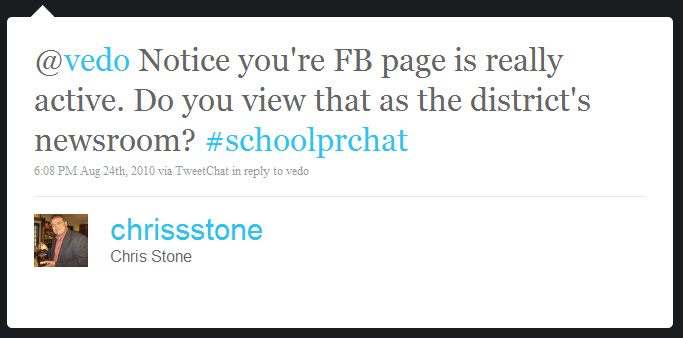
I like to keep track of interesting questions in the hopes that someday I might have an answer or would ask others in the hopes of furthering the dialogue on social media and school public relations.

One such question came from a marketing professional, Chris Stone during the #schoolprchat, (a Twitter chat that is currently on hiatus.)


This is a great question because it forced me to pause and take a critical look about how I was using my school district's Facebook page.

A school district's Facebook page is a prime location for sharing timely, relevant, and interesting content with the community of parents, students, staff and even some random people that have decided to 'Like' the page along the way.

The strategy behind the school district using Facebook could be summed up as fish where the fish are. With so many people on the social utility, it just makes sense for school districts engage their community there.

But Facebook as a school district's newsroom? I think in the traditional sense of the term 'newsroom' perhaps not since it doesn't really provide enough to meet journalists' expectations. From distribution and content expectations of journalists, Facebook doesn't really work.

Ah, but journalists aren't the only people school PR folks are trying to reach. Certainly traditional media should (and will continue to) be a fundamental component for school district communication pros. And we should do everything we can to sharpen our media relations skills and approach.

But don't let that be the only focus.

School districts should already be leveraging Facebook for communication and community outreach. Set your district's Facebook rules of engagement, prepare and gather content from all over the district to share. Post, listen, engage and promote...and repeat.

I know some school districts don't allow you to comment on their Facebook page wall. I don't agree with this broadcast-only practice. The magic is in the feedback. When we post items to Facebook like updates, questions, links, photos, videos, student/staff recognitions, explanations, news, events, etc. it's done with the audience in mind. I use Facebook in my school district to share and engage with the community.

Oh and for the record, I recently tried to pitch a story to a local newspaper reporter only to be told, "yeah, I saw that on Facebook earlier."

Come to think of it, maybe it is the district's newsroom.

Monday, March 7, 2011

5 Tips to keep your School PR job - Tim Caroll, APR

I had the pleasure of spending some time in sessions, catching up with school PR colleagues and friends in addition to presenting at the 2011 Texas School Public Relations Association conference last month. The current Texas public school financial realities seemed to be a common theme of discussions and among a few of the presentations. Folks were concerned just like educators across the state about whether or not personnel reductions will happen in the name of cost-cutting measures.

I caught up with Tim Carroll, APR from the Allen ISD to ask him what he thought are some ways school PR people can help themselves keep their jobs:


5 Tips to keep your school PR job
  1. Contribute in areas that benefit the school district financially or that clearly address goals and objectives. Find the things that are important to the district leadership.
  2. Get a seat on the superintendent's cabinet. You need to be/become a trusted advisor to management.
  3. Become the go to person for strategic communication needs. Go beyond being the camera, press release, newsletter person.
  4. Get out of the office. It's just a good idea to spend time at campuses to see what's going on so you can tell good stories and remind yourself why we do what we do. (It's for the kids.)
  5. Seek additional responsibilities that fit into your skill set. Staff reductions will leave gaps that need to be filled.

In addition to being the Director of Public Information for the Allen ISD, Tim Carroll, APR is the 2011 President of the Texas School Public Relations Association and a 31 year PR veteran. He sums up two of the best reasons I concur for why school communications pros should be a part of professional organizations like TSPRA or the NSPRA; (one) networking with other PR pros and (two) access to shared resources.

What do you think of these tips? What would you add? As always, the comments are yours.

(Photo credit: zawtowers via Flickr Creative Commons)

Thursday, February 24, 2011

Putting Social Media to Work for #SchoolPR - #tspra11

This is my presentation given at the 2011 Texas School Public Relations Association Annual Conference in Arlington, TX.

Thank you to the attendees who came out in the afternoon for this social media 201 session. I wanted to provide some thoughts on how to put social media to work for school PR people and share some tips and tactics that could be taken back to their home districts.