This checklist was first prepared and shared at the 2014 Texas School Public Relations Association conference during the roundtables session.
Showing posts with label Communications. Show all posts
Thursday, February 20, 2014
RPIE for the #schoolPR Pro: Communication Plan Checklist #tspra14
School public relations programs have a much greater chance of success with proactive, strategic planning that incudes measurabIe objectives set forth by research and evaluated. The following is the RPIE for the School PR Pro checklist I created to share with other school public relations pros to guide them through the 4-step process -- Research, Planning, Implementation, and Evaluation.
Saturday, July 20, 2013
In defense of (and clarifying) #schoolPR
Some people really don't get school public relations (or even PR in general). Repeat after me, public relations is greater than media relations. It's even worse when someone has worked in the field and still doesn't get it.
Public has no clue what school PR pros do. "New York Taxpayers Foot the Bill for #SchoolPR Services" http://t.co/gvGrqHgYTQ #edchatThanks to Delaina Biernstein for sharing an article that perpetuates a silly mischaracterization and miscalculation of what is/is not school PR. In the Yahoo! Contributor Network article, "New York Taxpayers Foot the Bill for School Public Relations Services," the writer suggests:
— delainanicole (@delainanicole) June 25, 2013
School public relations specialists are essentially hired to spread the word about the good things being done by students, with the hope that getting the information out into the media will help districts get their budgets passed.
These specialists do photography at student recognition nights at school board meetings, write press releases on the latest district news, and assist with school publications.
They prepare newsletters, flyers, posters, brochures, and articles for district websites. Additionally, school public relations specialists attend major district functions, such as board of education meetings, homecoming, and graduations, to compile stories and photos for dissemination to local media outlets. [emphasis added]
Tactics, tactics, tactics
That brief description above is just a bunch of boring tactics. School PR is more than what this writer purports. I believe school PR pros must approach the position from a strategic communication vision.
The Texas Association of School Boards HR Services Division defines the Communications Officer [school PR] function as one that:
“Manages and directs the dissemination of public information regarding the district. Coordinates the exchange of information with media outlets and the general public. Develops public relations programs and materials to promote a favorable image of the district and its activities.” [2012 Position Detail Report for Communication Officers]
Did you catch that? Coordinates the exchange of information with media outlets and the general public.
To be fair, I'll cut that writer some slack since he claims to have three years of experience working in school public relations. My guess is he likely served in a tactics-driven specialist job and was never given the great professional opportunity to write PR plans using the RPIE process. What he described is the implementation of some tactics that, whether he knows it or not, are from a strategic vision for a district.
It's also worth noting that in New York, as in other states, a school district's operating budget must be approved annually by vote. This no doubt adds an interesting (challenging) dimension for school communicators, but a strategic process is still in play.
Education leaders must keep school PR in and around their vision and strategy discussions if they hope to have any success in program or campaign implementations. The media may well be a key audience, but it's certainly not the only audience to consider.
Posted by
Unknown
at
1:12 PM
Labels:
Communications,
Education,
Media Relations,
NSPRA,
School PR,
TSPRA
Friday, June 8, 2012
Valuing School PR and Summer Timing
Earlier this week the Dallas ISD received some summertime media attention with their incoming superintendent setting the salaries for four chiefs in his cabinet including $185K for a Chief of communications.
I have no interest in debating whether or not this individual should or should not be paid this as a base salary for a school PR job mainly because I don't know the ins and outs of the DISD budget. Nor am I interested in the arguing the newsworthiness of the Dallas Morning News article that raised eyebrows because that education reporter was simply following the template of others: share salary of public official + compare it/share it = shock and disbelief x readers. Textbook.
No, I'm focused on two intriguing aspects of this situation from a school PR perspective:
(1.) An increase in the value of school communication professionals by superintendents and (2.) the timing of summer information releases.
Top-level value of school public relations
The article mentions that the new superintendent, Mike Miles, is bringing the district's communication position into the executive fold.
Summer Timing
The other tactical aspect of this news story should be of interest to school PR pros as well. While the administration of school districts continue all year long, some of the stories for education reporters dwindles in the summer. While this salary brouhaha will cause a bit of bruising in the short-term for DISD, it won't have lasting effects since people move on to other things in their heads pretty quickly. Especially in the summer. If there was going to be a time for an OMG-look-at-what-they-are-paying article to come out, the summer is really the best time for it. Controversial news has a better chance of being managed internally and externally when released over the summer. I recommend information-gathering and using online statements as well as direct communication with the community in addition to working with the media. It's true during the school year and during the summer.
Photo credit: grbenching via Flickr Creative Commons
I have no interest in debating whether or not this individual should or should not be paid this as a base salary for a school PR job mainly because I don't know the ins and outs of the DISD budget. Nor am I interested in the arguing the newsworthiness of the Dallas Morning News article that raised eyebrows because that education reporter was simply following the template of others: share salary of public official + compare it/share it = shock and disbelief x readers. Textbook.
No, I'm focused on two intriguing aspects of this situation from a school PR perspective:
(1.) An increase in the value of school communication professionals by superintendents and (2.) the timing of summer information releases.
Top-level value of school public relations
The article mentions that the new superintendent, Mike Miles, is bringing the district's communication position into the executive fold.
DISD’s top communications position has not been a chief-level job, but Miles said the change was needed because there will be an increased focus on communication.Honestly, I was surprised to read that communications was not previously an executive or cabinet-level position in Dallas ISD. By including his communications person among his chiefs, the new superintendent has shown how much he values strategic communications for his district administration. I sincerely hope DISD has found someone to help bring things along (or turn things around depending on where you sit) for the school communities. School PR should take note of how expectations for internal and external communication can be of value and service to a school district.
“We’re going to do communications differently,” Miles said. “Most people in the community will agree that our communications have to be better.”I do, however, take exception to part of the Dallas Observer's post on the salary from their "Edumication News" section. (Yikes!) and his premise that anyone can do communications because it's a sales job. Joe Tone writes,
There are plenty of areas of public education that require a really specific set of skills. But communications isn't one of them. It's sales, basically, only for almost every customer you have, yours is the only product they've ever heard of.Wrongo. What Joe Tone doesn't realize (or care to understand) is that strategic communications and school public relations does require a specific skill set just like other administrative functions. But that's ok, he's in the media. He can write what he wants. I may need to save that list for a future post.

Summer Timing
The other tactical aspect of this news story should be of interest to school PR pros as well. While the administration of school districts continue all year long, some of the stories for education reporters dwindles in the summer. While this salary brouhaha will cause a bit of bruising in the short-term for DISD, it won't have lasting effects since people move on to other things in their heads pretty quickly. Especially in the summer. If there was going to be a time for an OMG-look-at-what-they-are-paying article to come out, the summer is really the best time for it. Controversial news has a better chance of being managed internally and externally when released over the summer. I recommend information-gathering and using online statements as well as direct communication with the community in addition to working with the media. It's true during the school year and during the summer.
Photo credit: grbenching via Flickr Creative Commons
Tuesday, April 17, 2012
Highlights from Simon Salt's "Conversing with Consumers"
Last week, Simon Salt (@incslinger) spoke at the Greater Ft. Worth Chapter of PRSA April luncheon with his presentation, "Conversing with Consumers." He covered the types of conversations that consumers are already having about your brand, plus how you can join in and more importantly, when it's appropriate. These are the highlights:
The social consumer has a much larger network from which to gather advice/guidance for purchases. The old sales paradigm was relatively simple: your brand has product(s)/service(s) and you exchange those for money. The new sales paradigm includes social capital. Simon explained that the social consumer expects more from the exchange. They want a way to accrue goodwill from a brand and be rewarded for leveraging their network.
You need to know where they are sharing
Salt reaffirmed the reality that social media is not the silver bullet or the center of the universe. Social consumers share IRL (in real life); face-to-face, over the phone, etc. Are they using social media tools? Yes, of course. But bear in mind the influence is still very much a relational activity. Using a grid of opportunity and engagement, Salt touched on mobile and brand property compared to face-to-face and social media for relevant reach.
He gave the stat that 70% of brands fail to respond to negative tweets and that if you'd do that small thing, you'd be outpacing much of the competition. He also is a proponent of leveraging Yelp with the caveat that customers don't know how to rate you. Rating are not the end of the conversation, just the beginning. (I think this could be an area for deep-dive for retailers, restaurants, and other service-industry types.)
You need to know why they share
"There are no wallflowers in social media," stated Salt on using social media to share all of the details of your day. "Your life isn't really that interesting." I think he's right since being an Internet celebrity often seems to be the name of the game for some especially those that go way overboard on the 'personal branding' kick. It goes back to having a motivation to improve social capital. He also said do not dismiss the fact that some people may be paid to bash your brand by other brands. (This concept seemed to shock some attendees.) Look for the sharer's deeper motivation.
On monitoring, Salt listed and touched on a few of his favorites like Google Alerts, Social Mention, Lithium, Viralheat, Radian6 and Visible Technologies. (Personally, I've been using BurrellesLuce Workflow with Engage121 for traditional media and social media monitoring and have kicked the tires on Meltwater.) Bottom-line for PR pros, you need to have ways to listen to the conversation, filter and respond appropriately.
At this point, Simon Salt shared a breakdown of the Conversation Triage likening it to emergency response color-coded tape for dealing with injuries:
RED - Critical; YELLOW - Urgent; GREEN - Non-Urgent; and BLACK - Non-responsive
I was particularly intrigued by this concept and asked him to explain it again after the meeting. Here's his response:
He gave some quick advice on what to do with typical interactions in social media. If you/your brand gets:
--> Content strategy must be a part of the planning. <--
He shared some thoughts on working with influences and fans plus the idea of having brand advocates as defenders. They will defend your brand if you empower them.
Simon Salt closed with the three keys to giving your content greatest opportunity to spread:
---
Attendees can get Simon Salt's slide deck here: incsl.gr/PRSAFW after submitting a name/email for follow-up and e-newsletter sign-up.
Photo credit: fragmented via Flickr Creative Commons
The social consumer has a much larger network from which to gather advice/guidance for purchases. The old sales paradigm was relatively simple: your brand has product(s)/service(s) and you exchange those for money. The new sales paradigm includes social capital. Simon explained that the social consumer expects more from the exchange. They want a way to accrue goodwill from a brand and be rewarded for leveraging their network.
You need to know where they are sharing
Salt reaffirmed the reality that social media is not the silver bullet or the center of the universe. Social consumers share IRL (in real life); face-to-face, over the phone, etc. Are they using social media tools? Yes, of course. But bear in mind the influence is still very much a relational activity. Using a grid of opportunity and engagement, Salt touched on mobile and brand property compared to face-to-face and social media for relevant reach.
He gave the stat that 70% of brands fail to respond to negative tweets and that if you'd do that small thing, you'd be outpacing much of the competition. He also is a proponent of leveraging Yelp with the caveat that customers don't know how to rate you. Rating are not the end of the conversation, just the beginning. (I think this could be an area for deep-dive for retailers, restaurants, and other service-industry types.)
You need to know why they share
"There are no wallflowers in social media," stated Salt on using social media to share all of the details of your day. "Your life isn't really that interesting." I think he's right since being an Internet celebrity often seems to be the name of the game for some especially those that go way overboard on the 'personal branding' kick. It goes back to having a motivation to improve social capital. He also said do not dismiss the fact that some people may be paid to bash your brand by other brands. (This concept seemed to shock some attendees.) Look for the sharer's deeper motivation.
On monitoring, Salt listed and touched on a few of his favorites like Google Alerts, Social Mention, Lithium, Viralheat, Radian6 and Visible Technologies. (Personally, I've been using BurrellesLuce Workflow with Engage121 for traditional media and social media monitoring and have kicked the tires on Meltwater.) Bottom-line for PR pros, you need to have ways to listen to the conversation, filter and respond appropriately.
At this point, Simon Salt shared a breakdown of the Conversation Triage likening it to emergency response color-coded tape for dealing with injuries:
RED - Critical; YELLOW - Urgent; GREEN - Non-Urgent; and BLACK - Non-responsive
I was particularly intrigued by this concept and asked him to explain it again after the meeting. Here's his response:
He gave some quick advice on what to do with typical interactions in social media. If you/your brand gets:
- Praise - Say 'thank you'
- Question - Route it to the appropriate person and respond as necessary
- Complaint - Apologize
--> Content strategy must be a part of the planning. <--
He shared some thoughts on working with influences and fans plus the idea of having brand advocates as defenders. They will defend your brand if you empower them.
Simon Salt closed with the three keys to giving your content greatest opportunity to spread:
- Make it Fun - Humor works. (Self-deprecating humor is best. Don't make fun of your customers.)
- Repeatable
- Shareable
---
Attendees can get Simon Salt's slide deck here: incsl.gr/PRSAFW after submitting a name/email for follow-up and e-newsletter sign-up.
Photo credit: fragmented via Flickr Creative Commons
Friday, April 6, 2012
PR Roles explained through Baseball Positions
In honor of the start of the 2012 MLB season and excitement I have for my favorite team, Texas Rangers, I thought it was time to repost something from a few years back: a list of the roles and functions for public relations pros explained using baseball positions.
- Pitcher (P) - In baseball, the pitcher is the player who throws the baseball from the pitcher's mound toward the catcher to begin each play, with the goal of retiring a batter who attempts to either make contact with it or draw a walk. In PR, the pitching role is one where the professional attempts to garner publicity or attention through effective media relations.
- Catcher (C) - Positioned behind home plate, the catcher can see the whole field; therefore, he is in the best position to direct and lead the other players in a defensive play. In PR, this is the role of strategy. Like a catcher, the PR professional sees the big picture where they understand that actions will lead to specific reactions.
- First baseman (1B) - A first baseman is the player on the team playing defense who fields the area nearest first base. In PR, this is the role of first response. The initial response to problems and/or crisis will make or break the situation.
- Second baseman (2B) - The second baseman often possesses quick hands and feet, the ability to get rid of the ball quickly, and must be able to make the pivot on a double play. In PR, this role is of measured quickness. A public relations professional helps to protect reputation and vital relationships when an organization is under attack.
- Third baseman (3B) - Third base is known as the "hot corner", because the third baseman is relatively close to the batter and most right-handed hitters tend to hit the ball hard in this direction. In PR, this is the role of coordination and quick reactions that comes with experience from having to catch hard line drives or difficult internal communication challenges.
- Shortstop (SS) - Shortstop is often regarded as the most dynamic defensive position in baseball so naturally the PR role is one of adaptability. The one constant is that things change, it is up to the public relations professional to be aware and keep up with the broad and shifting landscape of the PR profession, media, and organizational industry.
- Left fielder (LF) - Outfielders must cover large distances, so speed, instincts, and quickness in reacting to the ball are key. They must be able to learn to judge whether to attempt a difficult catch and risk letting the ball get past them, or to instead allow the ball to fall in order to guarantee a swift play and prevent the advance of runners. In PR, this role can be equated to good judgment. Professionals need to understand when not doing or saying something will provide the best benefit to the organization.
- Center fielder (CF) - The center fielder has the greatest responsibility among the three outfielders for coordinating their play to prevent collisions when converging on a fly ball, and on plays where he does not make the catch, he must position himself behind the corner outfielder in case the ball gets past him. In PR, this role is made up of the credibility a professional must possess in order to be an effective communicator to both internal and external audiences. Just like a center fielder, the PR professional needs excellent situational awareness, vision and depth perception.
- Right fielder (RF) - Of all outfield positions, the right fielder often has the strongest arm, because they are the farthest from third base. However, oftentimes, as in lower-levels of baseball, right field is the least likely to see much action because most hitters are right-handed and tend to pull the ball to the left field and center. In PR, this is the role of monitoring and measurement. Unfortunately, many professionals are not as up to speed in this area (me included) as we should do whatever it takes to learn how to measure. Thankfully, there is a greater push in PR measurement these days, so I consider this is a bright spot for the future of our profession. It requires additional work and research, but it is one of reward, sales, leads and maybe even justification for jobs well done.
- Designated Hitter (DH) - The designated hitter is the official position in the American League to bat in place of the pitcher. In PR, this is the role that the professional understands the usefulness of social media for listening and engaging an organization's community. We are well past the time of whether or not a PR pro needs to know how to use social media tools. They are indispensable tools in the toolbelt. The PR professional needs to fully grasp various aspects and nuances of the social web to reach audiences including, at times, as a way to by-pass the mainstream media.
- Manager - A manager controls matters of team strategy on the field and team leadership. In PR, it's the same thing; strategic coordination of play and tactical movements are integral for successful public relations.
Play Ball!
Photo credit: ESPNDallas
Saturday, February 11, 2012
Let Them Eat RPIE: Communication Planning
What does that have to do with communication? Not much, really. I just thought it was a neat little bit of knowledge worth sharing. Plus, it made me think of pie.
Hungry for RPIE
The communication planning process of RPIE (Research, Planning, Implementation, and Evaluation) has been on my mind a lot lately. Listening to two local PR pros share their insights from their award-winning PR campaigns at the Ft. Worth PRSA luncheon this week, both speakers framed things using RPIE. At work, I have a number of plans for events and campaigns running right now, all using the RPIE template to keep us on track. And most recently, while preparing a presentation on social media issues and best practices for the 2012 TSPRA Conference next week, the RPIE process made yet another appearance.
So I figured it was again time to revisit RPIE and share some themes for the process.
- What do we know?
- What don’t we know?
- Who do we want to reach? What do we know about them? Where do we find them? What do we want them to do?
- It starts with thinking about the people.
- School District Buyer Personas
- What do School Districts Sell?
- Goals
- Measurable Objectives (who, what, by when, by how much)
- Strategies Tactics/Tools
- Notice the tactics/tools are the last thing before implementation
- Execution of the plan or communicating
- Creative
- Materials
- Budget
- Timeline
- Delivery
- Actual messages sent through what channels?
- How many messages reached your targeted audiences?
- What monitoring tools will you use for execution?
- Did you accomplish your objectives? Prove it.
- Identify ways to improve and recommendations for the future.
- Media hits are not measurement.
- Measure effectiveness of the program against objectives.
- Adjust the plan, materials, etc., before going forward.
- Can serve as research for the next phase or program.
- Were you able to get key messages out and heard?
Using the RPIE method (or similar methods) is a solid way to make sure your key messages have the greatest opportunities to reach your target audiences. It's also the foundation to determine what's working, what's not, and how to tell the difference.
Photo credit: mackenziedreadful via Flickr Creative Commons
Sunday, January 8, 2012
The Best Communication Tool: Your Brain
While flipping through my Pulse newsfeed I ran across a headline that required a double-take and click-thru: Coffee Cup Alerts Mount Rainier Campers. I was familiar with the bizarre and tragic story that unfolded last week in Mt. Rainier so I had to see what a coffee cup had to do with things.
On Monday, January 2, four Seattle hikers were enjoying a weekend of winter camping at Mount Rainier National Park when a helicopter buzzed overhead with a mostly incoherent message through a loudspeaker. The campers were unclear as to the pilot's spoken words, so he went to Plan B. He dropped a coffee cup with a warning written in black ink: "A ranger has been shot shooter at large. Call on cell if able to Pierce Co Sheriff."
Communication Win
In addition to things working out in the end for the campers as they made it to safety, I also really like this story from a communication professional's perspective. This is a fantastic reminder that quick-thinking and creative problem-solving are sometimes necessary to get a message across. Those typically faithful effective communication options and channels may fail you when you least expect it. Do whatever it takes to communicate. Be ready for your Plan B.
I think one the comments from the Discovery News post said it best: "This proves (again) that the best tool humans could ever have is brain. With or without technology at hand."
What do you think? As always, the comments are yours.
--------------
Photo credit: NWhikers.net along with more images and a full report from the campers
--------------
(BTW, Pulse is a sweet interactive mobile news aggregator if you're looking for one.)
On Monday, January 2, four Seattle hikers were enjoying a weekend of winter camping at Mount Rainier National Park when a helicopter buzzed overhead with a mostly incoherent message through a loudspeaker. The campers were unclear as to the pilot's spoken words, so he went to Plan B. He dropped a coffee cup with a warning written in black ink: "A ranger has been shot shooter at large. Call on cell if able to Pierce Co Sheriff."
Communication Win
In addition to things working out in the end for the campers as they made it to safety, I also really like this story from a communication professional's perspective. This is a fantastic reminder that quick-thinking and creative problem-solving are sometimes necessary to get a message across. Those typically faithful effective communication options and channels may fail you when you least expect it. Do whatever it takes to communicate. Be ready for your Plan B.
I think one the comments from the Discovery News post said it best: "This proves (again) that the best tool humans could ever have is brain. With or without technology at hand."
What do you think? As always, the comments are yours.
--------------
Photo credit: NWhikers.net along with more images and a full report from the campers
--------------
(BTW, Pulse is a sweet interactive mobile news aggregator if you're looking for one.)
Sunday, January 1, 2012
New Year's Hat Tip For PR Triumphs
There's no escaping the glare of ever-present shine of media, masses, and individuals waiting to pounce on the failures of others. As 2011 came to a close, another round-up of listings of public relations blunders made their yearly trek around the interwebs. (Some examples here, here, here, and here.)
This brief Twitter exchange between Shel Holz and Richard Becker got me thinking about the topic:
Indeed.
So let's take a moment to start 2012 with a hat tip to all of the public relations pros who got it right. Congratulations to all of you professionals who achieved strategic communication victories big and small. Great job on deepening those relationships within your communities. Thumbs up for releasing relevant stories and engaging a variety of communication channels.
PR triumphs happen on a regular basis throughout our industry because they represent business as usual for public relations. Often these wins go largely unnoticed.
And that's a good thing.
If an organization's leadership or clients expect business success and acumen from the PR team, then the credibility of our profession is buoyed. When things go wrong, learn from the mistakes (yours and others) and move on to what's next.
Who's with me?
Photo credit: ooberayhay via Flickr Creative Commons
This brief Twitter exchange between Shel Holz and Richard Becker got me thinking about the topic:
I keep seeing posts on PR blunders of 2011. Has anybody written about PR triumphs of 2011? Surely there have been some.
— Shel Holtz (@shelholtz) December 30, 2011
@shelholtz Many public relations triumphs go unseen, which is why they are triumphs. ;)
— Richard Becker (@RichBecker) December 30, 2011
@richbecker And yet the abundance of blunder-focused posts skews the public perception of PR, don't you think?
— Shel Holtz (@shelholtz) December 30, 2011
Indeed.
So let's take a moment to start 2012 with a hat tip to all of the public relations pros who got it right. Congratulations to all of you professionals who achieved strategic communication victories big and small. Great job on deepening those relationships within your communities. Thumbs up for releasing relevant stories and engaging a variety of communication channels.
PR triumphs happen on a regular basis throughout our industry because they represent business as usual for public relations. Often these wins go largely unnoticed.
And that's a good thing.
If an organization's leadership or clients expect business success and acumen from the PR team, then the credibility of our profession is buoyed. When things go wrong, learn from the mistakes (yours and others) and move on to what's next.
Who's with me?
Photo credit: ooberayhay via Flickr Creative Commons
Wednesday, December 7, 2011
Two Developing Wins for PR
Win No. 1
Last week, the PRSA wrapped up an early collaborative stage of a joint campaign to define the term public relations. I was curious as to the number of submissions for the definition and heard back from Keith Trivitt, PRSA's Associate Director of PR. He responded via Twitter, "927, my friend, for a combined 4,000 lines of data and approx. 16,000 submitted words. We're analyzing the data now."
These are fantastic numbers for the 12-day submission campaign but it's just the beginning. Up next is a process to create the three draft definitions from the PRSA Definition of Public Relations Task Force followed by another round of online responses through a 10-day vote for the top definition on the PRSA website.
Why this is a win: In addition to establishing a concise PR definition, the public relations industry benefits from the ongoing internal discussion about our roles as strategic communicators.
Win No. 2
Businessweek posted an article earlier with some great news for the PR industry, "Public Relations: Coming to a B-School Near You." This is from another solid example of advocacy and research from PRSA's Business Case for Public Relations:
Last week, the PRSA wrapped up an early collaborative stage of a joint campaign to define the term public relations. I was curious as to the number of submissions for the definition and heard back from Keith Trivitt, PRSA's Associate Director of PR. He responded via Twitter, "927, my friend, for a combined 4,000 lines of data and approx. 16,000 submitted words. We're analyzing the data now."
These are fantastic numbers for the 12-day submission campaign but it's just the beginning. Up next is a process to create the three draft definitions from the PRSA Definition of Public Relations Task Force followed by another round of online responses through a 10-day vote for the top definition on the PRSA website.
Why this is a win: In addition to establishing a concise PR definition, the public relations industry benefits from the ongoing internal discussion about our roles as strategic communicators.
Win No. 2
Businessweek posted an article earlier with some great news for the PR industry, "Public Relations: Coming to a B-School Near You." This is from another solid example of advocacy and research from PRSA's Business Case for Public Relations:
"PRSA surveyed 204 American business leaders in the fall of 2011 to ascertain their thoughts on how well MBA candidates understand the strategic business value and tools of public relations. The survey also looked into the role public relations and reputation management play in modern business leadership and whether business leaders felt that MBA programs were effectively teaching these skills."Why this is a win: Having business schools create MBA curricula with serious emphasis on reputation management and strategic communication crystallizes further external understanding and appreciation of and credibility for public relations by business leaders.
Friday, November 4, 2011
Surviving a Pterodactyl Invasion with Social Media
On Halloween Monday the University of North Texas launched an awareness campaign for some official communication channels and procedures in a fun and creative package. The campaign had a simple premise: UNT had been invaded by pterodactyls.
The campaign included a fake press release, safety tips highlighting some campus resources and even a subtitled PSA from the mascot, Scrappy the Eagle.
Alyssa Yancey, a university News Promotion Specialist, pointed out that the project was "designed to show a lighter side of UNT" and encourage students to engage with the university’s Facebook page and Twitter
profile.
(Full Disclosure: I am a proud alumnus of UNT and thought this was pretty cool.)
I sent a few questions to Alyssa to get her take.
What was your inspiration for this project?
The University of North Texas’ Halloween mock-pterodactyl invasion was inspired by the Center for Disease Control’s Zombie Apocalypse preparedness tips from last May.
Why did you choose pterodactyls?
The University of North Texas wanted to choose a topic that would be recognized as a joke and not a serious threat immediately. UNT also wanted something that would resonate with students and alumni. An extinct dinosaur, with a striking resemblance to UNT’s mascot Scrappy the eagle seemed to fit the bill.
What did you hope to achieve through this initiative?
This initiative was designed to increase UNT’s engagement with our Facebook fans and our Twitter followers. We haven’t ever really done anything like this, so we wanted to show our students that we have a personality and a sense of humor.
Was it considered a success?
The invasion was definitely a success. Throughout the day, we engaged with students and others in the Denton community, and had a great time. We encouraged students to submit photos, and they did. Some went on to add to the pterodactyl storyline by submitting historic photos of pterodactyls on campus, and suggesting they know other dinosaurs are plotting a Thanksgiving invasion. Students also joined in on the fun by retweeting the safety tips, release and PSA, sharing information to their Facebook pages and blogging about the invasion.
On Twitter, our retweets, direct mentions and follower counts all showed a strong increase from regular news days. UNT Facebook posts about the invasion, as well as student-contributed content, received numerous likes and positive comments, and the Scrappy YouTube video shot to more than 500 views quickly.
In addition to Alyssa, I reached out to Samra Bufkins, MJ, APR, Strategic Communications Lecturer at UNT's Mayborn School of Journalism for some additional thoughts on the invasion"
I really loved this fun and creative attempt to increase awareness and usage of the university's Facebook and Twitter presences along with some basic campus resource information. This is a great example of an organization demonstrating that they have a personality. Well done.
[Top photo credit: UNT Facebook page submitted photo]
The campaign included a fake press release, safety tips highlighting some campus resources and even a subtitled PSA from the mascot, Scrappy the Eagle.
Alyssa Yancey, a university News Promotion Specialist, pointed out that the project was "designed to show a lighter side of UNT" and encourage students to engage with the university’s Facebook page and Twitter
profile.
(Full Disclosure: I am a proud alumnus of UNT and thought this was pretty cool.)
I sent a few questions to Alyssa to get her take.
What was your inspiration for this project?
The University of North Texas’ Halloween mock-pterodactyl invasion was inspired by the Center for Disease Control’s Zombie Apocalypse preparedness tips from last May.
Why did you choose pterodactyls?
The University of North Texas wanted to choose a topic that would be recognized as a joke and not a serious threat immediately. UNT also wanted something that would resonate with students and alumni. An extinct dinosaur, with a striking resemblance to UNT’s mascot Scrappy the eagle seemed to fit the bill.
What did you hope to achieve through this initiative?
This initiative was designed to increase UNT’s engagement with our Facebook fans and our Twitter followers. We haven’t ever really done anything like this, so we wanted to show our students that we have a personality and a sense of humor.
Was it considered a success?
The invasion was definitely a success. Throughout the day, we engaged with students and others in the Denton community, and had a great time. We encouraged students to submit photos, and they did. Some went on to add to the pterodactyl storyline by submitting historic photos of pterodactyls on campus, and suggesting they know other dinosaurs are plotting a Thanksgiving invasion. Students also joined in on the fun by retweeting the safety tips, release and PSA, sharing information to their Facebook pages and blogging about the invasion.
On Twitter, our retweets, direct mentions and follower counts all showed a strong increase from regular news days. UNT Facebook posts about the invasion, as well as student-contributed content, received numerous likes and positive comments, and the Scrappy YouTube video shot to more than 500 views quickly.
In addition to Alyssa, I reached out to Samra Bufkins, MJ, APR, Strategic Communications Lecturer at UNT's Mayborn School of Journalism for some additional thoughts on the invasion"
"They were hoping for a little more student interaction, but we're finding many students still aren't on twitter or following UNT official accounts. However, I think it's the kind of thing they should try again, maybe at another holiday time. You expect stuff like this at Halloween and April Fool's Day—maybe have some fun around a holiday that's not one for pranks. It was a good, fun, creative outlet and allowed everyone to poke fun at the construction and some other things around here. And at mid-semester, everyone needs a laugh!"---
I really loved this fun and creative attempt to increase awareness and usage of the university's Facebook and Twitter presences along with some basic campus resource information. This is a great example of an organization demonstrating that they have a personality. Well done.
[Top photo credit: UNT Facebook page submitted photo]
Related articles
Thursday, August 11, 2011
How crisis communication theory meets crisis communication reality
Guest post by Brad Domitrovich, PR Zealot
What is a crisis? By definition, it is a crucial or decisive situation, a turning point. For those of us who happen to be in the school PR business, a crisis is better defined as any event that causes us to stop what we are doing and react. From a personal standpoint, I define a crisis as any situation that makes me reach into my medicine cabinet and grab my favorite bottle of headache relief!
Over the past year, I’ve presented crisis communication seminars at several conferences across Texas. In attendance at these workshops were School Board Trustees, Superintendents, District Level Administrators, and Campus Level Administrators. It is always such a breeze lecturing people about what to do in a crisis, especially when there isn’t one going on at that very moment. It sure is easy being “the expert” on stage answering questions about managing the media when there isn’t a line of reporters at my door. Life is so easy when you’re operating in “theory” mode rather than “reality” mode. I’m a big fan of the show Seinfeld. So what happens when, as the character George Costanza states, “worlds collide?” What happens when reality is here and theory takes a back seat?
Every school district has to deal with a crisis from time to time. The ones I have worked for are no exceptions. A couple of months ago, I had a crisis situation pop up. A big one. One of those that you know that within the next twenty-four hours, you are going to be contacted by virtually every media outlet in your market.
Instead of getting myself worked up into frenzy mode, I opted to close my office door, sit in the quiet for a few minutes, and jot down some notes as a plan of action. When I finished penning my last bullet point, I realized that what I was jotting down, was a parroting of what I have been presenting as “theory” throughout the past year.
#1: Be prepared
Although each crisis is different and should be weighed on its own merit, preparation is paramount. What does being prepared mean? Being prepared for me in this case was reviewing information with key individuals. I made sure that I had all the details I needed so I knew what to say. There is no such thing as having too much information when you are preparing for a media blitz. I reviewed timelines, activities, and actions and made sure that all of us knew what to do and what to say during and after the crisis period. Bradley D. Smith, School Board President for Georgetown ISD reiterates this thought. “My advice to administrators would be to completely understand the facts regarding the crisis and then articulate a strong strategy,” he states.
#2: Never say “no comment”
Everyone knows that you should never say no comment. I always try to view the crisis from the eye of the public. Do they want to hear you say “no comment”? Anytime you ignore a crisis situation, it only makes things worse. If we provided no comment, we would have lost our greatest opportunity to control the crisis.
#3: Have one spokesperson
Having one spokesperson who is comfortable in front of reporters is an incredible asset in a crisis situation. One individual should always be designated as the primary spokesperson to make official statements and represent the company. A back-up individual should also be identified in the event the primary person is unavailable. “Have a predetermined spokesperson to handle all the information releases and interviews,” explains Craig Verley, Public Relations Director for Mission Consolidated ISD. “One voice with correct and timely info – frees up other staff to do their jobs in dealing with the emergency situation without media distractions,” he adds.
#4: Media relations is critical
The best time to build a relationship with the media is when you don’t have a major issue in the spotlight. Stay current with reporter names, phone numbers and e-mail addresses. Be proactive. Don’t wait for bad news to begin developing relationships. Mansfield ISD’s Director of Media and Communications Richie Escovedo tells us to “establish positive relationships with the media, community, and advocates before you need them.”
#5: Bleed for a day, not a week
It is always good practice to confront the situation immediately and take charge. If you’re hoping that the radar doesn’t find you because you’re lying low, that just doesn’t work. Embracing the crisis, being prepared, and having a statement ready allows you to get on with business as usual after only one day of controlled chaos.
So those were the five bullet points I jotted down. As I look back, worlds can collide! Managing a crisis can be accomplished as long as you allow “reality” to meet with “theory.”
------
Brad Domitrovich is a “PR Zealot” with over thirty years of experience in the academic, entrepreneurial, and corporate environment. He is Past President of the Texas School Public Relations Association and served for six years on the TSPRA Executive Committee. Brad is invited frequently to speak at conferences sponsored by a number of educational organizations. He has delivered keynotes and presentations for several school districts and Educational Service Centers throughout Texas. Currently, Brad is the Director of School and Community Relations for the Georgetown Independent School District. He can be contacted at Brad@Domitrovich.com or (830) 688-9912.
Thursday, June 2, 2011
8 Takeaways from the DFW Nonprofit Communicators Conference
Last month, I attended and presented at the DFW Nonprofit Communicators Conference here in Ft. Worth.
The sessions that interested me the most were on social media policies/guidelines and crisis communications. (I suppose being in school public relations, I'd gravitate to these two areas of concern since knowledge in these areas is often needed.)
Below are 8 key takeaways from these two sessions:
Legal Policies for Social Media Communicators
presented by Whitney Presley, Sr. Director of Digital Communications, American Heart Association
Crisis Communication:A crash course that leads to developing a crisis plan
presented by Jacqueline Lambiase, Ph.D., Texas Christian University
The sessions that interested me the most were on social media policies/guidelines and crisis communications. (I suppose being in school public relations, I'd gravitate to these two areas of concern since knowledge in these areas is often needed.)
Below are 8 key takeaways from these two sessions:
Legal Policies for Social Media Communicators
presented by Whitney Presley, Sr. Director of Digital Communications, American Heart Association
- There's a difference between social media policies and guidelines: policies protect the organization and employee while guidelines should give the rules for how to behave.
- Create commenting/posting disclaimer for networks and define difference between personal/professional use of social media and social networks for the organization's perspective.
- Check the Social Media Governance website for examples of corporate and nonprofit social media policies or the online Policy Tool for Social Media to get started.
- What makes a good social media guideline/policy for an organization? According to Presley, those that at their core tell employees to be honest, stay on message, and don't be stupid. (I'll add organizations should also look into implementing a social media gatekeeper system to keep the properties within their proper control.)
Crisis Communication:A crash course that leads to developing a crisis plan
presented by Jacqueline Lambiase, Ph.D., Texas Christian University
- In a crisis, you must determine audience awareness: media relations, community relations, employee relations among the top concerns.
- Develop realistic (and reassuring) messages based on audience concerns.
- Establish credibility with fast honesty.
- Get pre-approved for some “boilerplate” messaging, press releases, information bulletins, safety warnings, and apologies. (Example used of airlines with pre-written initial press releases for plane crashes that only require flight number and locations which is a little disturbing even if it is efficient.)
[Check out Jacqueline's presentation slides over on Slideshare for some additional tips, tactics, and thoughts on crisis communication.]
Friday, May 27, 2011
#WordPower for Social Media - DFW Nonprofit Communicators Conference (#dfwnpcc)
Last week I had the pleasure of joining some area and regional professionals as a speaker for the DFW Nonprofit Communicators Conference held at TCU.
Below is the slide deck for those that may have missed something because of the seating fun in the crowded room. (Special thanks to those who came and sat on the floor.)
Nonprofit Marketers and Communicators Collaborative
I really dig the idea and purpose behind this conference: to provide convenient one-day training and support for nonprofit communication professionals through interactive workshops at an affordable cost. (Simple and smart.)
Some of the quality presentation topics this year included:
I'd encourage Dallas/Ft. Worth and area nonprofits to pay attention to this collaborative effort and take advantage of future professional development and networking sessions.
If you attended this conference (and maybe even my session), I'd love to hear what you think.
Below is the slide deck for those that may have missed something because of the seating fun in the crowded room. (Special thanks to those who came and sat on the floor.)
Nonprofit Marketers and Communicators Collaborative
I really dig the idea and purpose behind this conference: to provide convenient one-day training and support for nonprofit communication professionals through interactive workshops at an affordable cost. (Simple and smart.)
Some of the quality presentation topics this year included:
- Communicating your Mission
- Legal Policies for Social Media Communicators (review post coming soon)
- Crisis Communication & Putting the Public First
- Social Media and Advocacy
- Reaching out to Diverse Publics
- Campus Connections for Nonprofits
- Social Innovation and Nonprofits
I'd encourage Dallas/Ft. Worth and area nonprofits to pay attention to this collaborative effort and take advantage of future professional development and networking sessions.
If you attended this conference (and maybe even my session), I'd love to hear what you think.
Thursday, May 12, 2011
James Lukaszewski on Negative Language and PR
The following video interview with James E. Lukaszewski, ABC, APR, Fellow PRSA was taken after a recent area Communications and Public Relations workshop. The day-long professional development opportunity was provided by the Texas School Public Relations Association.
(Note: apologies for the slight shakiness of the video. Lesson-learned: Use a tripod.)
Lukaszewski's workshop focused on three man areas:
Image by hyku via FlickrThis was the second time for me to hear Lukaszewski and he didn't disappoint. Here's the PR gold that was mined from his presentations:
On Victims and Critics during a PR crisis (and other challenging times):
This is just some of the great material Lukaszewski shared along with some fantastic information on strategically advising leadership during a crisis. He gave valuable tactics on providing operational advice and how to provide the next useful thing to management.
As a communications professional, if you ever have the opportunity to hear from Lukaszewski at a conference or other speaking engagement, I would highly recommend carving out some time and sharpen your skills.
(Note: apologies for the slight shakiness of the video. Lesson-learned: Use a tripod.)
Lukaszewski's workshop focused on three man areas:
- Crisis-proofing your organization
- Building Community Relationships
- Being a Strategic Advisor
- We need to change the language we use; Readiness vs. Crisis Management
- Readiness means being ready for adverse things.
- Old-fashioned definition of PR - Do good; take credit
- New definition of PR - Do good and let it speak for itself
- Strategic Communicators need to ask/answer, "What do we contribute to the mix?"
- Candor in a crisis - "If you want to be trusted, get the truth out there."
- Truth = Absence of fear
- In a crisis, communications becomes an operating function
- Crises happen explosively but are resolved incrementally
On Victims and Critics during a PR crisis (and other challenging times):
- Victimization is a totally irrational and voluntary state; it is self-maintaining and self-terminating
- Victims use language like betrayed, loneliness, personal/personnel failure, grief, why me/us, why now, etc.
- Victims require validation, visibility, vindication, and apology (This is part of why our media friends like to talk to the victims)
- The strategy for negotiations need to start with what is possible instead of what organization is not going to do.
- "Create as few critics everyday."
- Keep your base supporters and avoid making new angry people.
- Silence is a toxic strategy
- You must manage the victims dimension
- Don't forget the obvious - Stop the activity that is creating more victims
- The art of crisis management is to know what the mistakes are going to be
- "When there's a crisis that needs management, management is in crisis."
- Take in big picture without taking it personal; go to 50,000 feet and stay at 50,000 feet
This is just some of the great material Lukaszewski shared along with some fantastic information on strategically advising leadership during a crisis. He gave valuable tactics on providing operational advice and how to provide the next useful thing to management.
As a communications professional, if you ever have the opportunity to hear from Lukaszewski at a conference or other speaking engagement, I would highly recommend carving out some time and sharpen your skills.
Thursday, May 5, 2011
Closing a School District's Facebook Page
In an explanatory blog post, we shared the following in part:
"Mansfield ISD will no longer host district or campus-level Facebook pages. The open nature of the Facebook commenting feature continues to cause regular disruption and place the district as a liable participant in issues related to sharing of private student information, defamation of employees and other abusive online behavior. In addition, MISD is not able to commit the administrative or campus staff time necessary to adequately moderate user content posted to these pages."Those of you that know me know that I am huge advocate for integrating social media tools into communication and public relations work flow. Facebook page management was/is among those tools I recommend.
Be careful what you wish for...
With the District page open for community commenting, of course we created and posted the rules of engagement to back up our removal of inappropriate material. We wanted feedback. We got feedback. Not all of it positive. Which was, and is fine. Getting useful feedback from the community on news and information was an objective since it helped us determine if messages were being received. The human element of the social web will always bring out critics and critiques. The problems came when those were aimed at students, parents, community and individual staff members.
So what changed?
In essence the liabilities were outweighing the benefits of the district's Facebook page. We became keenly aware of just how much time it was taking to adequately monitor the page in order to remove postings that were abusive and/or offensive.The page audience grew to a respectable 6,900 fans ('Likes') connected to it. Unfortunately, somewhere along the way it reached a point where detractors (passionate and occasional) decided to use the commenting features to share negative information and feedback about individual students and staff members. There were also instances of bickering and arguing with each other including back and forth between kids and adults that sometimes left the realm of civil and intelligent discourse. I know that is shocking to anyone who has a personal Facebook profile. (sarcasm)
Perhaps there was a magic number of fans or tipping point for the community that marked this shift. It's hard to tell.
Why not just turn off the comments for the page?
In the current Facebook Page editing capabilities, Admins can toggle on/off the Posting Ability to adjust the setting "Users can write or post content on the wall." But, that only stopped new comments going to the wall, not on previous or new posts shared by the Page. That setting simply doesn't seem to exist right now. Admins still have to watch and delete inappropriate replies and ban users if necessary. So it's still a moderation/time issue.
Moving forward
If school PR people want to start/continue to use Facebook pages, I would recommend you make sure you (1.) have a policy that includes a response protocol for negative comments and inappropriate posts and (2.) set aside time, resources and money to listen to and moderate the conversation about your school district. This time resource is a sticky one. We could no longer sustain a level of moderation with the current Facebook Page administration capabilities to meet the growing demand for nearly constant oversight.
Does this mean we are backing away from social media? Hardly. Consider this:
Facebook ≠ Social Strategy
I do not consider adopting any one single social media tool, even the current front-runner, Facebook, as being equal to having a social strategy. The underlying reasons or objectives behind why you use these communication tools and how you evaluate and measure their effectiveness are what ultimately propel an organization's success.
What do you think? Have you run across these commenting management issue on pages you run for your school district or clients? I'm curious to know what others think. As always, the comments are yours.
Related articles
Saturday, April 9, 2011
QR Codes and School PR
The following is a guest post by Lauren Bingham from the Texas School Public Relations Association. It is cross-posted over on the TSPRA Blog:
At the grocery store, a bar code scanner reads the bar code on your product and tells the register what it is and how much it costs. QR Codes use the same concept.
People can now use their cell phone cameras (bar code scanner) to read QR Codes (bar codes), which instantly directs their phone to a designated website, PDF, contact information, video, etc.
Sufficiently confused? Let’s use it in an example scenario. Pretend I’m a PIO at Mainstreet ISD–my district is holding a TRE (tax rate or tax ratification election) and we’re holding a community meeting next week. We’ve built this awesome webpage with all kinds of information and graphs and videos explaining how school finance works and why we need to pass this TRE. But if we just tell them about the website, we risk them forgetting to go there after the meeting, or forgetting the URL altogether.
From the creator’s end
So I take my webpage URL, let’s say it’s www.mainstreetisd.org/news/finance/tre, and go to one of many QR Code generating websites, plug in my URL and it will automatically create a unique QR Code (just like a bar code). That QR Code has my link embedded in it so that anyone who scans it will be automatically directed to our TRE website. I can then print this QR Code on any posters or handouts we distribute at the meeting, I can make a giant display version so that anyone in the audience can scan it from their seats, I can even print it on t-shirts or stickers if I wanted to.
From the user’s end
While there are tools that make this technology available on any phone with a camera, it’s really most usefully for smart phone users. All I need to do is go to the app store on my phone and download a QR Scanner app–there are a bunch out there, not all of which work as well as the next, particularly for BlackBerry which seem to have a difficult time. Then, whenever I see a QR Code I want to scan, I open the QR Scanner app, which will typically activate my phone’s camera, then point the camera at the QR Code until your camera can scan the code–just like you’d do at the grocery store. Depending on the app, it’ll typically identify the file, URL, video, etc. that the QR Code is linked to and will ask you if you want to open it.
So what are some other ways school districts can use QR Codes?
What in the world are QR Codes?
At the grocery store, a bar code scanner reads the bar code on your product and tells the register what it is and how much it costs. QR Codes use the same concept.
People can now use their cell phone cameras (bar code scanner) to read QR Codes (bar codes), which instantly directs their phone to a designated website, PDF, contact information, video, etc.
Sufficiently confused? Let’s use it in an example scenario. Pretend I’m a PIO at Mainstreet ISD–my district is holding a TRE (tax rate or tax ratification election) and we’re holding a community meeting next week. We’ve built this awesome webpage with all kinds of information and graphs and videos explaining how school finance works and why we need to pass this TRE. But if we just tell them about the website, we risk them forgetting to go there after the meeting, or forgetting the URL altogether.
From the creator’s end
So I take my webpage URL, let’s say it’s www.mainstreetisd.org/news/finance/tre, and go to one of many QR Code generating websites, plug in my URL and it will automatically create a unique QR Code (just like a bar code). That QR Code has my link embedded in it so that anyone who scans it will be automatically directed to our TRE website. I can then print this QR Code on any posters or handouts we distribute at the meeting, I can make a giant display version so that anyone in the audience can scan it from their seats, I can even print it on t-shirts or stickers if I wanted to.
You can create a personal account on many of these QR Code generator websites that will allow you to see how many people are scanning your code, change the link (without changing the bar code) that your users are directed to, password protect your code or set it to expire at a certain date.
From the user’s end
While there are tools that make this technology available on any phone with a camera, it’s really most usefully for smart phone users. All I need to do is go to the app store on my phone and download a QR Scanner app–there are a bunch out there, not all of which work as well as the next, particularly for BlackBerry which seem to have a difficult time. Then, whenever I see a QR Code I want to scan, I open the QR Scanner app, which will typically activate my phone’s camera, then point the camera at the QR Code until your camera can scan the code–just like you’d do at the grocery store. Depending on the app, it’ll typically identify the file, URL, video, etc. that the QR Code is linked to and will ask you if you want to open it.
Because there’s linking involved, this does require a wireless connection on your phone, which involves data usage and the fees associated with it. If the code links to a PDF, Word doc, Google map, calendar event, etc., these will likely be saved onto my phone; websites, however, will not be saved unless through the phone’s browser history.
So what are some other ways school districts can use QR Codes?
- Using codes on back to school materials to link to school calendars (some tools will allow users to integrate your calendar into their phone’s calendar) or school supply lists
- Displaying codes at the front of schools that will link to school contact information, TEA ratings, etc.
- Displaying codes at graduation that link to do’s and don’ts, a PDF of the program or information on school-sponsored graduation night activities
- Posting codes in teachers lounges and workrooms with links to internal communication materials
- Collateral materials with codes to your district’s fundraising initiatives–information on branded licenses plates, website that allows them to purchase tickets for your event, online store for school/district merchandise, etc.
- Consider your audience–how many of your parents or community members are using smart phones? What about students?
- While this technology has caught fire in Asia, and is growing in popularity among the techie Westerners, many people may still be unaware of QR Codes and how they work (even if they already have the technology to use them). Before rolling out any coded materials, take the time to educate your constituency.
- The mystery of these codes can, however, create more interest in using them and finding out what they do.
- This technology is free for you to produce and free (besides data usage) for them to scan and use.
- Because your codes will generally redirect users to existing content, this doesn’t require a third-party developer, or drafting usage policies, or monitoring for misuse, or purchasing expensive/complicated hardware or software. This is just a more direct way to get them from point A to point B.
If you’re looking for more inspiration, here’s how others have used QR Codes:
Santa Monica Museum of Art links to mobile site for annual fundraising event
New York Public Library uses codes in promotional scavenger hunt
Some job hunters use codes on resumes to link to portfolio
SXSW uses codes everywhere on everything, linking to maps, e-business cards, Twitter feeds…
Retailers like Macy’s, Best Buy, Home Depot use codes for coupons, product info and demo videos
Santa Monica Museum of Art links to mobile site for annual fundraising event
New York Public Library uses codes in promotional scavenger hunt
Some job hunters use codes on resumes to link to portfolio
SXSW uses codes everywhere on everything, linking to maps, e-business cards, Twitter feeds…
Retailers like Macy’s, Best Buy, Home Depot use codes for coupons, product info and demo videos
Thursday, March 31, 2011
Facebook as a school district's newsroom
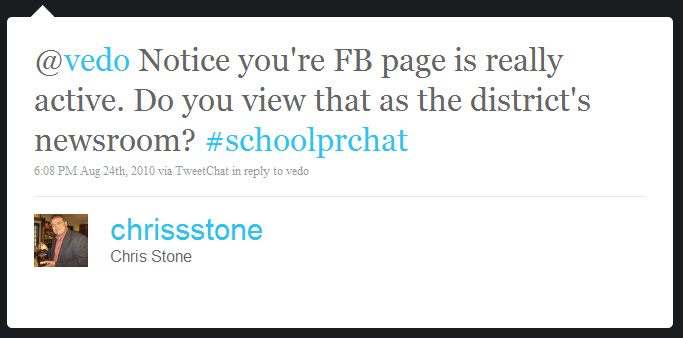
I like to keep track of interesting questions in the hopes that someday I might have an answer or would ask others in the hopes of furthering the dialogue on social media and school public relations.
One such question came from a marketing professional, Chris Stone during the #schoolprchat, (a Twitter chat that is currently on hiatus.)
This is a great question because it forced me to pause and take a critical look about how I was using my school district's Facebook page.
A school district's Facebook page is a prime location for sharing timely, relevant, and interesting content with the community of parents, students, staff and even some random people that have decided to 'Like' the page along the way.
The strategy behind the school district using Facebook could be summed up as fish where the fish are. With so many people on the social utility, it just makes sense for school districts engage their community there.
But Facebook as a school district's newsroom? I think in the traditional sense of the term 'newsroom' perhaps not since it doesn't really provide enough to meet journalists' expectations. From distribution and content expectations of journalists, Facebook doesn't really work.
Ah, but journalists aren't the only people school PR folks are trying to reach. Certainly traditional media should (and will continue to) be a fundamental component for school district communication pros. And we should do everything we can to sharpen our media relations skills and approach.
But don't let that be the only focus.
School districts should already be leveraging Facebook for communication and community outreach. Set your district's Facebook rules of engagement, prepare and gather content from all over the district to share. Post, listen, engage and promote...and repeat.
I know some school districts don't allow you to comment on their Facebook page wall. I don't agree with this broadcast-only practice. The magic is in the feedback. When we post items to Facebook like updates, questions, links, photos, videos, student/staff recognitions, explanations, news, events, etc. it's done with the audience in mind. I use Facebook in my school district to share and engage with the community.
Oh and for the record, I recently tried to pitch a story to a local newspaper reporter only to be told, "yeah, I saw that on Facebook earlier."
Come to think of it, maybe it is the district's newsroom.
One such question came from a marketing professional, Chris Stone during the #schoolprchat, (a Twitter chat that is currently on hiatus.)
This is a great question because it forced me to pause and take a critical look about how I was using my school district's Facebook page.
A school district's Facebook page is a prime location for sharing timely, relevant, and interesting content with the community of parents, students, staff and even some random people that have decided to 'Like' the page along the way.
The strategy behind the school district using Facebook could be summed up as fish where the fish are. With so many people on the social utility, it just makes sense for school districts engage their community there.
But Facebook as a school district's newsroom? I think in the traditional sense of the term 'newsroom' perhaps not since it doesn't really provide enough to meet journalists' expectations. From distribution and content expectations of journalists, Facebook doesn't really work.
Ah, but journalists aren't the only people school PR folks are trying to reach. Certainly traditional media should (and will continue to) be a fundamental component for school district communication pros. And we should do everything we can to sharpen our media relations skills and approach.
But don't let that be the only focus.
School districts should already be leveraging Facebook for communication and community outreach. Set your district's Facebook rules of engagement, prepare and gather content from all over the district to share. Post, listen, engage and promote...and repeat.
I know some school districts don't allow you to comment on their Facebook page wall. I don't agree with this broadcast-only practice. The magic is in the feedback. When we post items to Facebook like updates, questions, links, photos, videos, student/staff recognitions, explanations, news, events, etc. it's done with the audience in mind. I use Facebook in my school district to share and engage with the community.
Oh and for the record, I recently tried to pitch a story to a local newspaper reporter only to be told, "yeah, I saw that on Facebook earlier."
Come to think of it, maybe it is the district's newsroom.
Saturday, March 26, 2011
Commmunication Planning and the Acronym Jumble
RPIE - RACE - REGOSATTBE - WTH?!
Creating communication plans is tough when you're doing it right. I've been using a short acronym to help me remember the steps for some recent PR planning and it made me think that we don't talk about PR planning enough.
It's crucial to put some forethought into your communication efforts. Admittedly, I have made what I believe is the mistake of taking an idea straight to the implementation phase (strategies/tactics) without much planning or analysis.
Sometimes this works. Sometimes it doesn't.
PR Plan Alphabet Soup
So what should you do? I've used RPIE (Research, Planning/Analysis, Implementation/Execution/Communication, Evaluation) for my PR planning taken directly from the Accreditation in Public Relations Study Guide.The outlined four-step process explains each section and gives questions as a guide. For me, it's as much a learning tool as it is a practical tool for public relations professionals.
RPIE
Research - Research is the systematic gathering of information to describe and understand a situation; check assumptions about publics and perceptions, and check the public relations consequences. Research helps define the problem and publics.
Planning/Analysis - Goals, audiences, objectives, strategies and tactics
Implementation - Execution of the plan or Communicating
Evaluation - Measure effectiveness of the program against objectives. Identify ways to improve and recommendations for the future. Adjust the plan, materials, etc., before going forward. This can serve as research for the next phase or program.
Here are a couple of other acronyms that might be useful.
RACE
Research
Action Plan
Communicate
Evaluate
REGOSATTBE
Research
Goals
Objectives
Strategy
Audience
Tactics
Timeline
Budget
Evaluation
Thanks to Mary Deming Barber for the REGOSATTBE acronym. She also shared a planning checklist document a while back that is a great, concise tool. (I love learning from PR people that are smarter than me.)
What about you? Do you use these or a different acronym method for your PR planning? Do you think PR people talk about PR planning enough? The comments are yours.
(Image credit: noeltanner via Flickr Creative Commons)
Creating communication plans is tough when you're doing it right. I've been using a short acronym to help me remember the steps for some recent PR planning and it made me think that we don't talk about PR planning enough.
It's crucial to put some forethought into your communication efforts. Admittedly, I have made what I believe is the mistake of taking an idea straight to the implementation phase (strategies/tactics) without much planning or analysis.
Sometimes this works. Sometimes it doesn't.
PR Plan Alphabet Soup
So what should you do? I've used RPIE (Research, Planning/Analysis, Implementation/Execution/Communication, Evaluation) for my PR planning taken directly from the Accreditation in Public Relations Study Guide.The outlined four-step process explains each section and gives questions as a guide. For me, it's as much a learning tool as it is a practical tool for public relations professionals.
"Public relations programs cannot be successful without proactive, strategic planning that includes measurable objectives, grounded in research and evaluated for return on investment"
- APR Study Guide
RPIE
Research - Research is the systematic gathering of information to describe and understand a situation; check assumptions about publics and perceptions, and check the public relations consequences. Research helps define the problem and publics.
Planning/Analysis - Goals, audiences, objectives, strategies and tactics
Implementation - Execution of the plan or Communicating
Evaluation - Measure effectiveness of the program against objectives. Identify ways to improve and recommendations for the future. Adjust the plan, materials, etc., before going forward. This can serve as research for the next phase or program.
Here are a couple of other acronyms that might be useful.
RACE
Research
Action Plan
Communicate
Evaluate
REGOSATTBE
Research
Goals
Objectives
Strategy
Audience
Tactics
Timeline
Budget
Evaluation
Thanks to Mary Deming Barber for the REGOSATTBE acronym. She also shared a planning checklist document a while back that is a great, concise tool. (I love learning from PR people that are smarter than me.)
What about you? Do you use these or a different acronym method for your PR planning? Do you think PR people talk about PR planning enough? The comments are yours.
(Image credit: noeltanner via Flickr Creative Commons)
Related articles
- Four steps to a stronger PR plan (dontdrinkthekoolaidblog.com)
- Writing a PR Plan: Tools, Tips & Resources to Create an Effective Roadmap (prtini.com)
- Get S.M.A.R.T. When Setting PR Objectives (journalistics.com)
Wednesday, March 9, 2011
35 hand-picked posts for fellow PR pros
| Photo via timrich26 |
These are writings from those who I believe are some thought-leaders in the public relations industry or from those who continually provide rich resources for communication professionals. Many of these could just be cool and I think you should (re)read.
(Also, if you are interested, you can also check out my lists from my 34th and 33rd trip around the sun.)
Let's begin:
- Crisis Planning: Prepare Your Company For Social Media Attacks (Web Strategy)
- The Private Nature of Public Relations (Conversation Agent)
- 5 Things Depeche Mode Can Teach You About Effective Online Marketing (Copyblogger)
- Interactions, Engagement & Ecosystems (Logic + Emotion)
- Where Next for the News Release (PR Breakfast Club)
- The Digitization of Research and Measurement (Metrics Man)
- Katie Delahaye Paine's Accuracy Checklist for Public Relations and Social Media Measurement (The Measurement Standard)
- The Difference Between Making the News and Being the News (Social Butterfly)
- Posterous Grows Up as a Blogging Platform (Danny Brown)
- Planning For Disaster: Communicators And PR Must Step Up (Copywrite, Ink)
- PR pros need to write more like…gasp! Sales copywriters! (Mengel Musings)
- 4 keys to to building a social media editorial calendar (Communications Conversations)
- 57 Social Media Policy Examples and Resources (Dave Fleet)
- 11 must-read posts about blogger outreach (Communications Conversations)
- Social Media Release: Evolution (PR Squared)
- 34 Reasons to Start a Blog (Conversation Agent)
- Don’t Build Your Brand On A Third Party Platform (Social Media Optimization)
- Want to get quoted in the media? Try a video expert advisory (As Media Changes)
- Corporate Altruism: The Blurring of the Lines Between CSR and Cause Marketing (Communication Overtones)
- Is PR Ready to Adopt a Standard Set of Measurement Principles? (The Buzz Bin)
- 5 Tips on Business Blogging With Minimal Resources (TopRank)
- It's Time to Stop Collecting Facebook Fans (Ad Age)
- Content curation: A required skill for digital-era communicators (Shel Holtz)
- Newsroom Facebook Fans: Quality vs. Quantity (Journalistics)
- Klout for Business: A Useful Metric –but an Incomplete View of Your Customer (Web Strategy)
- Putting Words Into Action: PRSA’s New Social Media Policy (PRSAY)
- 96 Free Professional Blog Topics (Geoff Livingston)
- Consumer-Facing PR Means Business (Jason Kintzler)
- ‘My Tweets Are My Own’ is a Bogus Line (Lauren Fernandez)
- 10 Press Release Alternatives (Social Media Today)
- Easy Strategies to Start Measuring Your Public Relations and Social Media (The Measurement Standard)
- Q: What’s a new tool for public relations? A: Quora (PRSA Tactics)
- Building Your Own PR or Social Media Measurement Index (Chuck Hemann)
- Social Media Crisis Management: A No-Nonsense Guide (Mack Collier)
- Becoming a Conscious Written Communicator (Brass Tack Thinking)
Monday, March 7, 2011
5 Tips to keep your School PR job - Tim Caroll, APR
I had the pleasure of spending some time in sessions, catching up with school PR colleagues and friends in addition to presenting at the 2011 Texas School Public Relations Association conference last month. The current Texas public school financial realities seemed to be a common theme of discussions and among a few of the presentations. Folks were concerned just like educators across the state about whether or not personnel reductions will happen in the name of cost-cutting measures.
I caught up with Tim Carroll, APR from the Allen ISD to ask him what he thought are some ways school PR people can help themselves keep their jobs:
5 Tips to keep your school PR job
In addition to being the Director of Public Information for the Allen ISD, Tim Carroll, APR is the 2011 President of the Texas School Public Relations Association and a 31 year PR veteran. He sums up two of the best reasons I concur for why school communications pros should be a part of professional organizations like TSPRA or the NSPRA; (one) networking with other PR pros and (two) access to shared resources.
What do you think of these tips? What would you add? As always, the comments are yours.
(Photo credit: zawtowers via Flickr Creative Commons)
I caught up with Tim Carroll, APR from the Allen ISD to ask him what he thought are some ways school PR people can help themselves keep their jobs:
5 Tips to keep your school PR job
- Contribute in areas that benefit the school district financially or that clearly address goals and objectives. Find the things that are important to the district leadership.
- Get a seat on the superintendent's cabinet. You need to be/become a trusted advisor to management.
- Become the go to person for strategic communication needs. Go beyond being the camera, press release, newsletter person.
- Get out of the office. It's just a good idea to spend time at campuses to see what's going on so you can tell good stories and remind yourself why we do what we do. (It's for the kids.)
- Seek additional responsibilities that fit into your skill set. Staff reductions will leave gaps that need to be filled.
In addition to being the Director of Public Information for the Allen ISD, Tim Carroll, APR is the 2011 President of the Texas School Public Relations Association and a 31 year PR veteran. He sums up two of the best reasons I concur for why school communications pros should be a part of professional organizations like TSPRA or the NSPRA; (one) networking with other PR pros and (two) access to shared resources.
What do you think of these tips? What would you add? As always, the comments are yours.
(Photo credit: zawtowers via Flickr Creative Commons)
Subscribe to:
Posts (Atom)