Showing posts with label Community. Show all posts

Friday, November 16, 2012

PR lessons from 'Kate' and Tarrant Area Food Bank's hunger campaign


The billboard asks a compelling question: What does hunger feel like? JustAskKate.org 

It strikes me that putting a (cartoon) face to hunger with a compelling narrative is a creative way to generate curiosity and hopefully leads to awareness, donations, volunteers, etc. The video component is simple but effective:


I reached out to Andrea Helms, Director of Communications for the Tarrant Area Food Bank and a Ft. Worth PRSA member for some insight into the campaign. I'm so thankful that she was wiling to share since I believe there are some interesting lessons and processes from this effort for PR and communication professionals:

Why did TAFB implement the 'Kate' concept campaign? 
Akron Canton Regional Food Bank in Ohio shared the Kate video concept with the Feeding America network of regional food banks, to which Tarrant Area Food Bank (TAFB) belongs. TAFB decided to customize this video for the organization not only because of the impact of Kate’s message, but to also join in creating a sense of unity across the network.

What are some of the strategic objectives you hope to achieve?
AWARENESS. We would like Kate’s message to be shared all over our community, through our Partner Agencies, donors and volunteers, and the general public. As part of our annual awareness initiative, we hope the community learns that hunger and food insecurity exist right here in our own neighborhood and we, together, can do something about it.

Through various print ads, billboards, and social media, we seek to increase awareness about hunger and direct people to the Kate video. We hope the Kate video and her message goes viral. The more that people share the video with their networks, the bigger the awareness of hunger we can create within our community. The video not only educates the public about the face of hunger--for example, Kate could be your next door neighbor, a co-worker or friend--but it also educates them about Tarrant Area Food Bank’s role in fighting local hunger.

When did it start and how long will the campaign run? 
The campaign started mid-October and will run through December. We will do another flight of the campaign in the Spring of 2013. The Kate video will remain active on our website and on justaskkate.org and through social media when the campaign is not active.

How would you say your version of the campaign differs from the original version?
We are the first Feeding America food bank to launch a traditional marketing campaign around the video. Up until now, the Kate video has been used as a tool in food banks for educating volunteers and donors and has been used through social media and word of mouth.

What communication channels are you using to share Kate? 
Facebook and Twitter posts, Facebook ads, billboards, print ads in the Fort Worth Star-Telegram and Fort Worth Business Press, the Just Ask Kate web page, the TAFB website, YouTube, e-blasts, email signatures, volunteer training and exclusive showings at TAFB related events.

We also have several collateral pieces our staff use for various audiences, such as children’s activities and giveaways, including Kate as a fan with suggestions on the backside for taking action to build awareness about hunger.  Our life-sized Kate cut-out is being used for photo opportunities with key people in our community for posting on social media.

How will you determine the success of this campaign?
Because this is an awareness campaign, we are most interested in how viral the campaign becomes. The more video views, shares and likes we get from the Kate video, the more we know the word is being spread around our community. We have been using Facebook and Google analytics to track where our viewers are coming from and what actions they are taking after they view the video, such as visiting our website or liking our Facebook page.
---
What do you think? Is this a compelling campaign to help generate awareness for the food bank's fight against local hunger? As always, the comments are yours.

Wednesday, September 19, 2012

5 Reasons to Make Your In-house Editorial Calendar

How does your communication department function? Is it stuck in an old mindset of spray and pray (as in spray the press releases out to the media and then pray for coverage) or do you treat the department like your organization's own newsroom where content creation and direct communication with your community are the objectives? I'm an advocate of the latter as part of the department's function for public relations in school districts and nonprofits. An internal editorial calendar is a smart way to help in-house PR departments meet leadership goals and strategic communication objectives all year long.

Keeping an editorial calendar for your communication department allows you to:

  1. Effectively plan around the monthly and yearly occurrences in the organization
  2. Position yourself and department as the go-to source for information
  3. Drop-in plans for special events and target dates
  4. Establish timing for press releases, newsletters, blog posts, video production, etc.
  5. Allows you to get back on track with messaging when things go wrong
That's great but how do you do it? 


Here's how to get started. I'm sure there are other possibly better or more creative ways to make an editorial calendar but here's what I did. I found a simple template in Google Docs (now Google Drive) for a blog Editorial Dashboard. Then I made the appropriate adjustments for a week-by-week calendar for the department to use all year long. 

First, drop in everything for which you have set dates on the calendar. You're looking for those things that happen every year. For a school district, we have many items to quickly drop in such as holidays, board meetings, first and last days of school, high school homecoming dates, graduations, etc. 

Next, add the target or scheduled dates for any special events like any facility ground-breaking events, building dedications, board elections, bond elections (referendums), etc. (Don't forget to include important weekend event dates.)

Once these items are in, it's time to work to include your planned schedule for your recurring communication channels: electronic and/or print newsletters (external and internal if applicable), regular video updates from leadership, blog post schedule, and planned Facebook page posts. This part is an ongoing exercise and and you never really feel finished because things inevitably get shifted and you'll have to make adjustments. The calendar just gives you a guide to bring things back in order. 

We've all had those days (weeks) when things are going wrong or we're in full-blown crisis communication mode and we know in the backs of our minds some things are getting lost in the shuffle. An editorial calendar can serve as your reference tool to get back on track. I've found ours to be a solid source for making sure our timing for important announcements doesn't interfere with something already planned. We've used the calendar to remind leadership of important issues and how they play among established plans, dates, and events.

What do you think? Have you created an editorial calendar for your communication department? Are there any other benefits or tips you can add? As always, the comments are yours.

Tuesday, August 14, 2012

JPS Health Network: A Changing Vision and Communication Lessons


The best way to tour a hospital and check out its fluorescent lighting is from a standing position, not while lying on your back. At least that's what we were told by JPS Health Network President and CEO, Robert Earley.

For the record, he's right.

Robert Earley, 
 JPS Health Network
President and CEO
Recently, the Ft. Worth Chapter of PRSA took its monthly lunch program on the road and got an "unfiltered view tour" [his words] of Tarrant County's public hospital with Mr. Robert Earley. This tour was our chance to hear from this local leader who is using a strategic communication and community outreach campaign to help change hearts and minds about the Tarrant County Hospital District.

"We're in the life and death business," said Earley of the work JPS does for what last year was over 1 million people. "We hope it's more life." 

As the county's public hospital, JPS gets a bit of bad rap. There's a misconception that since it's funded by tax dollars, people tend to think the care would be sub-par and that there's no need to provide additional resources through private funding. To be clear, his pre-tour talk did not come across to me like a fundraising effort. Instead, he just pointed out parallels to other publicly funded institutions getting additional resources from benefactors to programs they support. (cough - college football coaches salaries - cough) Funding challenges are typical for public institutions and there were many of those challenges he inherited.

As for the care, he explains that he wants a cultural shift. They had previously been operating in a realm of mediocrity. "We're not there yet," he said. Earley recognized, "while the care was good, [they] weren't treating people right." So he made some changes and expected more.

He wants JPS to be a place where best-practices in healthcare are created and then followed by others. Earley expects more from his 4,500 employees: "When people walk in the front door, everybody gets respect."

When they hire, he says they take a "360° approach." They want people with the right skill-set and heart.

Robert Earley has Three Rules for the JPS Health Network staff:
  1. Own It. He wants staff to be proud of where they work. When they hear about the good, it's ok to share that they work for JPS. When there are challenges, it's still ok to share that they work for JPS.
  2. Seek Joy. He wants employees to smile. Ideally, he hopes they have reasons to smile throughout the day. Healthcare can make for a stressful environment, providing clear direction and positivity can go a long way.  
  3. Don't Be A Jerk! Earley is on a personal campaign to against "jerkdom." He cites examples in our society where we seem to raise up jerks and jerk-like behavior ahead of being simply good people.
"We are trying to be a transparent organization." Earley is using what I consider to be a smart community relations tactic with on-site tours. One example of this unfiltered view was that we were encouraged to ask any question along the way; anything was fair game. He's proud of JPS being the Level 1 Trauma Center for Tarrant County. We saw operating rooms, including two that stay staffed, stocked, and ready 24-hours a day, seven days a week. Honestly, it's highly impressive.

Here are some additional public relations take-aways from Robert Earley and the JPS tour:

  • The JPS team observe other healthcare systems going through challenges and then they look internally to see if they have the same issue(s).
  • They want to establish a network by which they can communicate directly with stakeholders and not be reliant on traditional media methods.
  • The quality and safety standards as an organization are constantly in need improvement.
  • Training is top-notch: A JPS nurse receive approximately $64,000 in training. (Trauma nurses get double that amount!) The problem they have is talent retention. Nurse get well-trained, work a while then split. Earley said they have about a 20% turnover rate, which is way too high. (I wouldn't be surprised if JPS starts an aggressive campaign to keep their talent.)
  • Earley instituted a chair policy in the hospital. A folding chair hangs behind the door of the hospital rooms and doctors are required to remove the chair and set it next to patients so that they can be at eye-level with them to talk.
  • There are so many electronic and networked aspects of healthcare in general and especially within the hospital, but not much in their communication. Yet.
During the Q&A period, someone asked how do they tell the JPS story. Earley responded with a smile, "we hired J.R. Labbe."

Jill "J.R." Labbe is the former editorial director for the Ft. Worth Star-Telegram. I think this is an intriguing move for JPS and for Labbe. I'm interested to see how she can bring her skills to the other side of the news for storytelling and work from within the organization. She expressed some parting words in the newspaper about her new role:
While my responsibilities as vice president of communications and community affairs at JPS will differ greatly from what I've been doing the past 20 years -- and the irony of going from inflicting pain on government employees to being a government employee is not lost -- my love for this community and the people who call it home will not.
Wise move, JPS.


Robert Earley concluded by letting attendees know that others are welcome. They'd appreciate more people coming to JPS and seeing first-hand what's happening and how things are changing for the better. There's work to be done and it's wonderful to see organizational communications and community relations take starring roles in the process for this organization.

Monday, August 6, 2012

Back to #SchoolPR Tips: First Day Photos

Cute kid photos are like gold for school PR people. As a practice, we get to go around through the school year for events, programs, or any random opportunity to shoot photos in our campuses and school districts. We search for those elusive shots that capture the excitement, interest, and intrigue that can be found in education. A prime opportunity for these photos occurs during back to school.

But what happens when you can't be at all campuses at once? How can you get those first day photos with the bright smiles, carefully chosen threads, the occasional tears from the little ones and their parents, and other such images? Let the community submit these photos. Here's how:


User-Generated First Day Photos

I started our school district's first day photo concept back in 2008. The idea is simple: Put out the call for photo submissions via the communication channel(s) of  your choice website, blog, Twitter, Facebook, etc.

We do with a website posting like this 'Photo Gallery Request - Send us your first day photos' along with the criteria. We ask that users email photos taken during the first few days of school. I use Google applications for a number of other district-related items like the school district's blog, website analytics, and more so naturally I let folks email their photos to the Gmail account for quick access and labeling.  To make things even easier, we only accept .jpg format images.

We also note that by submitting photos, users are agreeing to allow the district to display the images among other submitted photos on the district's online gallery site. Users also agree to allow the district to use the images for other district-related print or electronic publications. 

These photos then get uploaded to a First Day Photos gallery for that year. (See our galleries from 2009, 2010, or 2011 for more samples.) We try not to show names or other easily identifiable images. 


Outcomes

I've been very impressed with some of the quality of images sent in by families. When I started this, I figured we get mostly younger kids. Surprisingly there are typically plenty of middle and high school students submitting photos as well. 

We get all kinds of shots like photos as kids walk out the door in their homes, standing in the driveway, climbing on the bus, walking up the school sidewalks, in the hallways and classrooms. 

In four years, we've posted over 540 photos that were sent in for the annual first day photos galleries. From these photos I've been able to pull images for use on the district's blog and website and in some cases, in print when the quality and resolution have both been high enough. Plus, there's the added bonus of being to get photos from almost every campus if we've done our job of effectively communicating the submission opportunity.

Creating a way for your users to submit photos is such an easy way to engage your families, drive traffic to various communication channels through cross-pollination of content, and mine that school PR gold. 

What do you think? What are some ways you have used back to school time for school public relations? The comments are yours.

Tuesday, February 21, 2012

Solid Crisis Response and Damage Control by TCU

The Brown-Lupton University Union at Texas Chr...
Image via Wikipedia
It's been a week since news broke on the drug arrests of 17 TCU students shocking the university and local Ft. Worth community on Wednesday, February 15. Much has already been written in the wake of the arrests involving the Ft. Worth Police Department and TCU Campus Police and their six-month investigation that included some students.

I think TCU navigated this challenging situation quite well. I was particularly impressed with the openness and use of their digital communication channels very early before the story developed. There are some great tactical lessons here for PR pros who are paying attention. (Disclosure: I am familiar and acquainted with staff members of the communication and media relations team at TCU.)

At 9:24 AM, Wednesday, February 15, the university tweeted the following:
At 9:25 AM, they also posted to their Facebook page:


Both links went to the university's online statement and were shared right before the Chancellor's 9:30 AM press conference. TCU then tweeted a few updates during his statement.

The communication team also provided FAQs and one additional update related to drug testing through their 'Other News' section of Recent News online.

And that pretty much covered things for them since the Ft. Worth Police took things over and explained the investigation and arrests in addition to releasing documentation. By that point, TCU had sustained some bruises, particularly the football team because of some misinformation and corrections. The arrests, while an unfortunate and sad reality for those individuals involved, gave TCU something to point the attention toward to help deflect the media spotlight a bit.

A quick check on Google News search for stories shows the typical spike in news articles and posts  immediately following any major issue and then it tapered off as the recovery phase sets in and the news moved on to other things.
PR Gold
TCU must have learned some valuable transparency lessons and damage control from other high-profile crisis communication issues at other higher ed institutions. Fortunately for them they came forward very early with their information. They shared what I consider a quality statement and response to the investigation and arrests along with details about the process.

Through the university's communication, expectations for students were reinforced along with encouragement for the university community.

Others in public relations have approved of the way TCU initially navigated this issue including Helen Vollmer, president of Edelman Southwest. Vollmer wrote via email on TCU's response:
"...TCU has done a GREAT job in the last couple of days with the drug busts happening. We do a lot of work in education (not for TCU)—Notre Dame, Ohio State, U of H, Princeton, etc. and I laud them highly for their handling of this issue and their great use of social media to convey their 'no nonsense' approach."


Enhanced by Zemanta

Friday, November 4, 2011

Surviving a Pterodactyl Invasion with Social Media

On Halloween Monday the University of North Texas launched an awareness campaign for some official communication channels and procedures in a fun and creative package. The campaign had a simple premise: UNT had been invaded by pterodactyls.

The campaign included a fake press release, safety tips highlighting some campus resources and even a subtitled PSA from the mascot, Scrappy the Eagle.

Alyssa Yancey, a university News Promotion Specialist, pointed out that the project was "designed to show a lighter side of UNT" and encourage students to engage with the university’s Facebook page and Twitter 
profile.

(Full Disclosure: I am a proud alumnus of UNT and thought this was pretty cool.) 

I sent a few questions to Alyssa to get her take.

What was your inspiration for this project?
The University of North Texas’ Halloween mock-pterodactyl invasion was inspired by the Center for Disease Control’s Zombie Apocalypse preparedness tips from last May.

Why did you choose pterodactyls?
The University of North Texas wanted to choose a topic that would be recognized as a joke and not a serious threat immediately. UNT also wanted something that would resonate with students and alumni. An extinct dinosaur, with a striking resemblance to UNT’s mascot Scrappy the eagle seemed to fit the bill.

What did you hope to achieve through this initiative?
This initiative was designed to increase UNT’s engagement with our Facebook fans and our Twitter followers. We haven’t ever really done anything like this, so we wanted to show our students that we have a personality and a sense of humor.

Was it considered a success?
The invasion was definitely a success. Throughout the day, we engaged with students and others in the Denton community, and had a great time. We encouraged students to submit photos, and they did. Some went on to add to the pterodactyl storyline by submitting historic photos of pterodactyls on campus, and suggesting they know other dinosaurs are plotting a Thanksgiving invasion. Students also joined in on the fun by retweeting the safety tips, release and PSA, sharing information to their Facebook pages and blogging about the invasion.

On Twitter, our retweets, direct mentions and follower counts all showed a strong increase from regular news days. UNT Facebook posts about the invasion, as well as student-contributed content, received numerous likes and positive comments, and the Scrappy YouTube video shot to more than 500 views quickly.

In addition to Alyssa, I reached out to Samra Bufkins, MJ, APR, Strategic Communications Lecturer at UNT's Mayborn School of Journalism for some additional thoughts on the invasion"
"They were hoping for a little more student interaction, but we're finding many students still aren't on twitter or following UNT official accounts. However, I think it's the kind of thing they should try again, maybe at another holiday time. You expect stuff like this at Halloween and April Fool's Day—maybe have some fun around a holiday that's not one for pranks. It was a good, fun, creative outlet and allowed everyone to poke fun at the construction and some other things around here. And at mid-semester, everyone needs a laugh!"
---
I really loved this fun and creative attempt to increase awareness and usage of the university's Facebook and Twitter presences along with some basic campus resource information. This is a great example of an organization demonstrating that they have a personality. Well done.

[Top photo credit: UNT Facebook page submitted photo]
Enhanced by Zemanta

Thursday, May 5, 2011

Closing a School District's Facebook Page

Facebook logoImage via WikipediaAfter approximately 20 months of building a (mostly) positive online community, my school district has shut down its Facebook page.

In an explanatory blog post, we shared the following in part:
"Mansfield ISD will no longer host district or campus-level Facebook pages. The open nature of the Facebook commenting feature continues to cause regular disruption and place the district as a liable participant in issues related to sharing of private student information, defamation of employees and other abusive online behavior. In addition, MISD is not able to commit the administrative or campus staff time necessary to adequately moderate user content posted to these pages."
Those of you that know me know that I am huge advocate for integrating social media tools into communication and public relations work flow. Facebook page management was/is among those tools I recommend.

Be careful what you wish for...
With the District page open for community commenting, of course we created and posted the rules of engagement to back up our removal of inappropriate material. We wanted feedback. We got feedback. Not all of it positive. Which was, and is fine. Getting useful feedback from the community on news and information was an objective since it helped us determine if messages were being received. The human element of the social web will always bring out critics and critiques. The problems came when those were aimed at students, parents, community and individual staff members.

So what changed?
In essence the liabilities were outweighing the benefits of the district's Facebook page. We became keenly aware of just how much time it was taking to adequately monitor the page in order to remove postings that were abusive and/or offensive.The page audience grew to a respectable 6,900 fans ('Likes') connected to it. Unfortunately, somewhere along the way it reached a point where detractors (passionate and occasional) decided to use the commenting features to share negative information and feedback about individual students and staff members. There were also instances of bickering and arguing with each other including back and forth between kids and adults that sometimes left the realm of civil and intelligent discourse. I know that is shocking to anyone who has a personal Facebook profile. (sarcasm)

Perhaps there was a magic number of fans or tipping point for the community that marked this shift. It's hard to tell.

Why not just turn off the comments for the page?
In the current Facebook Page editing capabilities, Admins can toggle on/off the Posting Ability to adjust the setting "Users can write or post content on the wall." But, that only stopped new comments going to the wall, not on previous or new posts shared by the Page. That setting simply doesn't seem to exist right now. Admins still have to watch and delete inappropriate replies and ban users if necessary. So it's still a moderation/time issue.

Moving forward
If school PR people want to start/continue to use Facebook pages, I would recommend you make sure you (1.) have a policy that includes a response protocol for negative comments and inappropriate posts and (2.) set aside time, resources and money to listen to and moderate the conversation about your school district. This time resource is a sticky one. We could no longer sustain a level of moderation with the current Facebook Page administration capabilities to meet the growing demand for nearly constant oversight.

Does this mean we are backing away from social media? Hardly. Consider this:
Facebook ≠ Social Strategy

I do not consider adopting any one single social media tool, even the current front-runner, Facebook, as being equal to having a social strategy. The underlying reasons or objectives behind why you use these communication tools and how you evaluate and measure their effectiveness are what ultimately propel an organization's success.

What do you think? Have you run across these commenting management issue on pages you run for your school district or clients? I'm curious to know what others think. As always, the comments are yours.

Related articles
Enhanced by Zemanta

Thursday, March 31, 2011

Facebook as a school district's newsroom

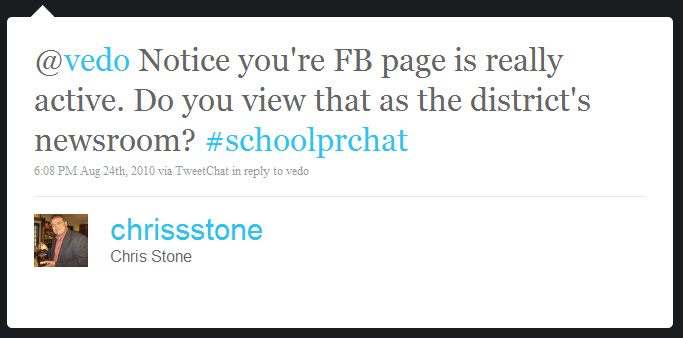
I like to keep track of interesting questions in the hopes that someday I might have an answer or would ask others in the hopes of furthering the dialogue on social media and school public relations.

One such question came from a marketing professional, Chris Stone during the #schoolprchat, (a Twitter chat that is currently on hiatus.)


This is a great question because it forced me to pause and take a critical look about how I was using my school district's Facebook page.

A school district's Facebook page is a prime location for sharing timely, relevant, and interesting content with the community of parents, students, staff and even some random people that have decided to 'Like' the page along the way.

The strategy behind the school district using Facebook could be summed up as fish where the fish are. With so many people on the social utility, it just makes sense for school districts engage their community there.

But Facebook as a school district's newsroom? I think in the traditional sense of the term 'newsroom' perhaps not since it doesn't really provide enough to meet journalists' expectations. From distribution and content expectations of journalists, Facebook doesn't really work.

Ah, but journalists aren't the only people school PR folks are trying to reach. Certainly traditional media should (and will continue to) be a fundamental component for school district communication pros. And we should do everything we can to sharpen our media relations skills and approach.

But don't let that be the only focus.

School districts should already be leveraging Facebook for communication and community outreach. Set your district's Facebook rules of engagement, prepare and gather content from all over the district to share. Post, listen, engage and promote...and repeat.

I know some school districts don't allow you to comment on their Facebook page wall. I don't agree with this broadcast-only practice. The magic is in the feedback. When we post items to Facebook like updates, questions, links, photos, videos, student/staff recognitions, explanations, news, events, etc. it's done with the audience in mind. I use Facebook in my school district to share and engage with the community.

Oh and for the record, I recently tried to pitch a story to a local newspaper reporter only to be told, "yeah, I saw that on Facebook earlier."

Come to think of it, maybe it is the district's newsroom.

Wednesday, March 9, 2011

35 hand-picked posts for fellow PR pros

Photo via timrich26
So here we are again with what has become my annual birthday gift to you, a simple round-up of PR-related and digital communication blog posts, features, resources and tips that I've collected, saved, shared, loved, tweeted, and bookmarked or just found fascinating.


These are writings from those who I believe are some thought-leaders in the public relations industry or from those who continually provide rich resources for communication professionals. Many of these could just be cool and I think you should (re)read.

(Also, if you are interested, you can also check out my lists from my 34th and 33rd trip around the sun.)

Let's begin:
  1. Crisis Planning: Prepare Your Company For Social Media Attacks (Web Strategy)
  2. The Private Nature of Public Relations (Conversation Agent)
  3. 5 Things Depeche Mode Can Teach You About Effective Online Marketing (Copyblogger)
  4. Interactions, Engagement & Ecosystems (Logic + Emotion) 
  5. Where Next for the News Release (PR Breakfast Club)
  6. The Digitization of Research and Measurement (Metrics Man)
  7. Katie Delahaye Paine's Accuracy Checklist for Public Relations and Social Media Measurement (The Measurement Standard) 
  8. The Difference Between Making the News and Being the News (Social Butterfly)
  9. Posterous Grows Up as a Blogging Platform (Danny Brown) 
  10. Planning For Disaster: Communicators And PR Must Step Up (Copywrite, Ink)
  11. PR pros need to write more like…gasp! Sales copywriters! (Mengel Musings) 
  12. 4 keys to to building a social media editorial calendar (Communications Conversations) 
  13. 57 Social Media Policy Examples and Resources (Dave Fleet) 
  14. 11 must-read posts about blogger outreach (Communications Conversations) 
  15. Social Media Release: Evolution (PR Squared) 
  16. 34 Reasons to Start a Blog (Conversation Agent)
  17. Don’t Build Your Brand On A Third Party Platform (Social Media Optimization)
  18. Want to get quoted in the media? Try a video expert advisory (As Media Changes) 
  19. Corporate Altruism: The Blurring of the Lines Between CSR and Cause Marketing (Communication Overtones)
  20. Is PR Ready to Adopt a Standard Set of Measurement Principles? (The Buzz Bin) 
  21. 5 Tips on Business Blogging With Minimal Resources (TopRank)
  22. It's Time to Stop Collecting Facebook Fans (Ad Age)
  23. Content curation: A required skill for digital-era communicators (Shel Holtz)
  24. Newsroom Facebook Fans: Quality vs. Quantity (Journalistics)
  25. Klout for Business: A Useful Metric –but an Incomplete View of Your Customer (Web Strategy)
  26. Putting Words Into Action: PRSA’s New Social Media Policy (PRSAY) 
  27. 96 Free Professional Blog Topics (Geoff Livingston) 
  28. Consumer-Facing PR Means Business (Jason Kintzler)
  29. ‘My Tweets Are My Own’ is a Bogus Line (Lauren Fernandez)
  30. 10 Press Release Alternatives (Social Media Today)
  31. Easy Strategies to Start Measuring Your Public Relations and Social Media (The Measurement Standard)
  32. Q: What’s a new tool for public relations? A: Quora (PRSA Tactics)
  33. Building Your Own PR or Social Media Measurement Index (Chuck Hemann)
  34. Social Media Crisis Management: A No-Nonsense Guide (Mack Collier)
  35. Becoming a Conscious Written Communicator (Brass Tack Thinking)
Whew. That's a lot of reading. Just like in the previous years, there are some source repeats, but I think they are worth it. I hope you take some time and go through this gift of public relations resources or just save it for later. Either way the birthday party is mine but the comments are yours.

Tuesday, February 15, 2011

Social Media 101 for Congregations

This is the presentation I gave at the Fifth Annual Faith Community Leadership Summit provided to the community by Texas Health Resources. I was thrilled to be included as a speaker at this educational outreach event.

Tuesday, October 19, 2010

KDFW Channel-4 Pokes Fun of Social Media

Our local FOX affiliate station, KDFW, took a brilliant tongue-firmly-in-cheek swipe at social media in a fun video that was posted to their Facebook page with the title: Social Media Bit - Lone Star Emmys

This is a fantastic example of allowing yourself (even you media outlets) to have a personality. Let your community know you're human and that at times you don't have to take yourself too seriously. Thanks FOX 4 for the fun reminder. Well done.

Friday, September 24, 2010

Social Media in Government - Schools at manor.govfresh #manorgf

Earlier this week, I ventured south to the small town of Manor, TX. The city, specifically the school district in Manor, was was the unlikely host of manor.govfresh conference. The conference brought together "government and industry innovators to share and learn about emerging, cost-effective technologies for state and local government."

I say unlikely host because at first glance this small city looks like any other. However, looks can be deceiving. Manor's innovative use of technology has been featured by government agencies and media, including the White House, Inc. Magazine, Wall Street Journal, Austin American Statesman, and others according to the conference press room. And the district is on par with technology innovation and student digital literacy instruction.

So what does this have to do with school communications or public relations?

I was asked to participate as a panelist for a session entitled Social Media in Government. Coordinating the panel was Andrew Krzmarzick, the GovLoop Community Manager. And rounding out the panel was Sandra Fernandez, Manager of Public Relations for the Houston Public Library, and Jacqueline Lambiase, Ph.D., public relations professor from TCU.

It was our job to convey strategic and tactical uses of social media in government in hopes of aspiring other local governments to look into ways to partner with each other, their school systems, libraries to better engage citizens and make educated decisions about social media tools.

Below are the slides from my portion of the session on school districts:Schools and Social Media -- Manor GovFresh
---
This was a significant step in a positive direction for open government in Texas and around the country.

Seeing the continued interest and conversations around government 2.0 is something that school district communicators need to be paying attention to and learning as shifts in community expectations lead us to further government transparency.

This shift puts greater emphasis and access to what is happening inside local government. I think this is a good thing.

I also like how Andy put it in a recent tweet about the manor.govfresh conference.
Here's the article by Alex Howard (@digiphile) "Harnessing the Civic Surplus for Open Government."

This is an area worth exploring deeper for school PR. What do you think? What are seeing or hearing in communities in the way of open government? The comments are yours.

Monday, September 13, 2010

Book Review: Putting the Public Back in Public Relations

Photo: Frank Gruber via Flickr Creative Commons
I've been devouring a professional book for a while. I just finished reading Putting the Public Back in Public Relations: How Social Media is Reinventing the Aging Business of PR by Brian Solis and Deirdre Breakenridge.

This book should be required reading for PR students as well as for those PR professionals willing to pursue and learn what's now and what's next in our profession.

After laying the foundation what New PR is, it's value, and what it looks like through relationships, the authors guide readers through some tactical ways to facilitate an organizations' conversations.

Breakenridge and Solis guide the reader beyond the surface-level of social media tools into deeper waters of conversation curation techniques.

Here are some of the more intriguing ideas and passages the struck me to share:
In a section called Don't Fear Change, the authors write
"Social Media is forcing changes that should have happened a long time ago in everything related to business...Whether or not you jump on board, these changes will continue to occur. And, to be honest, not every current PR professional will survive the transition: The fittest and those most willing and able to adapt will be the survivors...The PR professionals of tomorrow should all be engaged in meaningful conversations using the Social and New Media applications that enable forward-moving dialogue. In fact, every department of every business will soon find itself embracing social strategies."
I believe this sums up quite well the current trend in PR. What will be telling is whether or not communication professionals will embrace the conversations with, for, and by people as opposed to focusing just on the tools themselves. To ignore the people making the rants and raves is to ignore some of the very voices that make up a community. As Breakenridge and Solis point out [in a section on Micromedia], "When enough individual voices pool together, the whisper becomes a roar -- transforming micromedia into macro influence."

Later in the book, the authors move into PR 2.0: A Promising Future explaining new roles for professional communicators, the socialization of communication, customer service and breaking news in online communities.
"...[Y]ou must humanize your intent and story, and learn how, where, and why to participate. By doing so, you reset the dynamic for engagement from top-down to one-on-one interaction...it's critical that you understand that PR is no longer rooted in broadcast methodologies and the single-focused, general messages that drive them. PR needs to follow the authoritative dialogue, where it takes place. Without you, who will answer questions, clarify confusion, defend the brand, or develop relationships for the long term?"
The authors weave theoretical with the tactical in such a way that the reader cannot help but learn of useful tools along the way. The section called A New Guide to Metrics alone is almost worth the price of the book itself.

The final section of Convergence puts it all together in a PR 2.0 + PR 1.0 formula with defining new public relations roles, the future of PR, and the conversation prism. I am very hopeful in their vision for the future of the PR profession.
"Next-generation PR professionals will exemplify a hybrid of several critical roles...PR will relearn the art of communications, listening, and interchange, and, in the process, become well versed in not only the new rules of PR, but also the following:
  • Web marketing and analytics
  • Viral marketing
  • Customer service and relationship management
  • Social tools
  • Focus groups and market audits
  • Market analysts"
Deirdre Breakenridge and Brian Solis paint an amazing picture of what could be for the PR profession while providing a roadmap and instructions on how to get there.

Don't ignore this book.

[Note: You can check out a preview of this book on Google books and see for yourself, but I still highly recommend getting your own copy if you get an opportunity.]

Tuesday, August 24, 2010

How you look determines PR success

This post is not about what you look like. It's about how you look...

How do you look at problems, opportunities, celebrations, etc.? How do you view situations and progress for your organization or client?

This is a photo of my son back in July in Yellowstone National Park. And yes, that's Old Faithful in the background. (Cute, huh?)
Public relations professionals have to look at things like our communities see them. We must see what they see. As individuals and as a group. Our views need to include those of our audience in order to have any hope of reaching them. We need to be able to step back and take it all in. A PR person's ability to have that wide-angle lens view of things is one of his/her greatest assets.

We may not always be able to be advocates 100% of the time for stakeholders since our roles require our allegiance to the communication and business objectives of our organizations. However, we do ourselves (and our organizational leadership) a huge disservice if we ignore how things look from the outside. We can doom ourselves to fail by choosing to only concern ourselves with one-way organizational messaging.

How wide of a view do you have? What do you do to gain that crucial perspective?
How do you look?
Enhanced by Zemanta

Friday, August 6, 2010

Blog writing ideas and tips for school districts

Once you've moved passed your initial fears of blogging for your school district, it's time to think about the type of content you wish to provide for the community. Let the goals be your guide for what to write.

You could have an informal, community-centered blog that has a broad approach and covers a wide range of topics, a superintendent (leadership) blog, a news release and announcement blog, department and/or curriculum-related blog, internal blog featuring staff stories, or any combination of these.
(Image: avrdreamer)

Of course, the above is by no means an exhaustive list, rather just some ideas that might help get you going.

When deciding what to write in a school district's blog remember:

  • Write what you know - Blogs are at there best when they are written from the perspective of someone who has relevant knowledge and information to share.
  • Be interesting - A school district community is a collective of individual parents, students, staff, and public. You have to figure out what are the compelling needs and topics to match their interests.
  • Be Honest - This is a big one. If you have access to information AND are authorized to share, you can use these behind-the-scenes topics as relevant posts. The caveat is just like when dealing with the media, you must be honest or you could set yourself up for failure. Dishonesty and failure in a blog can take on a mini-to-major PR storm if you are not careful.
  • Be Yourself - You school district blog can have an informal tone. Use the language that you would use in conversation and avoid the eduspeak as much as possible. Or think of it like author/blogger David Meerman Scott said in a recent keynote speech, "speak to your buyers in their language, not yours."
  • It's a two-way street - Commenting is a must in my opinion. School districts can get the most out of their blogs if they have a commenting system in place for readers. Being able to get feedback is a great listening tool and should not be overlooked. Arik Hanson, sums it up quite well I think:
"...the best part of many blogs isn’t the posts. It’s the comments. Why? Because the comments represent the real discussion board. People with varying viewpoints adding valuable content. Folks starting productive conversation threads that go in a different direction from the original post. And people leaving tips and tools that are beneficial to us all. That’s the real gold of blog posts."

Your school district blog can provide a place where parents, students, staff and the public can read some of the latest news, thoughts, and information from school district leadership and engage in respectful dialogue. It's up to you to cultivate an atmosphere of sharing with the community and develop the strategies the best fit the needs of your school district. What would you add? If you blog for a school district, what issues have come up for you?

Friday, April 30, 2010

Unexpected #HAPPO Help

I opened up my blog for a guest post in the hopes of featuring a college senior about to graduate for the 2nd edition of Help a PR Pro Out (HAPPO). I have been communicating with and invited Kathelin (Kat) Buxton, UTA PRSSA President, to share some insights here on why employers should hire her. However, she sort of turned down the offer and turned things around. What resulted was a wonderful example of PR advocacy:

Kathelin wrote to me and explained why she was turning down my blog feature offer:
I have been fortunate these past few weeks to have been presented with more than a handful of interviews and one or two job offers that I thought it would be better suited to field this blog post opportunity to another PR pro who needs a hand.Below a blog post that Elizabeth Flores wrote, a fellow soon to be graduate and highly underrated individual. She played a pivotal role in the UTA Bateman case study team, and was part of our group that presented at the last PRSSA meeting. She is very dedicated and a hard worker but has not had the opportunity to immerse herself in the world of PR as I have due to other extenuating circumstances and a few too many curve balls thrown her way. I'm sorry if this is not what you had in mind, but what good am I as a PR pro if I can't be an advocate...[emphasis added]

So with that, here is the HAPPO guest post featuring Elizabeth Flores:
Elizabeth E. Flores | @isabella026

Kilma'njaro, captured out the window of our fl...
Mountain climbing might be considered an extreme sport, but it has become my passion over the past few years. More so this past year as I prepare to reach one of the highest mountains tops I have worked hard to conquer. In two weeks, I will have reached my Mt. Kilimanjaro and be the first in a large family to graduate from college. Despite many obstacles that could have prevented the climb, I hurdled the odds and reached the top.

As I try to make my way into the workforce, I know many employers will ask why her? out of the many other promising recent graduates, who might have more experience. There are three rules I came across and embraced to drive myself to success:
  1. Know what to expect and expect the unexpected;
  2. Be Accountable; and
  3. Stay Motivated.
I didn’t have the opportunity to have the best internships to get valuable experience because a full-time school load and job took most of my time. However, by being resourceful I took as many opportunities as I could to get experience through class work, school organizations and professional events.

Success to me is not just about the end result; it is about the journey taken and lessons learned. I can’t and won’t promise perfection, that’s not what I learned in college. What I learned throughout my experience was to work hard for what you want and always strive for the best. What I will bring to the table is a foundation to build real world experiences. My foundation is the core of what will help me contribute to my future employers success. I am proud to say that my foundation consists of integrity, ambition, perseverance, leadership, self-discipline and a competitive and positive perspective. Lastly is determination to always continue my personal and professional development.
---
I appreciate Kat sharing this opportunity to a fellow PR major and I am impressed with the will and determination by Elizabeth. I expect to see good things from these two and others who are applying themselves to our industry.
Reblog this post [with Zemanta]

Wednesday, April 28, 2010

Hungry Hungry #HAPPO: Playing with your PR Future

To recent college grads and graduating seniors:

It's right there in front of you. What is it? Your future. I know, it sounds cliché, but believe it or not, it's real and it's out there. Are you ready?  Are you hungry?

The 1970s-era ad for Hungry Hungry Hippos featured this song:
If you wanna win the game you've gotta take good aim
And get the most marbles with your hippo
Playin' Hungry Hungry Hippos
Hungry Hungry Hippos 
 ...you've gotta take good aim
What are you doing to prepare for your shot at your professional future? If you are seeking an internship or job in the communications and public relations field, I highly encourage you to pay attention to the HAPPO movement.
On Friday, April 30, the second edition of Help A PR Pro Out (HAPPO) will be held fom 12-2 PM EST (11 AM - 1 PM Central).

What's HAPPO? 
HAPPO (Help A PR Pro Out) is designed to help connect PR job seekers with employers looking for top talent. This time we're focusing efforts on college seniors and recent college grads.

* Are you an employer looking to fill a specific role? Contact me or your local champion with details so we can spread your information.

* Are you a blogger?
Would you be interested in helping us build momentum for the event? Donate a post on your blog to highlight a worthy job seeker and tweet it to @helpaprproout.com and use the #HAPPO hashtag.

* Are you a job seeker? Ask a friend who wants to help in your job search to write a HAPPO post for you.

* Are you curious about HAPPO and hungry to get going on your PR future? Check out the blog, Facebook page, search the #HAPPO hashtag, follow @helpaprproout, check out the LinkedIn group, read some of great posts by other HAPPO champions and contributors

...basically, pay attention, use your marbles and put these free resources and collective efforts to work.

(Image credit: Dylan Hartmann)

Tuesday, March 9, 2010

34 Unforgettable Posts for PR People

That's right, I said 34 unforgettable posts. I compiled a round-up list last year as my gift to you on my 33rd birthday and wanted to continue the tradition on my 34th trip around the sun.

These are writings from some of the top thought-leaders in the public relations industry or from those who provide remarkable contributions for communication professionals or are just really pretty cool and I think  you should read. So without further ado, this year's list from oldest to newest:
  1. Micro Interactions in PR (Conversation Agent)
  2. Personal Branding: Be careful what you wish for (The Harte of Marketing)
  3. Why You Shouldn’t Trust Social Media To An SEO Consultant (Social Media Explorer)
  4. 7 Things I Learned Online that I Use at Work (Conversation Agent)
  5. Being a Director of Community (Altitude Branding)
  6. Hashtags: Coming to a conference near you (Media Bullseye)
  7. Moving from Siloes to Hives (The Buzz Bin)
  8. Public Relations Roles explained through Baseball Positions (Next Communications)
  9. Social Media ain't about one-night stands, it's about relationships (The Viral Garden)
  10. Social Media in the Nonprofit Workplace: Does Your Organization Need A Social Media Policy? (Beth's Blog)
  11. Could It Be? Is PR Becoming Unnecessary? (The Bad Pitch Blog)
  12. Are corporate communicators hopeless in social media? (Mengel Musings)
  13. Public Relations Activities That Affect SEO (Online Marketing Blog)
  14. Five reasons why your company blog sucks (The Viral Garden)
  15. Journalism 2.0: Don't Throw Out the Baby (Read Write Web)
  16. Communication silos don’t work (The Harte of Marketing)
  17. A 12 Step Program to End PR Fail (The Lost Jacket)
  18. Beware the PR Prophets (Communication Catalyst)
  19. The last PR stand (Fort Worth PRSA)
  20. Your Press Release has a Long Tail in New Media (Conversation Agent)
  21. Public Relations Pros Must Be Social Media Ready (Social Media Explorer)
  22. Who Owns the Social Media Play: Marketing, PR or Advertising? (Communication Overtones)
  23. Building Community for Your Employees (Deirdre Breakenridge)
  24. 9 simple words to live by in the digital age (Communications Conversations)
  25. Bad Apples in PR (PR Squared)
  26. How Are You Measuring Your Community? (Outspoken Media)
  27. Relationship Chaining: Building and Activating a Community (Communication Overtones)
  28. Proof the Splinternet is real (Groundswell)
  29. When Clients Want Coverage in your Blog: Social Media Ethical Dilemmas (PR Squared)
  30. ROI: How to Measure Return on Investment in Social Media (Brian Solis)
  31. Facebook Friday: 5 Essential Elements to Your Facebook Page Guidelines (Fresh Influence)
  32. Captain Planet Style: Powers Combined in PR/Marketing (LAF)
  33. What does tomorrow’s PR pro look like? (Communications Conversations)
  34. Take the next step: Meet in Real Life (PR Breakfast Club)
Wow! That took longer than I thought it would. Just like last year, there are some source repeats, but I still read some of the same great content creators. I hope you take some time and go through this gift of resources or save it for later. As always, the (comment) party is yours.

(Photo credit: young and with it)

    Friday, March 5, 2010

    Social Networking For Texas School Districts Presentation Slides

    In case any of you have been wondering why my postings have been sporadic lately, here's the story: I have had the pleasure lately of presenting thoughts, research, and tips on communication and public relations in an education setting to a few groups.

    Last week was a presentation during the Texas School Public Relations Association (TSPRA) 2010 conference. This week I was invited to speak on social media tools during the TCU Schieffer School of Journalism's Social Media Week. Additionally, I had the rather unique experience as the speaker for the Texas Association of  School Board's CommLINK webinar. (More on the webinar experience in a later post.)

    As promised to yesterday's webinar attendees, here are the presentation slides:
    As stated during the presentation, there are many other social networking opportunities through groups and specific communities through tools such as Ning and even wikis that are worth exploring by school districts. I primarily stuck with Facebook for the discussion yesterday.

    If you took part in this webinar and have any questions, please feel free to leave them here via comments or contact me.

    Related Bonus: Feel free to use any or all of the suggestions in the Facebook Fan Page Rules for a School District.

    I will attempt to get back to some regular blogging soon. As always, the comments are yours.
    Reblog this post [with Zemanta]

    Tuesday, February 23, 2010

    Media Shmedia: Be your own Newsroom (from #TSPRA2010)

    As promised to the attendees of my session at the Texas School Public Relations Association (TSPRA) 2010 Conference, here are the slides and links:

    Additional Links and Resources
    http://www.stateofthemedia.org/2009/index.htm
    http://www.journalism.org/analysis_report/how_news_happens
    http://nextcommunications.blogspot.com/2009/08/school-districts-sell-trust.html
    http://mashable.com/2010/02/11/social-objects/
    http://blogs.forrester.com/marketing/2009/12/defining-earned-owned-and-paid-media.html
    http://www.conversationagent.com/2010/02/trust-in-media-down-good-news-for-experts.html
    http://www.pr-squared.com/index.php/2010/02/trail-of-breadcrumbs
    http://www.pr-squared.com/2008/04/social_media_release_template.html
    http://www.conversationagent.com/2009/08/creating-the-desire-for-news.html
    http://wiki.kenburbary.com/social-meda-monitoring-wiki
    http://www.slideshare.net/bnixon/public-relations-during-times-of-crisis-presentation
    http://nextcommunications.blogspot.com/2009/10/facebook-fan-page-rules-for-school.html
    http://prsarahevans.com/2010/01/how-to-set-up-a-free-online-monitoring-system/
    http://www.briansolis.com/2008/11/reinventing-crisis-communications-for/
    http://delicious.com/rescovedo/online-pressrooms

    Monitoring (Listening):

    Perspctv http://www.perspctv.com/
    IceRocket http://www.icerocket.com/
    Twitter Search http://search.twitter.com/
    Google Alerts http://www.google.com/alerts
    Backtype http://www.backtype.com/connect
    Much more (free and paid) http://wiki.kenburbary.com/social-meda-monitoring-wiki

    If you attended this TSPRA session, I would love to know what you think. The comments are yours.