Showing posts with label Facebook. Show all posts

Thursday, September 12, 2013

Ft. Worth @StarTelegram requires Facebook for comments; good for discourse, bad for trolls

In a move that I hope will send some of those online trolls to cower under their bridges away from the light, the Ft. Worth Star-Telegram announced this week that they will now require users to log in to Facebook to use their commenting system.

In his announcement, S-T executive editor, Jim Witt explained that the reason was pretty simple: "Facebook requires account holders to use their names, and we believe that anyone who wants to contribute to our public forums should put their name on it."

He then went on to bolster the argument for signed (in) online comments because of the difference in discourse between those that were anonymous vs those that come in with real names attached.

"In signed letters for our print editions, writers make their points using reasoned and usually reasonable arguments. But online, comment threads too often devolve into a cesspool of name-calling. On some stories, we are forced to turn off the commenting feature because the language becomes too offensive. 
"In talking to readers, I’ve found that many have been discouraged from commenting because they are turned off by the nastiness."
I believe this is a smart move for my local paper and one that hopefully will raise the intelligence quotient a bit on stories that matter to communities across DFW covered in the paper. It seems to me the S-T recognizes that for at least the near future, Facebook doesn't appear to be going anywhere. And other media outlets use it as their commenting system of choice for some of the very same reasons as outlined in the S_t announcement.  
Why is this important for PR? Since a function of PR includes media relations, it's part of our job to know how the stories are getting developed, sourced and told. We should also know to whom we connect a journalist in order to provide the trusted source they need. (Hint: it's often not the PR person.) We've seen that a growing number of journalists are finding and using sources from social channels.

"...51 per cent of journalists worldwide say they use microblogs (e.g. Twitter, Facebook and Weibo) to gather new stories – provided the source behind those accounts is known and trusted by them (2012 figure, 54 per cent). As was the case in 2012, reliance on these sources falls dramatically when the sources are not known to the journalist: 25 per cent say they source stories in this way." [Oriella PR Network Global Digital Journalism Study 2013]
The study also indicates that in certain respects, a journalist's success on stories now tends to be measured in the number of unique visits, number of views, increase in social followers, likes/tweets on articles, and number of online comments along with advertising revenue and exclusive features.

I hope our journalist friends over at the Star-Telegram will take this shift to Facebook commenting as an opportunity to engage in what could be ongoing dialogue on the important issues in the community. It is not out of the realm of possibility to have a trusted source from within the organization chime in through article comments (if it's in the best interest of the organization s/he is representing) to provide clarifications, corrections, or contextual additions. This might give pause to some especially for those who don't like to mix work life with home/community life. I believe we've reached the point that our online professional and personal selves are blends now and we should treat online communication as such.

TL;DR
The Ft. Worth Star-Telegram now requires Facebook for article comments. It's a good thing and online trolls beware.


Photo credit: Doug Wildman via Flickr Creative Commons

Friday, June 1, 2012

Getting the best PR outcome from a student protest

Oh what a difference a year makes. One year ago my school district had a lively (and ultimately positive) PR issue at end to the school year: a high school student protest at the administration building.

From our official statement:
On Friday, June 3, approximately 100 students from Timberview High School held a peaceful demonstration at the Mansfield ISD administration building voicing their concerns over the decision to transfer a staff member from their campus to another school within the District.

The Timberview staff member received notice of an administrative transfer to a middle school in MISD as a teacher and coach starting in the 2011-12 school year. To date, this individual is one of 75 Mansfield ISD employees who received such administrative transfers in our continuing efforts to save jobs in the District. (While other districts were cutting staff and eliminating positions, the Mansfield ISD administration and board committed to avoid personnel and student program cuts during the state of Texas' education budget uncertainty.)

The important thing to note is that in this situation is we were not surprised by the demonstration. The students tipped their hand through word of mouth and social media. The rumor-mill revved up during the last week of school about the students being upset that one of the teachers was being moved/fired/replaced/sent away/etc. (You know, the way the rumor-mill works, they only had a portion of the truth.)

Thankfully, I got wind of it pretty early because we aggressively monitor traditional media and social media for mentions, problems, topics related to the District and campuses. It wasn't long before the students took to Twitter and Facebook to rally support and organize the demonstration. Using Twitter search and a Boolean search string with hastags, campus name, the teacher's name and the 'OR' operator, I had a pretty good handle (and free look) into the conversation on that channel. The students also set up a Facebook Page to save the coach and pretty much left it wide open for anyone to see. This was good because we could observe as well.

When the conversation moved to an actual organized protest for the last day of school, we were not taken by surprise and were able to anticipate their movements. Originally, they wanted to demonstrate at the high school, which was a bad idea because in addition to it being the last day of school it was also a finals day. Naturally, the concern here was a disruption in the academic process particularly for those students not involved or interested in this particular demonstration. But things changed.

What happened next? Since we were monitoring the conversation, we followed the news that the students decided against rallying at the high school and instead were going to gather and demonstrate at the District administration building. Great. Again, this was the last day of school but this was a better situation for us since we could contain things away from students taking finals.

As luck would have it, that same morning I was finishing up with an interview at another campus about a great story of teen from the district who had published her first novel when I got the first call from a local radio station about the high school student demonstration.

The radio station told me they had heard there were "300 students gathered at the stadium" to protest. Since we had anticipated the students' moves and had confirmation from District police, I was able to give her the actual numbers (approximately 50 kids at the time) and an updated location of our administrative complex. I told her to have the reporter meet me in the parking lot and we'd go from there.

And thus started the media relations side to this story.

As members of the local media began to arrive and get their b-roll of the students marching then coming over to get some interviews I took an opportunity to show a little strategic support for the students. I had our student nutrition department deliver cases of bottled water so we could distribute among the students during what was quickly becoming a hot Texas day. Ideally, I wanted the media footage to include us passing out the water. Yes, this was done on purpose from a strategic viewing benefit as well as simply being a case of us still being responsible for the students during a school day.

The media interviews went fine. Most of the articles and stories that aired were balanced and we were able to share the key messages that this was all a part of our District's job-saving measures during a time of state education budget cuts. In general, I still consider this a positive experience also because the students did a good job of staying focused and took the demonstration seriously instead of using it to act unruly, disrespectful, or cause problems for traffic or the general community. These were good kids, they didn't have a perspective beyond what they thought they knew. It was actually refreshing to observe an organized student protest for something they believe in even though we had to deal with the media fall-out from it and took a bit of a short-term bruising.

I've used this case study a few times over the past year, but figured it was time to put it down in a post so hopefully other school PR pros or administrators can benefit from some of the steps we took. Simply put, school districts must monitor the online conversations and when topics or issues arise, be ready to take action. Traditional media and social media monitoring are must-haves in a school PR pro's arsenal from an early-warning device to a part of the measurement practices.

I'll leave you with one of the local media stories on the protest:

Saturday, December 10, 2011

Lesson from pub owner's Facebook rant

Opening Day at Zio Carlo!
Image by Diorama Sky via Flickr
Ft. Worth pub owner, Carlo Galotto, isn't making running his new business easy on himself. Galotto operates Zio Carlo Magnolia Brew Pub which opened earlier this fall after some apparent setbacks. Unfortunately for Galotto, the setbacks continue this time at his own hands.

Apparently, the owner had imbibed heavily when he took to his pub's business Facebook page for a single-line rant: (via DFW.com)
On Monday afternoon, a controversy exploded online, when the recently opened Zio Carlo Magnolia Brew Pub posted what seemed like a bitter indictment of President Obama and his followers on its Facebook page: “I would prefer not have spoiled Obama kids around me.”
Although the specific author of the posting is not clear, a later comment from Zio Carlo in the same thread that reads “I was born in Italy” suggests it was written by Zio Carlo owner Carlo Galotto.
The post was subsequently removed, but this screen shot – taken by one angry patron who claimed he would never return to the place – illustrates the instantaneous blowback Zio Carlo received. The vast majority of the nearly hundred 100 comments were negative.
Oops.

Fortunately for Galotto, a local public relations pro, Beth Hutson of Hutson Creative Group in Ft. Worth, offered some pro bono damage control and reputation repair. Hutson assisted with the owner's apology and subsequent free pizza slice and happy hour on Saturday.


I hope this works for Carlo Galotto and his fledgling business. Was getting drunk and dropping f-bombs in the comments on his Facebook business page stupid? Absolutely. But accepting PR counsel and acquiescing to a decent mea culpa after the screw up is actually a pretty smart business move. Most likely this episode has caused enough of a stir in the area that folks will come out in support or even just out of curiosity. When they do, Zio Carlo's food and drinks needs to do the talking. The pizza and beer better live up to the hype. That's the best way for Galotto to get back on message.
Enhanced by Zemanta

Friday, November 4, 2011

Surviving a Pterodactyl Invasion with Social Media

On Halloween Monday the University of North Texas launched an awareness campaign for some official communication channels and procedures in a fun and creative package. The campaign had a simple premise: UNT had been invaded by pterodactyls.

The campaign included a fake press release, safety tips highlighting some campus resources and even a subtitled PSA from the mascot, Scrappy the Eagle.

Alyssa Yancey, a university News Promotion Specialist, pointed out that the project was "designed to show a lighter side of UNT" and encourage students to engage with the university’s Facebook page and Twitter 
profile.

(Full Disclosure: I am a proud alumnus of UNT and thought this was pretty cool.) 

I sent a few questions to Alyssa to get her take.

What was your inspiration for this project?
The University of North Texas’ Halloween mock-pterodactyl invasion was inspired by the Center for Disease Control’s Zombie Apocalypse preparedness tips from last May.

Why did you choose pterodactyls?
The University of North Texas wanted to choose a topic that would be recognized as a joke and not a serious threat immediately. UNT also wanted something that would resonate with students and alumni. An extinct dinosaur, with a striking resemblance to UNT’s mascot Scrappy the eagle seemed to fit the bill.

What did you hope to achieve through this initiative?
This initiative was designed to increase UNT’s engagement with our Facebook fans and our Twitter followers. We haven’t ever really done anything like this, so we wanted to show our students that we have a personality and a sense of humor.

Was it considered a success?
The invasion was definitely a success. Throughout the day, we engaged with students and others in the Denton community, and had a great time. We encouraged students to submit photos, and they did. Some went on to add to the pterodactyl storyline by submitting historic photos of pterodactyls on campus, and suggesting they know other dinosaurs are plotting a Thanksgiving invasion. Students also joined in on the fun by retweeting the safety tips, release and PSA, sharing information to their Facebook pages and blogging about the invasion.

On Twitter, our retweets, direct mentions and follower counts all showed a strong increase from regular news days. UNT Facebook posts about the invasion, as well as student-contributed content, received numerous likes and positive comments, and the Scrappy YouTube video shot to more than 500 views quickly.

In addition to Alyssa, I reached out to Samra Bufkins, MJ, APR, Strategic Communications Lecturer at UNT's Mayborn School of Journalism for some additional thoughts on the invasion"
"They were hoping for a little more student interaction, but we're finding many students still aren't on twitter or following UNT official accounts. However, I think it's the kind of thing they should try again, maybe at another holiday time. You expect stuff like this at Halloween and April Fool's Day—maybe have some fun around a holiday that's not one for pranks. It was a good, fun, creative outlet and allowed everyone to poke fun at the construction and some other things around here. And at mid-semester, everyone needs a laugh!"
---
I really loved this fun and creative attempt to increase awareness and usage of the university's Facebook and Twitter presences along with some basic campus resource information. This is a great example of an organization demonstrating that they have a personality. Well done.

[Top photo credit: UNT Facebook page submitted photo]
Enhanced by Zemanta

Saturday, August 27, 2011

Missouri judge makes good call on "Facebook bill"

Courthouse of Cole County, MissouriImage via WikipediaCole County (Mo.) Circuit Judge Jon Beetem issued a preliminary injunction on Friday against a law designed to prohibit teachers from having private online conversations with students declaring that it “would have a chilling effect” on free speech.

The law reads in pertinent part, "No teacher shall establish, maintain, or use non-work-related internet site which allows exclusive access with a current or former student."

Judge Beetem writes in the preliminary injunction, "Even if a complete ban on certain forms of communication between certain individuals could be construed as content neutral and only a reasonable restriction on 'time, place, and manner,' the breadth of the prohibition is staggering...The Court finds that the statute would have a chilling effect on speech."

Soon after the injunction, Missouri Governor Jay Nixon announced that he will ask the General Assembly to repeal the social media provisions in the controversial law.

Good call.

This clumsy state-wide provision was sitting there waiting to be challenged and (hopefully) overturned. I have no issue with the intent of wanting to curtail inappropriate contact between students and teachers using social media. It just seems these provisions were doomed from the beginning from a free speech perspective and from an enforcement standpoint. It will be interesting to see what comes next or if other states watch the Missouri outcome and tailor similar bans.
Enhanced by Zemanta

Thursday, May 5, 2011

Closing a School District's Facebook Page

Facebook logoImage via WikipediaAfter approximately 20 months of building a (mostly) positive online community, my school district has shut down its Facebook page.

In an explanatory blog post, we shared the following in part:
"Mansfield ISD will no longer host district or campus-level Facebook pages. The open nature of the Facebook commenting feature continues to cause regular disruption and place the district as a liable participant in issues related to sharing of private student information, defamation of employees and other abusive online behavior. In addition, MISD is not able to commit the administrative or campus staff time necessary to adequately moderate user content posted to these pages."
Those of you that know me know that I am huge advocate for integrating social media tools into communication and public relations work flow. Facebook page management was/is among those tools I recommend.

Be careful what you wish for...
With the District page open for community commenting, of course we created and posted the rules of engagement to back up our removal of inappropriate material. We wanted feedback. We got feedback. Not all of it positive. Which was, and is fine. Getting useful feedback from the community on news and information was an objective since it helped us determine if messages were being received. The human element of the social web will always bring out critics and critiques. The problems came when those were aimed at students, parents, community and individual staff members.

So what changed?
In essence the liabilities were outweighing the benefits of the district's Facebook page. We became keenly aware of just how much time it was taking to adequately monitor the page in order to remove postings that were abusive and/or offensive.The page audience grew to a respectable 6,900 fans ('Likes') connected to it. Unfortunately, somewhere along the way it reached a point where detractors (passionate and occasional) decided to use the commenting features to share negative information and feedback about individual students and staff members. There were also instances of bickering and arguing with each other including back and forth between kids and adults that sometimes left the realm of civil and intelligent discourse. I know that is shocking to anyone who has a personal Facebook profile. (sarcasm)

Perhaps there was a magic number of fans or tipping point for the community that marked this shift. It's hard to tell.

Why not just turn off the comments for the page?
In the current Facebook Page editing capabilities, Admins can toggle on/off the Posting Ability to adjust the setting "Users can write or post content on the wall." But, that only stopped new comments going to the wall, not on previous or new posts shared by the Page. That setting simply doesn't seem to exist right now. Admins still have to watch and delete inappropriate replies and ban users if necessary. So it's still a moderation/time issue.

Moving forward
If school PR people want to start/continue to use Facebook pages, I would recommend you make sure you (1.) have a policy that includes a response protocol for negative comments and inappropriate posts and (2.) set aside time, resources and money to listen to and moderate the conversation about your school district. This time resource is a sticky one. We could no longer sustain a level of moderation with the current Facebook Page administration capabilities to meet the growing demand for nearly constant oversight.

Does this mean we are backing away from social media? Hardly. Consider this:
Facebook ≠ Social Strategy

I do not consider adopting any one single social media tool, even the current front-runner, Facebook, as being equal to having a social strategy. The underlying reasons or objectives behind why you use these communication tools and how you evaluate and measure their effectiveness are what ultimately propel an organization's success.

What do you think? Have you run across these commenting management issue on pages you run for your school district or clients? I'm curious to know what others think. As always, the comments are yours.

Related articles
Enhanced by Zemanta

Thursday, March 31, 2011

Facebook as a school district's newsroom

I like to keep track of interesting questions in the hopes that someday I might have an answer or would ask others in the hopes of furthering the dialogue on social media and school public relations.

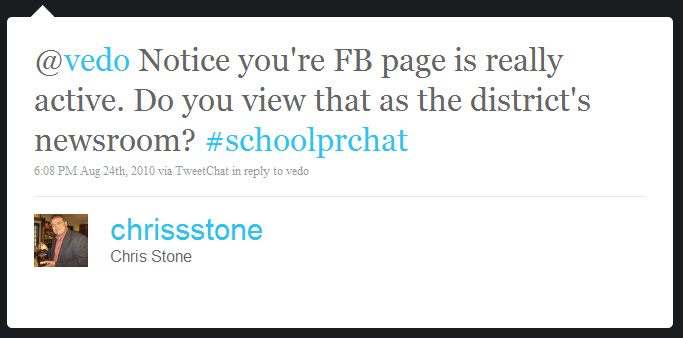
One such question came from a marketing professional, Chris Stone during the #schoolprchat, (a Twitter chat that is currently on hiatus.)


This is a great question because it forced me to pause and take a critical look about how I was using my school district's Facebook page.

A school district's Facebook page is a prime location for sharing timely, relevant, and interesting content with the community of parents, students, staff and even some random people that have decided to 'Like' the page along the way.

The strategy behind the school district using Facebook could be summed up as fish where the fish are. With so many people on the social utility, it just makes sense for school districts engage their community there.

But Facebook as a school district's newsroom? I think in the traditional sense of the term 'newsroom' perhaps not since it doesn't really provide enough to meet journalists' expectations. From distribution and content expectations of journalists, Facebook doesn't really work.

Ah, but journalists aren't the only people school PR folks are trying to reach. Certainly traditional media should (and will continue to) be a fundamental component for school district communication pros. And we should do everything we can to sharpen our media relations skills and approach.

But don't let that be the only focus.

School districts should already be leveraging Facebook for communication and community outreach. Set your district's Facebook rules of engagement, prepare and gather content from all over the district to share. Post, listen, engage and promote...and repeat.

I know some school districts don't allow you to comment on their Facebook page wall. I don't agree with this broadcast-only practice. The magic is in the feedback. When we post items to Facebook like updates, questions, links, photos, videos, student/staff recognitions, explanations, news, events, etc. it's done with the audience in mind. I use Facebook in my school district to share and engage with the community.

Oh and for the record, I recently tried to pitch a story to a local newspaper reporter only to be told, "yeah, I saw that on Facebook earlier."

Come to think of it, maybe it is the district's newsroom.

Wednesday, March 9, 2011

35 hand-picked posts for fellow PR pros

Photo via timrich26
So here we are again with what has become my annual birthday gift to you, a simple round-up of PR-related and digital communication blog posts, features, resources and tips that I've collected, saved, shared, loved, tweeted, and bookmarked or just found fascinating.


These are writings from those who I believe are some thought-leaders in the public relations industry or from those who continually provide rich resources for communication professionals. Many of these could just be cool and I think you should (re)read.

(Also, if you are interested, you can also check out my lists from my 34th and 33rd trip around the sun.)

Let's begin:
  1. Crisis Planning: Prepare Your Company For Social Media Attacks (Web Strategy)
  2. The Private Nature of Public Relations (Conversation Agent)
  3. 5 Things Depeche Mode Can Teach You About Effective Online Marketing (Copyblogger)
  4. Interactions, Engagement & Ecosystems (Logic + Emotion) 
  5. Where Next for the News Release (PR Breakfast Club)
  6. The Digitization of Research and Measurement (Metrics Man)
  7. Katie Delahaye Paine's Accuracy Checklist for Public Relations and Social Media Measurement (The Measurement Standard) 
  8. The Difference Between Making the News and Being the News (Social Butterfly)
  9. Posterous Grows Up as a Blogging Platform (Danny Brown) 
  10. Planning For Disaster: Communicators And PR Must Step Up (Copywrite, Ink)
  11. PR pros need to write more like…gasp! Sales copywriters! (Mengel Musings) 
  12. 4 keys to to building a social media editorial calendar (Communications Conversations) 
  13. 57 Social Media Policy Examples and Resources (Dave Fleet) 
  14. 11 must-read posts about blogger outreach (Communications Conversations) 
  15. Social Media Release: Evolution (PR Squared) 
  16. 34 Reasons to Start a Blog (Conversation Agent)
  17. Don’t Build Your Brand On A Third Party Platform (Social Media Optimization)
  18. Want to get quoted in the media? Try a video expert advisory (As Media Changes) 
  19. Corporate Altruism: The Blurring of the Lines Between CSR and Cause Marketing (Communication Overtones)
  20. Is PR Ready to Adopt a Standard Set of Measurement Principles? (The Buzz Bin) 
  21. 5 Tips on Business Blogging With Minimal Resources (TopRank)
  22. It's Time to Stop Collecting Facebook Fans (Ad Age)
  23. Content curation: A required skill for digital-era communicators (Shel Holtz)
  24. Newsroom Facebook Fans: Quality vs. Quantity (Journalistics)
  25. Klout for Business: A Useful Metric –but an Incomplete View of Your Customer (Web Strategy)
  26. Putting Words Into Action: PRSA’s New Social Media Policy (PRSAY) 
  27. 96 Free Professional Blog Topics (Geoff Livingston) 
  28. Consumer-Facing PR Means Business (Jason Kintzler)
  29. ‘My Tweets Are My Own’ is a Bogus Line (Lauren Fernandez)
  30. 10 Press Release Alternatives (Social Media Today)
  31. Easy Strategies to Start Measuring Your Public Relations and Social Media (The Measurement Standard)
  32. Q: What’s a new tool for public relations? A: Quora (PRSA Tactics)
  33. Building Your Own PR or Social Media Measurement Index (Chuck Hemann)
  34. Social Media Crisis Management: A No-Nonsense Guide (Mack Collier)
  35. Becoming a Conscious Written Communicator (Brass Tack Thinking)
Whew. That's a lot of reading. Just like in the previous years, there are some source repeats, but I think they are worth it. I hope you take some time and go through this gift of public relations resources or just save it for later. Either way the birthday party is mine but the comments are yours.

Thursday, February 24, 2011

Putting Social Media to Work for #SchoolPR - #tspra11

This is my presentation given at the 2011 Texas School Public Relations Association Annual Conference in Arlington, TX.

Thank you to the attendees who came out in the afternoon for this social media 201 session. I wanted to provide some thoughts on how to put social media to work for school PR people and share some tips and tactics that could be taken back to their home districts.

Tuesday, August 31, 2010

Facebook for School Districts: The Set Up Guide

Facebook logoImage via WikipediaThanks to the continuing wave of school district communicators and administrators seeking ways to reach their communities, a common question gets asked: How do you set up a Facebook page for a school district?

This post is for my school PR colleagues as well as those school district administrators seeking a step-by-step guide to set up a Facebook page in an educational setting plus some considerations and lessons learned from being a school district Facebook page administrator.

Step 1 - Create the Page
There are a few ways to do this. Visit the 'Create a Page' page: http://www.facebook.com/pages/create.php
or click the 'Create a Page for My Business' link from any random Facebook page.

Whatever you chose to do, you need to get to the screen that looks like this:

On this page completely ignore the Create Community Page. (That's a whole other headache.) You want to concentrate on the section for "Official Page." Using the radio buttons, pick "Local business" then scroll down the drop-down menu to "Education."

Next is the"Page name" text box. This is an important step that should not be taken lightly.


The name of the page will be how your community will find your district while searching within the social network. Additionally, since pages are public your district Facebook page will likely get traffic from popular search engines. I suggest naming the page how it is most commonly used in the community. In the example above, Blank Slate School District is the name I've chosen for my fictitious page. But this could have been any number of standard district names like 'Public Schools,' or 'Independent School District.' (Note: If you have Independent School District in your official name, I recommend shortening it down to ISD, so the example above would be 'Blank Slate ISD.' This is common enough to stand alone, plus it will shorten some of the postings.)

After you've given your page its name, click that "Create Official Page" button and you're ready to roll.

Step 2 - Adjust the Settings
When you create that page, the new default is to have the page in the "Published" setting. This means it's open for business. If you want some time to finish creating the page thus making it suitable for visitors, I suggest you Click the "Edit Page" directly under the big gray question mark where you district logo will soon be placed.


Your first stop will be "Settings." Click Edit then choose Unpublished (visible to no one but admins), then click Save Changes. You've just bought yourself some time to finishing tidying up your page to make it worthy of public consumption. (In Settings you also have a couple of other options for Country and Age Restrictions. Facebook has good explanation for these if you wish to adjust these for any reasons.)

After you've unpublished your new page. You can go back to the page by clicking the "View Page" link near the top of the edit page screen. (Hint: You can toggle back and forth between Page view and Edit view to see how your updates look.) Facebook has made things really easy these days with the new look for page creation. They've given their own step-by-step guide:


Step 3 - Add your logo
Next up is your school district logo or image you wish to use on the official page. You can maximize the real estate of this image by using up to 200 pixels wide by 600 pixels high for your graphic element to represent your district. Most examples that I've seen just use the district's logo. In some cases you may wish to use a different image in the event you are in a specific campaign or initiative. (Note: Your image will be reduced down to a 50 x 50 pixel image on your wall and centered so it may not look exactly how you imagined it to look. Try different versions to get the best look.)

To add your image you can hover over the big question mark in the upper left and use the "Change Picture" option or click the "Upload an Image" link in the Get Started section. Once you've added your image, you should see something like this:
(And of course the "BS" was done on purpose.)

Step 4 - Edit your page 
Continue to go down the line to edit your page with Basic Info, including Location, Phone, Hours of Operation, Website, and Parking. This is the easy one. The next part is the Wall Settings. You are going to need to make some decisions here. You need to decide who gets to write or post things to your District's Facebook page Wall. I recommend the default view set to All Posts since this is for the District's community and they should see that their posts have value to the district. Set the Default Landing Tab to "Wall" instead of Info, Photos, or Discussions. Having the Wall as the default lets those visiting your page see that you are providing an opportunity to share. Permissions and Posting Ability is another chance to think things through. I like the top option that allows people who like the Page to write or post content on the wall. However, you may consider leaving the other sub-posting abilities unchecked unless you are sure you are comfortable with people posting their own photos, videos, and links to your District wall. (Hint: Even with "links" unchecked, people connected to your page can still post links as wall postings/comments and those will be active links. The links just won't be the dynamic links with optional pictures the other way.)

Going mobile? Under Wall Settings in the Edit screen is Mobile that let's you "Publish status updates, photos and videos to your Facebook Page on the go." Once you click "Edit" you'll see your page's unique e-mail address that let's you upload photos and video via a smart phone and e-mail. This could be really handy if you wanted to update the Page while at a District event or something else where you might be pulled away from typical page management. Protect this e-mail address.

Step 5 - Set your Facebook Page Rules
I know there are some other interesting things going on in the Edit screen under the Applications heading, but for now, I suggest you concentrate on another section. You need to set up your School District's Facebook page posting guidelines. These are the rules to which posts and comments from your community will need to adhere in order to stay up for public consumption.
! If you need an example, feel free to use and/or improve on these Facebook Page Rules of Engagement for School Districts
Once you've drafted your District's Facebook page rules, they can be added to your page in the "Notes" section. Notes can be found on the Edit screen under Applications. Write your new Note and drop in your page's rules. Call them whatever you like, just make sure they get across the message that this is a monitored page and all posting of comments on the page are at the discretion of the page administrators.


Step 6 - Additional Page Considerations
Once you've set up your page's guidelines for the community you can go back and do some clean-up.
Under your page's logo/image, there is a box that will prompt you to write something about your district. (Hint: you only have enough room to fit 250 characters including spaces, so be judicious with this text.) This text box can be updated as often or as little as you want depending on what you'd like share here.

Now back in the Edit Page screen and let's look at the options under Applications:
  • Discussion Boards - This is a great opportunity to open up discussion threads on topics for your school district community. You may get some negative feedback here depending on the nature of the discussion, but with Facebook their are fewer opportunities for anonymity since typically people will post as themselves. Your district could gain some valuable insight using Discussion Boards if you are willing to open them up for use.
  • Events - The options for "Create an Event" are much easier now in Facebook. Basically it walks you through the process of an Event and lets you update the people who've liked your Page as well as allows them to share with their network of friends. This is another valuable feature of a Facebook page for school districts since you can use Events to gauge early interest for an event and let your network help spread the word on it.
  • Links - Depending on how you set up your Wall options back in Step 4, you shouldn't have to mess with this one. Plus, it's pretty self-explanatory.
  • Photos and Video - I lump these two together since they are similar. Peoples faces are compelling. Images and/or video of students, employees, a superintendent, community members, etc. doing something interesting can be great ways to help you tell the story of your district.
  • ! Posting updates as The Page -When you add items to the district's Wall, you will post as The Page and not as you the Admin. What this means is if you've set up the page using your personal Facebook profile, when you administer the page, you are adding items as The Page and not as yourself. So for our example page, even though I set up the Blank Slate School District page using my profile, updates appear to come from the BSSD Page and not as me:
That's it. If you've made it this far, congratulations and good luck with your school district's page. I hope you find this guide useful. If you know of others needing assistance with their district's page set up, feel free to pass this post along to them.

For even deeper cuts on Facebook page set up and management, be sure to check out these other resources:


Thursday, May 6, 2010

The Social Media Silver Rule

We're all familiar with the Golden Rule. This ethical code simply stated tells humans to do to others what you would like to be done to you. Simple enough, right? And yet we still collectively often get it wrong.

But that's not what this post is about.

Social Media's Silver Rule
I try to write down ideas for post topics when something strikes me as being interesting and relevant. One of the items that has been bouncing around my head for a bit has been the thought for a Social Media Silver Rule:
Don't Be Stupid.
That doesn't sound too hard and yet we see stupid stuff all the time being done on, through, and with social media.

So how can you follow the Social Media Silver Rule?
  1. Check your privacy settings on Facebook.
  2. Don't post things on social networks that will come back to haunt you like eating rancid meat.
  3. Think about what you are sharing.
  4. You don't have to be friends with everyone.
  5. Have a filter. Don't write/tweet/post/share everything that just pops in your head.
  6. Remember what you write/tweet/post/share could easily reflect poorly in professional settings.
  7. You have the right to remain silent; anything you write/tweet/post/share can and might actually be used against you in the court of public opinion.
  8. Check your privacy settings on Facebook. (Yes, it's repeated, but it's worth it if one more person sees the importance of clicking 'Account --> Privacy Settings' in Facebook. They've made some changes at Facebook and you need to know how to block them.)
 What do you think? What are some other ways to be wise in social media? The comments are yours.
    (Photo credit: Gret@Lorenz è una combattente!)

    Friday, March 5, 2010

    Social Networking For Texas School Districts Presentation Slides

    In case any of you have been wondering why my postings have been sporadic lately, here's the story: I have had the pleasure lately of presenting thoughts, research, and tips on communication and public relations in an education setting to a few groups.

    Last week was a presentation during the Texas School Public Relations Association (TSPRA) 2010 conference. This week I was invited to speak on social media tools during the TCU Schieffer School of Journalism's Social Media Week. Additionally, I had the rather unique experience as the speaker for the Texas Association of  School Board's CommLINK webinar. (More on the webinar experience in a later post.)

    As promised to yesterday's webinar attendees, here are the presentation slides:
    As stated during the presentation, there are many other social networking opportunities through groups and specific communities through tools such as Ning and even wikis that are worth exploring by school districts. I primarily stuck with Facebook for the discussion yesterday.

    If you took part in this webinar and have any questions, please feel free to leave them here via comments or contact me.

    Related Bonus: Feel free to use any or all of the suggestions in the Facebook Fan Page Rules for a School District.

    I will attempt to get back to some regular blogging soon. As always, the comments are yours.
    Reblog this post [with Zemanta]

    Friday, January 8, 2010

    How thick is your PR skin?

    European HornetImage by ricardo.martins via Flickr
    Inclement winter weather happens. That's pretty much a given. What isn't always a given is what school districts will do when winter weather threatens to sting them.

    The short-version: Our area experienced record low temperatures resulting in slight accumulation of ice in areas around the district. We opened schools at regular time. Many parents and students took longer times to get to school. Parents (and some students) expressed displeasure in the decision to remain open. They chose to share their displeasure via angry phone calls, on our Facebook fan page and through comments on our blog.

    Winter Weather Catch-22
    There are many things that go into the decision to open, close or delay a school district day because of weather concerns. I'm not going to go into any details on those types of procedures and considerations since they will vary by district.  The bottom-line is these are no-win situations because no matter what you choose to do, you run the risk of upsetting your community.

    What should a school PR person do when a significant number of your community disagrees with your decision and is willing to share their displeasure?
    Here is just a sampling of some of the posts and comments we received.
    We had some thoughtful posts: There are patches of ice and accidents in Mansfield. Schools should have at least been delayed. Be careful!
    Harsh: Its nice to know the district cares so much about state funds and so little about the safety of children that they are keeping schools open!

    Angry: this is unacceptable!
    i think that my child should not have to go to school when weather coditions are this bad!!!
    its hazardous!!!!!!!
    i hate this isd!!!!!!!!!

    Funny: This is not fair my friends in other citys get the day off but I do not!!! :(
    (I am guessing this was from a student or perhaps a staff member.)

    Argumentative: I was amazed to see that our garbage pickup was delayed 2 hours, but the start of school was not.

    The silver-lined Hornets Nest
    It seemed we had stirred the hornets nest with this one. But here's the kicker, since we had provided places for this feedback through our social media channels, we were able to hear them. We were able to appropriately respond when needed. Since we had people's attention, we were able to deliver messages on a couple of other topics. It was enough to be able to listen in on the buzz of issues and concerns that parents were openly sharing. We were even challenged to think and address some issues that had been basically invisible to us and respond quicker.

    It wasn't always comfortable to read, and sometimes bordered on blood-pressure raising. But, the significance of letting those in the community engaged with the district on the social web vent on our communication channels is, I believe, a positive step.

    We even had a few posts that seemed to be fed up with those railing against the district and share their thoughts too:
    ...As adults, our children will be expected to arrive at work on days such as today, even if they arrive late. Accidents do happen during bad weather but blaming the schools for that is unfair. I wonder how many people complaining about the trek to school also made trips to Walmart today...
    Communication Carry-out: You can choose to let those angry words sting you or you can choose to grow a thicker skin. I recommend the latter in cases like these for school PR people so you can hear what's being said. What do you think?
    Reblog this post [with Zemanta]

    Friday, December 4, 2009

    Nonprofit Facebook Primer


    ----
    Above is the presentation slides from yesterday's social media session on Facebook for the Fort Worth Funding Information Center. The group was kind enough to invite me back to give this follow-up session on Facebook after my first presentation last Spring on nonprofit social networking.

    For attendees: What did you think of the information presented? Do you have any additional questions that did not get asked? What other topics would you have liked to receive?

    For non-attendees: I certainly appreciate any thoughts from you as well.

    The comments are yours.
    Reblog this post [with Zemanta]

    Tuesday, December 1, 2009

    Facebook making privacy controls easier

    Mark ZuckerbergImage by jdlasica via Flickr
    Facebook founder, Mark Zuckerberg, sent an open letter to the social network's users announcing some good news both for the company and for users. He announced Facebook now has over 350 million users. To put that into perspective, the Facebook population is larger than those of all of the countries in the except China and India.

    The other, and arguably more intriguing, bit of information from Zuckerberg was the announcement of updates to Facebook privacy settings:
    "The plan we've come up with is to remove regional networks completely and create a simpler model for privacy control where you can set content to be available to only your friends, friends of your friends, or everyone.

    We're adding something that many of you have asked for — the ability to control who sees each individual piece of content you create or upload." (emphasis added)
    Make good privacy choices
    This is an important change because it will provide individuals a way to have better control and hopefully filter their postings for appropriateness. Perhaps this is Facebook's way of letting users help themselves and making good choices online. I especially liked how Zuckerberg leads users down the path of choosing privacy settings:
    "...the best way for you to find the right settings is to read through all your options and customize them for yourself. I encourage you to do this and consider who you're sharing with online." (emphasis added)
    If you're a Facebook user, will this change be helpful to you? Do you think people will take the time to update their privacy settings? The comments are yours.
    Reblog this post [with Zemanta]

    Wednesday, October 21, 2009

    Facebook Fan Page Rules for a School District

    For those of you looking for an example of a school district's Facebook policies, guidelines, rules, etc., I submit for your consideration the 'Mansfield ISD Facebook Fan Page Rules of Engagement.'


    These rules were posted earlier today on the District's Facebook Fan Page as a 'Note' to help set the rules and community expectations for the fan page usage.

    (It probably would have been better to have these posted before we acquired over 600 fans, but better late than never.)

    ------------------------------------
    The Mansfield ISD Facebook Fan Page is provided for the district community by the Mansfield ISD Department of Media & Communication Development. We will update this page as often as possible to share as much as we can about Mansfield ISD and the achievements of the students and staff as well as other relevant district community information.

    All posting of comments on this page are at the discretion of the page administrators. The intent of this policy is not to keep any negative or critical information from being posted, but to protect the privacy and rights of Mansfield ISD staff and students. Naming specific employees or students in a negative way will not be allowed (and is just generally rude.) The page administrators will review all postings to make sure they do not run afoul of the rules nor of the district’s Acceptable Use Guidelines regarding Internet access and practices.

    We welcome your thoughts and comments and look forward to what you have to say. However, we will not leave postings that:
    • Break the law or encourage others to do so. This includes respecting copyright and fair use laws. If you are talking about somebody else’s work, reference this or the person, and where possible include a link.
    • Contain abusive or inappropriate language or statements. This includes remarks that are racist, homophobic and sexist as well as those that contain obscenities or are sexually explicit.
    • Easily identify students and/or staff in defamatory, abusive, or generally negative terms.
    • Do not show proper consideration for others’ privacy or are considered likely to offend or provoke others – i.e. don’t pick fights or goad others into inflammatory debates. Nobody likes a bully.
    • Are spam – i.e. repeatedly posting the same comment or comments that are simply advertising/promoting a service or product. If you wouldn’t want to receive it yourself, don’t post it.
    The page administrators reserve the right to not post or remove any comments at any time, for any reason…but we hope that won’t ever be necessary.

    If you have a comment or would like to report an inappropriate comment for us to review, send an email to blog@mansfieldisd.org. (Yes, it’s the same e-mail as our district blog.)

    Please note, you can also receive e-mail and phone text messages of our updates as they are posted through the settings of your personal Facebook account.

    Thank you for stopping by and/or being a fan of Mansfield ISD.
    ------------------------------------

    What do you think? Are these a decent set of fan page rules for a public school district? I'd appreciate any thoughts on these rules.
    Reblog this post [with Zemanta]

    Sunday, September 6, 2009

    The Political Engine vs The School House

    As many of my readers know, I work in the communications department of a public school district in north Texas. Last week's plans were derailed by the announcement of President Obama's Tuesday, September 8 live address to students. Like many, our district became a center for lively debate and spirited feedback by our community.

    In no way am I here to disparage any of the parents or community members who called to, ahem, "discuss" the merits of showing or not showing the President's address to students. I'd rather focus on an interesting phenomenon in communication and why the headaches are worth it.

    School PR and a Presidential Address
    As the topic heated up for school districts, we reached out to other school PR teams in our area, across the state, and even a few friends across the country. It was important to find out what they were hearing, how they were handling the calls/e-mails, and if any decisions had been made on showing the broadcast. (Photo credit: darkmatter)

    The common themes we heard from our brothers and sisters in school PR were ones of political leanings being argued against the educational decision-making process. Of course this is nothing new, we often have to balance the political winds that blow in a community with educational needs, mandates, and expectations. But this time, the contrast was so stark as to see that we had all been thrust into a no-win situation.

    The difference was in the language that was used. While most school districts were trying to internally decide and discuss the instructional merits and curricular needs, we all were hearing arguments both for and against live (as well as taped) broadcasts of President Obama's address that hinged squarely on the shoulders of political dogma. (In our area, many of the calls began, I believed, during and after a local conservative talk-radio show.)

    Bottom-line: We weren't going to win over the hearts and minds of our communities because, in this instance, we were speaking different languages and looking at the same thing through different lenses. And this brings me to the bigger positive of the ordeal.

    Spotlight on Education
    For the many extra hours, meetings, arguments, e-mails, phone calls with media friends and decisions ultimately made, I will still be thankful for one big thing. The nation was talking about education for a change.

    In two days time, our neighbor asked, sports-talk radio shows discussed it, I read (and commented) on Facebook friends' wall postings as well as talked with random family members who don't usually engage in these types of talks. They were all talking about education and the issue of Obama's address along with the mainstream media:


    Future-gazing
    There is little doubt in my mind that on Tuesday, September 8 at 12:00 pm EDT, many people will stop what they are doing at work, school, and home to tune-in to the live broadcast of Obama's address just for the curiosity of it. Many will want to confirm their fears or solidify there beliefs, but they all will hear the message or at least hear of it. The address will continue to get local and national media coverage. Parents and students will get asked to share their thoughts via interviews. Pundits will claim righteousness or indifference. The machine will roll and just maybe, a greater discussion will open up on addressing the common issues that plague education.

    It is for this reason that I can be thankful for the havoc and short-term PR problems we'll face because they are outweighed by a larger (much-needed) discussion about education in this country. Further, I think we can all be a little calmer if in fact the Presidential address stays within the realm of wanting students to take personal responsibility for their own education, to set goals, and to not only stay in school but make the most of it.

    Those are good lessons and a debate worth having.

    Reblog this post [with Zemanta]

    Friday, April 17, 2009

    Facebook Rocks the (Site Governance) Vote

    When I logged into Facebook this afternoon, I was pleasantly surprised to see a call for the community to vote on revisions to the site's terms and conditions. Asking the community for feedback and doing something with that feedback is in the best interest of this or any online service (free or paid) - it shows a willingness to listen and be a partner in a positive user experience.

    No doubt there will be some critics who will line up and take sides for and against any changes to this free service. It is already making the rounds in the online which naturally helps get the word out on the vote itself.


    After reading the 'Response to Comments on Statement of Rights and Responsibilities,' I was interested in a few of the issues that originally questioned the actions of Facebook and how the site responded in the revised statement:
    • How will Facebook use, share, and store my content? Facebook needs the right to use, share, and store your content in order to provide Facebook to you and your friends. Our Privacy Policy explains what content we use, share, and store, and includes a number of examples (as do some of our responses to this section). In addition, your Privacy Settings give you the ability to direct and control how we use and share your content. 
    • Why doesn’t Facebook use one of the Creative Commons Licenses? In some ways the license grant in the Statement is more limited than the Creative Commons licenses. For example, the Creative Commons licenses are all perpetual. In addition, the Creative Commons licenses require attribution “in the manner specified by the author” and contain other restrictions (such as including Uniform Resource Identifiers) that we do not believe are feasible in a system with more than 175 million active registered users.
    • Why doesn’t Facebook audit every application? We unfortunately do not have the ability to control third-party applications, and cannot guarantee they are completely safe. However, if you feel that a particular application violates this Statement, please let us know by going to the application’s About page and clicking “Report Application.”
    • How can I limit Facebook’s use of my content in Social Ads? We provide a very transparent opt-out approach that allows you to easily tell us when you do not want to appear in Social Ads. You can do that by visiting this Privacy Setting.
    Listening to Community = Good
    These are just some of the things addressed by Facebook. At face-value this looks like a good move for Facebook. I am all for doing whatever you can to listen to the community (even if that community has around 200 million people.) The voting rules are interesting too:
    This vote will be binding if 30% or more of all active users as of February 26, 2009, the day that the vote was announced, vote. An active user is one who has logged in to Facebook at least once in the last 30 days. Users who signed up for Facebook after February 26, 2009 are not eligible to vote. They are eligible to vote on any future change to Facebook’s site governance documents that is put to a vote.

    If the Statement of Rights and Responsibilities is approved, all future changes will go through a process of notice and comment. As specified in the Statement, Facebook will hold a vote on any proposed change if at least 7,000 people submit comments. The vote will be advisory unless at least 30% of all active users participate. If turnout is 30% or more, the vote will be binding. [emphasis added]

    Here's hoping more than 30% vote so it can be binding and not merely a suggestion. I hope users actually take the time to read the response to comments from Facebook and make an informed vote.


    Reblog this post [with Zemanta]