Showing posts with label Media. Show all posts

Wednesday, February 5, 2014

Stuck between a shock and a tarred place

I first considered writing another column about the solid program we have for members and guests at the next luncheon. But that seemed like fluff when put up against a local, sensitive topic, the discussion of which substantially advances the PR profession and professional.

Sometimes working in PR and strategic communications sucks. That's where I believe the leadership and communications teams at JPS Health Network found themselves over the last few months. The situation of a patient and family leading up to a judge's ruling and follow-through on the order is unbelievably sad. To be clear, I have no interest mulling in print the thorny sociopolitical issues of this episode because it is so emotionally charged. Instead I would point to the well-presented and effective updates JPS released to the media.

JPS was stuck between a shock and a tarred place. No outcome was pleasant. Whether you're an in-house PR pro or hired consultant, in health care or nonprofit, a corporate communicator in education or in any part of the vast PR realm, at times things will go wrong. And the pain, the hurt, the confusion can last months.

Communication professionals provide strategic value to an organization in situations like these by being the voice of reason, conscience or even dissent to help leadership through the thicket. At such moments I appreciate the colleagues I know through PRSA who can help me strengthen an idea, clarify some wording, or just be a friendly ear. It’s great to know I’m not alone.

I tip my hat to the JPS Health Network communications and community affairs team. 

You do good work.
---
Photo credit: brookenovak via Flickr Creative Commons
---
The content for this post first appeared in the February eChaser newsletter as the my submission for the monthly President's Column. The eChaser is a joint digital newsletter for the Greater Ft. Worth Chapter of PRSA, SPJ of Ft. Worth, and IABC Ft. Worth.


Sunday, January 12, 2014

Children, it's ok to be in PR. Just be ethical.


When things go wrong in politics, things tend to go right for the media. Political corruption lead stories and exposés (local and national) can be the stuff on which journalism careers are made.

Because of this duality, it's no surprise that a well-respected (and well-followed) journalism academic and commentator, Jeff Jarvis, would chime in on the recent #bridgegate scandel in New Jersey. Quick recap: NJ Gov. Chris Christie fired a deputy chief of staff as part of some fallout over what apparently was a politically motivated George Washington Bridge toll booth and lane closure issue.

On Friday evening, Jarvis was tweeting screen captures from released government staff emails involving early reporting and a Wall Street Journal inquiry into Fort Lee toll booth topic that lead to "stonewalling." Most of his commentary was about what one would expect from a journalism associate professor.

However, one of his tweets raised the hairs on the back of my neck when he wrote: "Children, this is why you don't want to be a flack for a living."
Well thanks, Jeff. </sarcasm>

Let's just go ahead and paint the PR profession with the same damaging brushstroke because some political staffers (perhaps with questionable ethics) wrote some internal emails trying to figure out their next steps. Of course they should know by now that electronic communication within government agencies falls under FOIA rules and tend to eventually see the light of day. Duh.

What bugged me is that Jarvis picked this episode to flippantly dismiss thoughts by students of going into public relations, strategic communications or really any career in which one might be referred to as a "flack" for an organization. To be clear, I do not believe for a second that his remark will be the deciding factor for a student exploring the field of mass communications to scoff at PR. To me, it's just sad (infuriating?) reminder that our profession gets a bum rap.

It's up to us as PR professionals to practice strategic communications in an ethical manner. We should be among the chorus of calls for transparency, honesty, and open communication. I'll leave you with the charge given to us from the PRSA Code of Ethics. The Code advises PR professionals to:
  • Protect and advance the free flow of accurate and truthful information.
  • Foster informed decision making through open communication.
  • Protect confidential and private information.
  • Promote healthy and fair competition among professionals.
  • Avoid conflicts of interest.
  • Work to strengthen the public’s trust in the profession.
Perhaps even academics like Jeff Jarvis can appreciate their future hacks working with ethical flacks. (tongue-firmly-in-cheek!) Or at the very least, I hope he understands that ethical PR pros actually do exist.

Photo credit: tracylee via Flickr Creative Commons

Friday, April 12, 2013

Scope media coverage before sending your news release

Yesterday, a horrible bus accident occurred in Irving, TX on a major highway. A private charter bus carrying seniors to an Oklahoma casino veered across a busy DFW freeway and crashed. First responders, onlookers, and local media outlets quickly portrayed a chaotic scene for rescue of dozens injured or trapped inside and unfortunately, recovery of two people who lost their lives.

As the story developed, national news coverage broke with local affiliate footage from the scene as well as area hospitals where trauma teams awaited the arriving ambulances. The media echoed the calls from first responders to alert area motorists to avoid that and nearby roads. Additionally, reports came in citing the clean record of the bus company. The investigation will continue, but for the most part, I think it was a solid example of textbook media coverage for area outlets. As residents in DFW, our hearts go out to the victims and their loved ones affected by the accident.

So what does this tragic accident have to do with public relations? Yesterday was not the day to send irrelevant news releases to local media. I was reminded of this as we had some district information to share in partnership with a local hospital on something pretty fun for elementary students. But...yesterday was not the day to send out our news release. It was not the time to bother with something lighthearted in comparison to the day's events on the roadway.

The lesson: PR pros must pay attention to what's happening in local media coverage before pushing send on news that will fall on deaf ears because of something much more important. Situational awareness is a valuable asset.

Wednesday, September 19, 2012

5 Reasons to Make Your In-house Editorial Calendar

How does your communication department function? Is it stuck in an old mindset of spray and pray (as in spray the press releases out to the media and then pray for coverage) or do you treat the department like your organization's own newsroom where content creation and direct communication with your community are the objectives? I'm an advocate of the latter as part of the department's function for public relations in school districts and nonprofits. An internal editorial calendar is a smart way to help in-house PR departments meet leadership goals and strategic communication objectives all year long.

Keeping an editorial calendar for your communication department allows you to:

  1. Effectively plan around the monthly and yearly occurrences in the organization
  2. Position yourself and department as the go-to source for information
  3. Drop-in plans for special events and target dates
  4. Establish timing for press releases, newsletters, blog posts, video production, etc.
  5. Allows you to get back on track with messaging when things go wrong
That's great but how do you do it? 


Here's how to get started. I'm sure there are other possibly better or more creative ways to make an editorial calendar but here's what I did. I found a simple template in Google Docs (now Google Drive) for a blog Editorial Dashboard. Then I made the appropriate adjustments for a week-by-week calendar for the department to use all year long. 

First, drop in everything for which you have set dates on the calendar. You're looking for those things that happen every year. For a school district, we have many items to quickly drop in such as holidays, board meetings, first and last days of school, high school homecoming dates, graduations, etc. 

Next, add the target or scheduled dates for any special events like any facility ground-breaking events, building dedications, board elections, bond elections (referendums), etc. (Don't forget to include important weekend event dates.)

Once these items are in, it's time to work to include your planned schedule for your recurring communication channels: electronic and/or print newsletters (external and internal if applicable), regular video updates from leadership, blog post schedule, and planned Facebook page posts. This part is an ongoing exercise and and you never really feel finished because things inevitably get shifted and you'll have to make adjustments. The calendar just gives you a guide to bring things back in order. 

We've all had those days (weeks) when things are going wrong or we're in full-blown crisis communication mode and we know in the backs of our minds some things are getting lost in the shuffle. An editorial calendar can serve as your reference tool to get back on track. I've found ours to be a solid source for making sure our timing for important announcements doesn't interfere with something already planned. We've used the calendar to remind leadership of important issues and how they play among established plans, dates, and events.

What do you think? Have you created an editorial calendar for your communication department? Are there any other benefits or tips you can add? As always, the comments are yours.

Thursday, June 28, 2012

PR Tips: Two Media Interview Lessons

This morning on CNN's "Starting Point" program, Soledad O'Brien was interviewing Senator Charles Schumer (D-NY) about the Supreme Court's then pending healthcare law ruling announcement. It piqued my interest because Senator Schumer used two smart media interview tactics:
  1. Avoid repeating the negative - At one point O'Brien was asking about what people should consider as the main reason for low support for the healthcare reform law. She asked Schumer if he'd consider it a "failure of message" to which the senator replied, "I wouldn't call it that. I would say..." This is a smart and simple approach to a leading negative comment by the interviewer. Don't repeat the negative and give the media that sound bite. Use the opportunity to bridge on to what you need to say for clarification of message.
  2. Avoid speculations - I bit later in the interview O'Brian was trying to get the senator to talk about what he thought would happen if the Supreme Court ruled against all or part of the law. Schumer initially wouldn't take the bait and opted not to speculate on live TV about next steps. This was probably a result of the Schumer being pretty adept as a politician conducting himself with media. (He later went ahead and talked in general terms about what steps might be taken politically.) It's still a good idea to avoid speculations for anyone being interviewed by the media if ask about an area or possible scenarios that you do not fully know or can share. For goodness' sake, don't guess
Related Links:

Friday, June 8, 2012

Valuing School PR and Summer Timing

Earlier this week the Dallas ISD received some summertime media attention with their incoming superintendent setting the salaries for four chiefs in his cabinet including $185K for a Chief of communications.

I have no interest in debating whether or not this individual should or should not be paid this as a base salary for a school PR job mainly because I don't know the ins and outs of the DISD budget. Nor am I interested in the arguing the newsworthiness of the Dallas Morning News article that raised eyebrows because that education reporter was simply following the template of others: share salary of public official + compare it/share it = shock and disbelief  x  readers. Textbook.

No, I'm focused on two intriguing aspects of this situation from a school PR perspective:

(1.) An increase in the value of school communication professionals by superintendents and (2.) the timing of summer information releases.

Top-level value of school public relations
The article mentions that the new superintendent, Mike Miles, is bringing the district's communication position into the executive fold. 
DISD’s top communications position has not been a chief-level job, but Miles said the change was needed because there will be an increased focus on communication.
Honestly, I was surprised to read that communications was not previously an executive or cabinet-level position in Dallas ISD. By including his communications person among his chiefs, the new superintendent has shown how much he values strategic communications for his district administration. I sincerely hope DISD has found someone to help bring things along (or turn things around depending on where you sit) for the school communities. School PR should take note of how expectations for internal and external communication can be of value and service to a school district.
“We’re going to do communications differently,” Miles said. “Most people in the community will agree that our communications have to be better.”
I do, however, take exception to part of the Dallas Observer's post on the salary from their "Edumication News" section. (Yikes!) and his premise that anyone can do communications because it's a sales job. Joe Tone writes,
There are plenty of areas of public education that require a really specific set of skills. But communications isn't one of them. It's sales, basically, only for almost every customer you have, yours is the only product they've ever heard of.
Wrongo. What Joe Tone doesn't realize (or care to understand) is that strategic communications and school public relations does require a specific skill set just like other administrative functions. But that's ok, he's in the media. He can write what he wants. I may need to save that list for a future post.
 
Summer Timing
The other tactical aspect of this news story should be of interest to school PR pros as well. While the administration of school districts continue all year long, some of the stories for education reporters dwindles in the summer. While this salary brouhaha will cause a bit of bruising in the short-term for DISD, it won't have lasting effects since people move on to other things in their heads pretty quickly. Especially in the summer. If there was going to be a time for an OMG-look-at-what-they-are-paying article to come out, the summer is really the best time for it. Controversial news has a better chance of being managed internally and externally when released over the summer. I recommend information-gathering and using online statements as well as direct communication with the community in addition to working with the media. It's true during the school year and during the summer.

Photo credit: grbenching via Flickr Creative Commons

Friday, April 6, 2012

PR Roles explained through Baseball Positions


In honor of the start of the 2012 MLB season and excitement I have for my favorite team, Texas Rangers, I thought it was time to repost something from a few years back: a list of the roles and functions for public relations pros explained using baseball positions.
  1. Pitcher (P) - In baseball, the pitcher is the player who throws the baseball from the pitcher's mound toward the catcher to begin each play, with the goal of retiring a batter who attempts to either make contact with it or draw a walk. In PR, the pitching role is one where the professional attempts to garner publicity or attention through effective media relations.
  2. Catcher (C) - Positioned behind home plate, the catcher can see the whole field; therefore, he is in the best position to direct and lead the other players in a defensive play. In PR, this is the role of strategy. Like a catcher, the PR professional sees the big picture where they understand that actions will lead to specific reactions.
  3. First baseman (1B) - A first baseman is the player on the team playing defense who fields the area nearest first base. In PR, this is the role of first response. The initial response to problems and/or crisis will make or break the situation.
  4. Second baseman (2B) - The second baseman often possesses quick hands and feet, the ability to get rid of the ball quickly, and must be able to make the pivot on a double play. In PR, this role is of measured quickness. A public relations professional helps to protect reputation and vital relationships when an organization is under attack.
  5. Third baseman (3B) - Third base is known as the "hot corner", because the third baseman is relatively close to the batter and most right-handed hitters tend to hit the ball hard in this direction. In PR, this is the role of coordination and quick reactions that comes with experience from having to catch hard line drives or difficult internal communication challenges.
  6. Shortstop (SS) - Shortstop is often regarded as the most dynamic defensive position in baseball so naturally the PR role is one of adaptability. The one constant is that things change, it is up to the public relations professional to be aware and keep up with the broad and shifting landscape of the PR profession, media, and organizational industry.
  7. Left fielder (LF) - Outfielders must cover large distances, so speed, instincts, and quickness in reacting to the ball are key. They must be able to learn to judge whether to attempt a difficult catch and risk letting the ball get past them, or to instead allow the ball to fall in order to guarantee a swift play and prevent the advance of runners. In PR, this role can be equated to good judgment. Professionals need to understand when not doing or saying something will provide the best benefit to the organization.
  8. Center fielder (CF) - The center fielder has the greatest responsibility among the three outfielders for coordinating their play to prevent collisions when converging on a fly ball, and on plays where he does not make the catch, he must position himself behind the corner outfielder in case the ball gets past him. In PR, this role is made up of the credibility a professional must possess in order to be an effective communicator to both internal and external audiences. Just like a center fielder, the PR professional needs excellent situational awareness, vision and depth perception.
  9. Right fielder (RF) - Of all outfield positions, the right fielder often has the strongest arm, because they are the farthest from third base. However, oftentimes, as in lower-levels of baseball, right field is the least likely to see much action because most hitters are right-handed and tend to pull the ball to the left field and center. In PR, this is the role of monitoring and measurement. Unfortunately, many professionals are not as up to speed in this area (me included) as we should do whatever it takes to learn how to measure. Thankfully, there is a greater push in PR measurement these days, so I consider this is a bright spot for the future of our profession. It requires additional work and research, but it is one of reward, sales, leads and maybe even justification for jobs well done.
Additional Positions
  • Designated Hitter (DH) - The designated hitter is the official position in the American League to bat in place of the pitcher. In PR, this is the role that the professional understands the usefulness of social media for listening and engaging an organization's community. We are well past the time of whether or not a PR pro needs to know how to use social media tools. They are indispensable tools in the toolbelt. The PR professional needs to fully grasp various aspects and nuances of the social web to reach audiences including, at times, as a way to by-pass the mainstream media.
  • Manager - A manager controls matters of team strategy on the field and team leadership. In PR, it's the same thing; strategic coordination of play and tactical movements are integral for successful public relations.

Play Ball!


Photo credit: ESPNDallas

Friday, November 4, 2011

Surviving a Pterodactyl Invasion with Social Media

On Halloween Monday the University of North Texas launched an awareness campaign for some official communication channels and procedures in a fun and creative package. The campaign had a simple premise: UNT had been invaded by pterodactyls.

The campaign included a fake press release, safety tips highlighting some campus resources and even a subtitled PSA from the mascot, Scrappy the Eagle.

Alyssa Yancey, a university News Promotion Specialist, pointed out that the project was "designed to show a lighter side of UNT" and encourage students to engage with the university’s Facebook page and Twitter 
profile.

(Full Disclosure: I am a proud alumnus of UNT and thought this was pretty cool.) 

I sent a few questions to Alyssa to get her take.

What was your inspiration for this project?
The University of North Texas’ Halloween mock-pterodactyl invasion was inspired by the Center for Disease Control’s Zombie Apocalypse preparedness tips from last May.

Why did you choose pterodactyls?
The University of North Texas wanted to choose a topic that would be recognized as a joke and not a serious threat immediately. UNT also wanted something that would resonate with students and alumni. An extinct dinosaur, with a striking resemblance to UNT’s mascot Scrappy the eagle seemed to fit the bill.

What did you hope to achieve through this initiative?
This initiative was designed to increase UNT’s engagement with our Facebook fans and our Twitter followers. We haven’t ever really done anything like this, so we wanted to show our students that we have a personality and a sense of humor.

Was it considered a success?
The invasion was definitely a success. Throughout the day, we engaged with students and others in the Denton community, and had a great time. We encouraged students to submit photos, and they did. Some went on to add to the pterodactyl storyline by submitting historic photos of pterodactyls on campus, and suggesting they know other dinosaurs are plotting a Thanksgiving invasion. Students also joined in on the fun by retweeting the safety tips, release and PSA, sharing information to their Facebook pages and blogging about the invasion.

On Twitter, our retweets, direct mentions and follower counts all showed a strong increase from regular news days. UNT Facebook posts about the invasion, as well as student-contributed content, received numerous likes and positive comments, and the Scrappy YouTube video shot to more than 500 views quickly.

In addition to Alyssa, I reached out to Samra Bufkins, MJ, APR, Strategic Communications Lecturer at UNT's Mayborn School of Journalism for some additional thoughts on the invasion"
"They were hoping for a little more student interaction, but we're finding many students still aren't on twitter or following UNT official accounts. However, I think it's the kind of thing they should try again, maybe at another holiday time. You expect stuff like this at Halloween and April Fool's Day—maybe have some fun around a holiday that's not one for pranks. It was a good, fun, creative outlet and allowed everyone to poke fun at the construction and some other things around here. And at mid-semester, everyone needs a laugh!"
---
I really loved this fun and creative attempt to increase awareness and usage of the university's Facebook and Twitter presences along with some basic campus resource information. This is a great example of an organization demonstrating that they have a personality. Well done.

[Top photo credit: UNT Facebook page submitted photo]
Enhanced by Zemanta

Thursday, March 31, 2011

Facebook as a school district's newsroom

I like to keep track of interesting questions in the hopes that someday I might have an answer or would ask others in the hopes of furthering the dialogue on social media and school public relations.

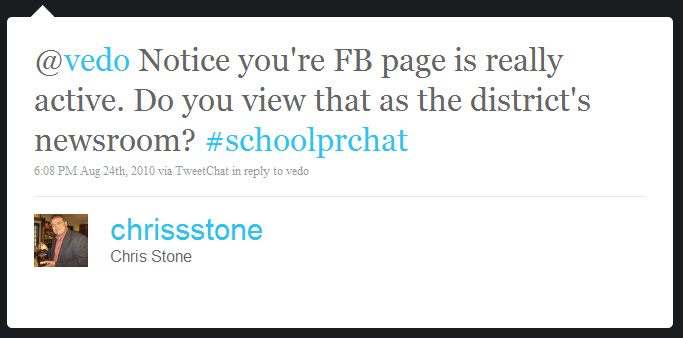
One such question came from a marketing professional, Chris Stone during the #schoolprchat, (a Twitter chat that is currently on hiatus.)


This is a great question because it forced me to pause and take a critical look about how I was using my school district's Facebook page.

A school district's Facebook page is a prime location for sharing timely, relevant, and interesting content with the community of parents, students, staff and even some random people that have decided to 'Like' the page along the way.

The strategy behind the school district using Facebook could be summed up as fish where the fish are. With so many people on the social utility, it just makes sense for school districts engage their community there.

But Facebook as a school district's newsroom? I think in the traditional sense of the term 'newsroom' perhaps not since it doesn't really provide enough to meet journalists' expectations. From distribution and content expectations of journalists, Facebook doesn't really work.

Ah, but journalists aren't the only people school PR folks are trying to reach. Certainly traditional media should (and will continue to) be a fundamental component for school district communication pros. And we should do everything we can to sharpen our media relations skills and approach.

But don't let that be the only focus.

School districts should already be leveraging Facebook for communication and community outreach. Set your district's Facebook rules of engagement, prepare and gather content from all over the district to share. Post, listen, engage and promote...and repeat.

I know some school districts don't allow you to comment on their Facebook page wall. I don't agree with this broadcast-only practice. The magic is in the feedback. When we post items to Facebook like updates, questions, links, photos, videos, student/staff recognitions, explanations, news, events, etc. it's done with the audience in mind. I use Facebook in my school district to share and engage with the community.

Oh and for the record, I recently tried to pitch a story to a local newspaper reporter only to be told, "yeah, I saw that on Facebook earlier."

Come to think of it, maybe it is the district's newsroom.

Sunday, March 6, 2011

Brazil surrenders to the multifunctionality of the Social Media Press Release

BrazilImage via Wikipedia
The following is a guest post from Brazilian public relations professional Rodrigo Capella.* Rodrigo is a lecturer and writer, he edits the blog PR Interview and has more than 20 books published.
------------------------------------------------
For a long time, the traditional press release has been used in Brazil. With basic information (title, lead, quotes, boilerplate and contacts of the PR agency), this tool of communication led several news (mergers, product launches, new strategies, etc.) to the journalists.

In the first years of existence, the traditional press release was very well evaluated by professionals working in publications. It happened because the Brazilian PR Agencies always adapted the institutional information according to the journalists’ needs.

Nowadays, the contact of the journalists with this tool is wearing out quickly (most of the media professionals prefer to receive all the information together - image, video, quotes, etc). Even so, for many years, Brazil has insisted - contrary to many countries - to use the traditional press release as a primary tool of communication.

To get an idea, for more than five years, many in the United States adopted alternative tools, such as the Social Media Press Release (SMPR). Made in various formats, this platform can unite, in a single space, podcast, video-release, relevant links, tags, and RSS. There is also, of course, the elements of the traditional press release, like boilerplate and quotes, among others.

An interesting example was the SMPR “Second Life Reforestation Project Qualifies as a Finalist in American Express Members Project,” which facilitated most of the media professionals’ work. An interesting point: this platform has presented to the journalists the direct contacts of the spokesperson (a fact that, for cultural reasons, seldom occurs in Brazil).

Now, after overseeing the successful of the SMPR around the world (here's another example), Brazil has surrendered to this agile tool and already collected some interesting cases. To announce the launch of the new 3DS, the portable console that lets you play in 3D without special glasses, the PR agency S2 Publicom sent to the Brazilian press a SMPR (there’s a password and login to access this platform) with files in English and Portuguese. In this SMPR, it was possible to have access to video-releases, pictures and a variety of information about the launch.

Another interesting example was conducted by CDN in partnership with Cinnamon Communication. The PR Agencies did a SMPR to launch the new VAIO notebook Y. With video release, links, images and testimonials, the platform has brought all the necessary information for journalists reporting the product.

These two examples of SMPR (3DS and VAIO Y) confirm a trend: there is no communication without innovation. Brazil learned this lesson. Now, it needs to be aware of upcoming changes for not getting used to be outdated. 

[The reference to the Social Media Press Release (SMPR) should be understood to flow interchangeably with social media news release (SMNR) or just Social Media Release. I found Rodrigo's post particularly interesting and relevant since it points out some of the basic ways to help PR pros get a better grasp on how one can use social elements and digital assets with releases.]

* Contact Rodrigo Capella via E-mail: capella.rodrigo@gmail.com Twitter: @rodrigo_capella 
Enhanced by Zemanta

Tuesday, October 19, 2010

KDFW Channel-4 Pokes Fun of Social Media

Our local FOX affiliate station, KDFW, took a brilliant tongue-firmly-in-cheek swipe at social media in a fun video that was posted to their Facebook page with the title: Social Media Bit - Lone Star Emmys

This is a fantastic example of allowing yourself (even you media outlets) to have a personality. Let your community know you're human and that at times you don't have to take yourself too seriously. Thanks FOX 4 for the fun reminder. Well done.

Sunday, October 10, 2010

Matte Releases: PR Branded Content for the Newbie

LA TimesImage via WikipediaHave you ever heard of matte releases? I'll be honest, I've been in school public relations for nearly ten years and that particular phrase never came up. So when it came up in an e-mail and subsequent conversation I was intrigued.

The matte (or mat) release is a consumer or community-related article that newspaper editors can run when they want additional content for their publication. This branded content from an organization is generated specifically for distribution through a syndicated service in the hopes of reaching multiple news outlets and thus a wider audience.

This caught my attention because I've seen articles that fit this description written by the PR person at Methodist Mansfield Medical Center (MMMC) show up in the Mansfield News-Mirror (a weekly newspaper owned by the Fort Worth Star-Telegram).

After reading one such article a while back, I contacted Angel Biasatti, Director of Marketing, Community Relations and Public Affairs at MMMC, and asked her some questions hoping she'd share how she uses matte releases:
How useful are the matte releases to you and your communication strategies? They are very helpful and assist Methodist Mansfield Medical Center in reaching individuals in our community and beyond to provide helpful health information.
Have you had success with using this type of branded content? Absolutely. Many of the community newspaper and magazine editors use our matte releases monthly to supplement staff-written stories to provide helpful health information to the public. With newspaper staffs being cut and spread thin, the content Methodist Mansfield provides is becoming an essential editorial tool.
How do you define success when using a matte release? We measure success in a number of ways – from formal methods such as community perception surveys to informal measures such as positive comments and feedback from community members.
What about items that do not get published, are those re-purposed online? Absolutely. All of our articles are posted on our website along with links to our health library at www.MethodistHealthSystem.org. We also distribute them to other online sources we feel might use them.
I figured it might also be helpful to know what an editor thinks about matte releases. I reached out to Amanda Rogers, editor of the Mansfield News-Mirror, and asked if she thought this type of branded content could be beneficial. Her response:
It is useful, especially for large community entities like the hospital, city and school district. It would give you another outlet and the paper another way to connect with the community.
Expanding reach with the evolved matte release
It is certainly easy to see the value in getting this type of branded content in the hands of consumers and your community through the media. It is also something that companies can help you accomplish with more efficiency and reach that you could possibly do on your own. One such service is ARAcontent. In her post, The Evolution of PR Branded Content, Deirdre Breakenridge shares some thoughts on this service:
ARAcontent entered the fray in 1996 and “automated” the matte release process by creating a system for electronic selection of articles by editors at newspapers and web sites. ARAcontent specialized in professional content creation to highlight a company’s products and services that is distributed and placed in top media outlets. In 2010, ARAcontent is further digitizing the release of feature articles through an increased focus on media web sites and backlinks to client sites.  Content is search engine optimized and the company also helps to generate real engagement with consumers via social media.
These SEO benefits and backlinks along with the top-tier placement through ARAcontent could be an answer for a company or organization from a tactical perspective.

An ARAcontent spokesperson showed me how a national home décor company created a matte release using the company’s tools in order to increase search engine visibility for keyword phrases around a line of children’s bedroom décor offerings. Among the results were 291 recognized backlinks, 514 online placements in one month period with an online ad value of nearly $240,000 to go with some great Google-juice for tracked phrases giving them the left they were seeking in keyword rankings.

(Of course, there are others that provide similar services and comparable paid placement reach such as PR Newswire, North American Precis Syndicate and News Force Network among others.)

On your own or through a service, the matte release could be worth your time and careful research if you haven't already. Dust off those writing skills and prepare something that will resonate with your consumers or community. Figure out if this little-known (or often ignored) PR tool is worth your time.
Enhanced by Zemanta

Tuesday, October 5, 2010

Crisis communication and the saving speed of info

It has been a week since a gunman took his own life at the University of Texas and vaulted the campus community into a panic albeit relatively briefly all things considered. I watched, as did many, as an outside observer hoping this was in a fact isolated to a single random actor who for whatever reason made some tragic choices that day.

As with anything that happens in today's hyper-connected world, we watched as the events (campus evacuation, lockdown, search and press conferences) unfolded in the media as well as through individuals using social media channels.
Photo: APD evacuating students from UT-Austin campus building.  on Twitpic

Communicators should stop being surprised at seeing as-it-happens information or images being shared from the scene like the one shared at right from KUT Radio or the photo gallery that the Austin-American Statesman was updating as the day progressed. It wasn't even surprising to listen to live call-in interviews with students being held inside a locked-down building. These are all part of the new reality for crisis response and communication. 


All of those things are secondary to a well-trained crisis response team.

What was gratifying was hearing students mention receiving text messages from UT on the situation. Also the fact that emergency e-mails and voice mails were distributed from UT made its way to the media outlets almost as fast as the news of the type of weapon being used by the shooter.

So let's give credit where it's due: through the coordinated efforts of University of Texas and the Austin Police Department. As pointed out last week in the TSPRA blog,
"UT officials were able to activate warning sirens on-campus, send text messages to students and faculty and distribute emails instructing those on-campus to lock down and those off-campus to stay away, within roughly 15 minutes of the first calls to police. "
During his first press conference during the active investigation for additional shooters, Austin Police Chief, Art Acevedo commended the "UT campus, UT police, and communication system to get information to students, secure the campus, and mobilize quickly. Students did their part; they cleared the streets, cleared the campus...my hats’ off to them all."

Being able to share information quickly is what saved the situation at UT last week. How quickly are you prepared to share? When was the last time you dusted off that crisis communication binder? What are some lessons learned? As always, the comments are yours.
Enhanced by Zemanta

Monday, September 27, 2010

PR pros, don't be digital media drop-outs

P EducationImage via Wikipedia
I really appreciate how our media friends have embraced the conversation on ways to improve education. From special reports on CNN to NBC's Education Nation, bringing education to the forefront of the dialogue is encouraging.

Perhaps the new conversation is tinged with typical politics for the election season and nothing new will come of it. On the other hand, having education in the public discourse through media like Oprah and even as the central theme in an upcoming documentary film, tells me it might be something more.

The stats are grim when taken as a whole. Bottom-line, we can all do better. School systems should operate like works-in-progress just as the students they teach and attempt to reach.

There is also a lesson for PR pros: Don't be a digital media drop-out. Don't be satisfied with where you are in your professional learning. I chose digital media specifically because that seems to be the area in our profession that is currently getting the bulk of the conversation. Social media integration concepts will continue to spread. It is my hope that PR pros won't take the easy road and, like a high school drop-out, just barely scratch the surface of usefulness of education for themselves.

Being a life-long learner would be a great example to set for students today and I believe that's a lesson worth sharing.
---
Special thanks to Shane Haggerty for bringing up this issue for other school PR people and framing the dialogue to advance and highlight local school district programs for communities.

Also, if you haven't seen it, I'd encourage you to check out the trailer for the documentary mentioned earlier:

Tuesday, July 20, 2010

School PR and the News Media - Ken Haseley, NSPRA 2010

Protest Rally Against Mainstream News Media   ...Image by asterix611 via Flickr
Note: This is cross-posted over on Shane Haggerty's blog, Social Learning Lab.
-----
Last week I attended the National School Public Relations Association 2010 Seminar. In addition to speaking during my brief stay I also took away some great insights from some respected communicators. One such speaker was Ken Haseley from The Ammerman Experience. Haseley gave a session entitled The News Media Today: Ally or Adversary?

In his session, Haseley touched on the shift from the news media being a public service to being more about profit and entertainment. He even pointed out that to a degree the news today is delivered as theater with reporters/anchors as the stars (think high graphics, dramatic music, and celebrity journalists on location, like Anderson Cooper from CNN.) He spoke about creating allies and how to handle the adversarial relationship school PR professionals tend to have with the media. I have attended Ken's sessions before on a variety of topics so I knew his would be one not to miss.

Important take-aways from The News Media Today: Ally or Adversary?

Today's news media:
  • Expect to have more contact with junior-level journalists. 
  • Expect more errors or inconsistencies
  • Communication pros need to do more hand-holding and listen more closely. (Example: During a phone interview, listen to how the reporter sums up your quotes and especially if there's anything that seems to still be confusing at the end.)
  • While the newsrooms may be shrinking, the news landscape is still expanding. Journalists have even greater levels of expectations today in reporting and content production.
Creating Allies:
  • Recognize the PR and media symbiotic relationship.
  • Think in terms of marketing and build relationships.
  • Remember business etiquette. (Example: It's so important for call backs. It's highly frustrating for a journalist to have to wait on you to get back with them. Call back even if you don't have the answer at the time.)
  • You will gain greater confidence (and competence) with media training.
Handling Adversaries:
  • Don't pick a fight with the media. (The old adage is still true, Never pick a fight with someone who buys ink by the barrel)
  • Learn how to just say no. (Sometimes it's ok to decline an interview request. This works when the story is not about your organization or it's a round-up piece that doesn't rely on your involvement. Say, "thank you, we've decided to pass on this one. Don't forget about us in the future." You still need to call them back.)
  • Have a straight-forward approach. Don't waste a reporter's time. They'll remember you for that too.
  • To fix errors in reporting you can either ignore it or take action. If you take action, Haseley suggests
    1.) Call the reporter to point out the error.
    2.) Ask for a correction.
    3.) Call the editor or news director
    4.) Strategically use letters to the editor or even paid advertising if necessary.
  • Mend fences. You never know when those adversarial reporters are going to wind up as communications and PR colleagues in the future.
In addition to his presentation, Haseley was gracious enough to spend a couple of minutes to share some thoughts for a brief video:


Enhanced by Zemanta

Tuesday, July 13, 2010

Media Shmedia: Be Your Own Newsroom - #NSPRA

The following is my presentation deck from the 57th Annual Seminar of the National School Public Relations Association:

Additionally, some attendees were asking about some guidelines they could use. Here's our school district's blogging policy for comments and Facbook Page Rules of Engagement for a School District.

Feel free to use and improve on anything where you can.

Now it's your turn: What is your school district using to engage your communities? What communication channels do you find most strategic for your efforts? The comments are yours.

Friday, May 28, 2010

Bad PR move: A "touchy" subject

From time to time I come across an example of how not to do PR and think to myself, yikes, that's not a good way to handle (fill in the blank). The key being that I just think about it and move on to other things in my head.

However, this one just bothered me and is worth pointing out as just a bad public relations move.

A hospital's community relations director uses a ridiculous touching tactic to try to get rid of a TV reporter that showed up prior to the start of a community meeting. The reporter was working on a story about a hospital's gift fund. Here's the bizarre exchange:


The story making the rounds in the social-sphere being called hilarious, creepy, best local news video of the year, and more.

Personally, I think it's just stupid and sad. Stupid because it should never have gotten that far. It's one thing to attempt to run interference in order to get the meeting started and try to schedule a more appropriate interview time. It's just poor form to not come up with anything else besides the reporter's apparent phobia for being touched (For the record, the reporter uses the overly aggressive ambush-style interview approach which is questionable as well.) It's just sad because it further perpetuates the caricature image of a smarmy PR persona.

I like this comment from someone on the SF Weekly blog:
"... I understand that reporters like to antagonize individuals to provoke an unpleasant response, but a professional communications director should know to keep his cool and not get drawn into a confrontation."

What do you think? The comments are yours.

Tuesday, April 20, 2010

2010 #PRSA Southwest District Conference on Speed Dial

Over the weekend I had the pleasure of participating in and speaking at the 2010 PRSA Southwest District Conference in Oklahoma City. First off, great conference and huge kudos and thanks to the committee and Oklahoma City Chapter of PRSA for being such gracious hosts.

Image by 1980Andrew
Dale Chihuly's blown glass sculpture
at Oklahoma City's Museum of Art
Here are the PR take-aways and conference quick bites that struck me as being important:
  • The Roaming Gnome is apparently very popular.
  • So is OKC Mayor Mick Cornett and he's a much better speaker.
  • To make an exit all you you need is an NBA mascot create a diversion.
  • Your network is your net worth.
  • The conference hashtag was #prsasw10.
  • Blown glass is awesome!
 Your Network is Your Net Worth
  • Ari B. Adler wants us to remember LSP (Listen, Share, and Participate).
  • Careers are now landscapes, not paths.
  • Create (join) a community before you need it.
  • Be an information hub.
  • Mentor, mentee, repeat.
 Message Management & Communicating During a Crisis
  • John Deveney advises that during crisis having a proactive and rapid response communication plans are vital.
  • Sometimes you can't get all of the facts before a story breaks.
  • You need 3rd party advocates during a crisis.
  • Crisis communications: Communicate frequently and make sure you are reliable.
  • Secure your position as trusted source.
  • You must be quick to establish who is involved and who is in charge.
  • Don't discount or short-change local news, they know you.
  • Most of the time some people know you; during a crisis, a lot of people are going to meet you.
  • Spokespeople need to feel what they say.
  • During interviews, pauses are the toughest, but best tip.
The Whuffie Factor: Using the Power of Social Networks to Build Your Business 
  • Tara Hunt @missrogue says your Social Media strategy won't save you.
  • Be happy social media is complicated because it makes our jobs much more interesting.
  • Think people-centric business that serves existing customers.
  • Concentrating on customer happiness; "enthusiasts" are far greater than "influencers."
  • Whuffie: reputation, trust, reach, positive sentiment, influence, # of people you know, # of people who know you, reciprocity, and known accomplishments.
Rebuilding, Recapturing and Retaining Stakeholder Trust
  • Alan Hilburg, APR and Margaret Ritsch reminds us that communication is about listening.
  • A brand is the trust consumers put into products or services.
  • It's about what someone feels not about what they think.
  • Ask yourself, what are you a protagonist for?
  • Data --> Information --> Knowledge --> Wisdom
  • Culture is the environment in which we make decisions.
Relationships Matter: How to Develop Relationships with The Media To Generate Ongoing Press Coverage
  • Margo Mateas paints a picture of failed media pitches because PR people irritate reporters and our information is often (90% of the time) ineffective and irrelevent.
  • Stop doing stupid things like failing to research the target media outlet.
  • 97% of media relations is preparation. We need to work smarter.
  • Understand a reporter's point of view.
  • Story origami: twist, fold, turn, bend, and turn it into something that benefits their audience.
  • Use an "Editor's Filter" - Summary statement, Why should I care? Are you credible? Call to action.
  • PR people get lost in the unimportant details when we have about 10 seconds to connect.
  • Give them what they need in the way they need it to develop the relationship.
  • Remember to front-load your e-mail pitches with relevant keywords and phrases.
  • Try this when working with a reporter: "Tell me what kind of stories you are looking for so I can help you."
  • You have to be real with reporters, be yourself, be casual, and be direct. Don't waste their time.
These are just a sample of the nuggets of information that I took from the conference. It was great connecting with some new and old friends. The conference title lived up to it's tagline: Your Network is Your Net Worth.
If you were at the conference, I'd love to get your thoughts on these or other sessions. If you couldn't make it, I hope you find something relevant in the post. Either way, the comments are yours.

Tuesday, March 9, 2010

34 Unforgettable Posts for PR People

That's right, I said 34 unforgettable posts. I compiled a round-up list last year as my gift to you on my 33rd birthday and wanted to continue the tradition on my 34th trip around the sun.

These are writings from some of the top thought-leaders in the public relations industry or from those who provide remarkable contributions for communication professionals or are just really pretty cool and I think  you should read. So without further ado, this year's list from oldest to newest:
  1. Micro Interactions in PR (Conversation Agent)
  2. Personal Branding: Be careful what you wish for (The Harte of Marketing)
  3. Why You Shouldn’t Trust Social Media To An SEO Consultant (Social Media Explorer)
  4. 7 Things I Learned Online that I Use at Work (Conversation Agent)
  5. Being a Director of Community (Altitude Branding)
  6. Hashtags: Coming to a conference near you (Media Bullseye)
  7. Moving from Siloes to Hives (The Buzz Bin)
  8. Public Relations Roles explained through Baseball Positions (Next Communications)
  9. Social Media ain't about one-night stands, it's about relationships (The Viral Garden)
  10. Social Media in the Nonprofit Workplace: Does Your Organization Need A Social Media Policy? (Beth's Blog)
  11. Could It Be? Is PR Becoming Unnecessary? (The Bad Pitch Blog)
  12. Are corporate communicators hopeless in social media? (Mengel Musings)
  13. Public Relations Activities That Affect SEO (Online Marketing Blog)
  14. Five reasons why your company blog sucks (The Viral Garden)
  15. Journalism 2.0: Don't Throw Out the Baby (Read Write Web)
  16. Communication silos don’t work (The Harte of Marketing)
  17. A 12 Step Program to End PR Fail (The Lost Jacket)
  18. Beware the PR Prophets (Communication Catalyst)
  19. The last PR stand (Fort Worth PRSA)
  20. Your Press Release has a Long Tail in New Media (Conversation Agent)
  21. Public Relations Pros Must Be Social Media Ready (Social Media Explorer)
  22. Who Owns the Social Media Play: Marketing, PR or Advertising? (Communication Overtones)
  23. Building Community for Your Employees (Deirdre Breakenridge)
  24. 9 simple words to live by in the digital age (Communications Conversations)
  25. Bad Apples in PR (PR Squared)
  26. How Are You Measuring Your Community? (Outspoken Media)
  27. Relationship Chaining: Building and Activating a Community (Communication Overtones)
  28. Proof the Splinternet is real (Groundswell)
  29. When Clients Want Coverage in your Blog: Social Media Ethical Dilemmas (PR Squared)
  30. ROI: How to Measure Return on Investment in Social Media (Brian Solis)
  31. Facebook Friday: 5 Essential Elements to Your Facebook Page Guidelines (Fresh Influence)
  32. Captain Planet Style: Powers Combined in PR/Marketing (LAF)
  33. What does tomorrow’s PR pro look like? (Communications Conversations)
  34. Take the next step: Meet in Real Life (PR Breakfast Club)
Wow! That took longer than I thought it would. Just like last year, there are some source repeats, but I still read some of the same great content creators. I hope you take some time and go through this gift of resources or save it for later. As always, the (comment) party is yours.

(Photo credit: young and with it)

    Tuesday, February 23, 2010

    Media Shmedia: Be your own Newsroom (from #TSPRA2010)

    As promised to the attendees of my session at the Texas School Public Relations Association (TSPRA) 2010 Conference, here are the slides and links:

    Additional Links and Resources
    http://www.stateofthemedia.org/2009/index.htm
    http://www.journalism.org/analysis_report/how_news_happens
    http://nextcommunications.blogspot.com/2009/08/school-districts-sell-trust.html
    http://mashable.com/2010/02/11/social-objects/
    http://blogs.forrester.com/marketing/2009/12/defining-earned-owned-and-paid-media.html
    http://www.conversationagent.com/2010/02/trust-in-media-down-good-news-for-experts.html
    http://www.pr-squared.com/index.php/2010/02/trail-of-breadcrumbs
    http://www.pr-squared.com/2008/04/social_media_release_template.html
    http://www.conversationagent.com/2009/08/creating-the-desire-for-news.html
    http://wiki.kenburbary.com/social-meda-monitoring-wiki
    http://www.slideshare.net/bnixon/public-relations-during-times-of-crisis-presentation
    http://nextcommunications.blogspot.com/2009/10/facebook-fan-page-rules-for-school.html
    http://prsarahevans.com/2010/01/how-to-set-up-a-free-online-monitoring-system/
    http://www.briansolis.com/2008/11/reinventing-crisis-communications-for/
    http://delicious.com/rescovedo/online-pressrooms

    Monitoring (Listening):

    Perspctv http://www.perspctv.com/
    IceRocket http://www.icerocket.com/
    Twitter Search http://search.twitter.com/
    Google Alerts http://www.google.com/alerts
    Backtype http://www.backtype.com/connect
    Much more (free and paid) http://wiki.kenburbary.com/social-meda-monitoring-wiki

    If you attended this TSPRA session, I would love to know what you think. The comments are yours.